“In this world of illusions, you only see what you feel.”
Field Notes: What the Fire Remembers
There’s a particular kind of vertigo that comes from writing two characters who are looking at each other across four thousand years and neither of them quite knowing it.
That’s where this week’s pages live — one foot in Bronze Age Ireland, one foot on the Hill of Uisneach in whatever passes for the present in this series, which is never quite as present as it looks.
Elena, Mid-Collapse
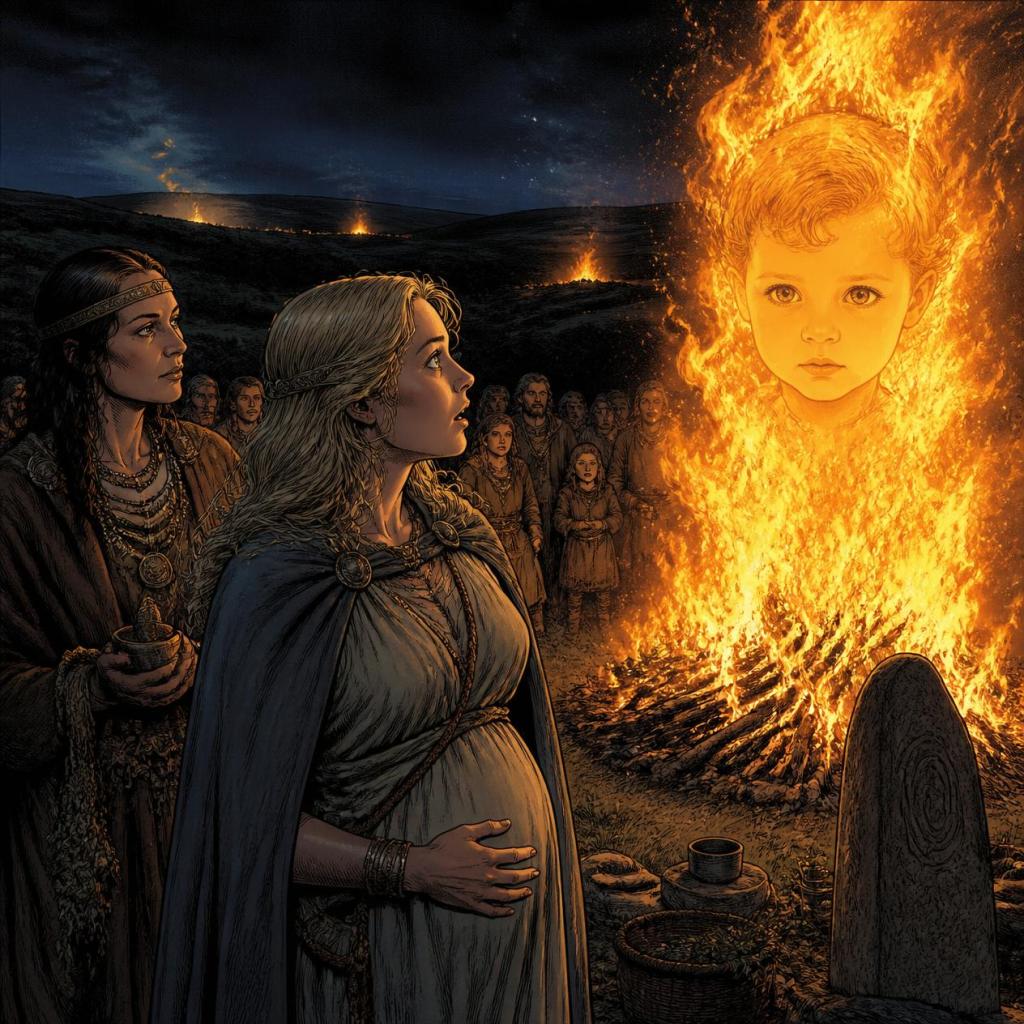
Elena doesn’t get to have her vision cleanly. She’s pregnant again — a fact delivered to her with the clinical bluntness of a woman who has delivered half a tribe and has no patience for Elena’s disbelief — and she’s still trying to do the arithmetic of her own scattered timeline when the veil thins.
She looks into the Samhain fire and sees a baby. Light curls. Her own eyes. Asdar’s mouth. Something else she can’t yet name.
And then she’s pulled away — quite literally caught, mid-lunge toward the flames, by a man with wings half-unfurled on instinct — before she can hold onto any of it. Elena’s crisis doesn’t pause for her epiphanies. It rarely does.
The Baby, Held Still
On the other side of that same thinning veil, a baby who has spent a week responding wordlessly to an old woman’s songs finally gets his answer.
Drina has been singing him across Ireland for days — five songs, none explained, each one shifting something in him that even Karim, watching, can’t name. At Uisneach, at the Cat Stone, with a fire built by strangers who take the old threshold seriously, the baby sees through.
A woman’s face. Light hair. Sharp features. Silver light behind her that might be wings, might be smoke, might be both.
He reaches. He cries — not in distress, but in the particular ache of recognizing something you’ve lost and have no words for yet.
Drina’s hands shake. She has never let anything shake her hands before.
“I’d recognize her everywhere,” she says. “Elena.”
Two Halves of the Same Moment
What I keep circling back to, writing this pair of scenes, is how differently the same instant lands depending on whose life has room for it. Elena’s vision gets swallowed almost instantly by her own crisis — she barely gets to feel it before the world drags her elsewhere. The baby’s vision gets an entire scene built around nothing else, a fire, a picnic, an old woman’s full attention.
Same convergence. Completely different weight. That asymmetry wasn’t something I planned going in — it’s just what happened when I followed both characters honestly into the same moment. Sometimes the story knows things before you do.
“Azad is still being edited, but if you want to understand how this whole cast came to be — and how they ended up where they are now — start with the first arc, Zavet.” Irena Phaedra.
Read the full series: The Memory Cartographer on Kobo
© 2026 I.Ph. de Lange All rights reserved. Published by CYcrds OÜ.

