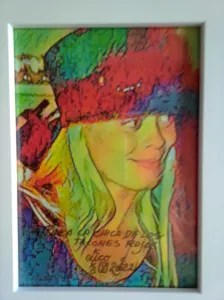
“I paint you because you never stay in one memory. So many faces.”
Zavet, Book III, Chapter 22. Elena is travelling through Poland in a hurry. With her are Sandi, a Finnish security officer, Bartek, a Pole who joined them in Warsaw, and Karim, always nearby, never in the way. They have just left Katowice.
It’s only after we’ve ditched the snarled avenues of Katowice—streets shivered with suspicion, every window a blind witness—that I let myself breathe. My reflections haze behind the car window: haunted tenement facades collapsing into their own shadows, the twilight river clutching secrets, that peculiar slanted lake like a wound refusing to scar over, holding more memory than reflection. Katowice is a city for forgetting and being forgotten, if one’s careful.
Bartek is not one for nostalgia. He hustles us out with barely a backwards glance, citing “practicalities”—the kind of passport deal that never quite smells legal, the invisible ledger of debts and dangers. Security, he claims, but his urge to escape is as much metaphysical as logistical.
So we trade the city’s iron embrace for the rolling throat of hills that rise above Bielsko-Biała—Poland’s unkempt borderland, half-mountain village, half-worn bohemian myth. It barely registers as a destination; more a pause between misfortune, a rumour of sanctuary.
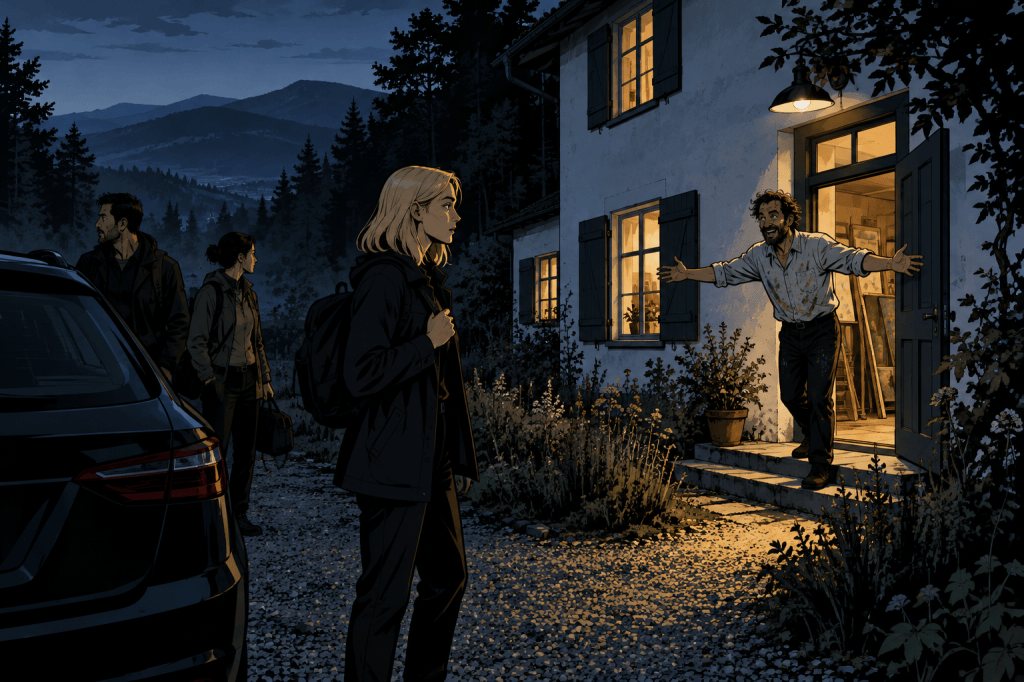
We arrive after dusk at Miro’s white house, nestled just shy of the woods. Light pours from the windows, yellow and unwavering against the encroaching dark. You feel the radiance before you see him.
Mirosław Biały, painter, friend, sometimes mirror. Born in 1966, he learned his first lines at the Lublin School of Fine Arts, then chased restless dreams through a Danish graphic academy. I remember those years in flashes: letters streaked with sketches, praise so honest it could scald, questions as blunt as the knives he used to mix pigment.
Then Miro bursts out from that almost-hidden white house as if he’s forgotten how to close his own doors. Painter, madman, patron saint of every stray and half-finished canvas from Silesia to Kraków. The corridor is a quagmire—colour, clutter, bottles of vodka sweating in the hearth’s afterglow, sacrificial bread and chopped pickles and wrinkled sausage on the table. The reek of patchouli and sour smoke in every couch cushion, in the fur of the disgruntled cat who rules the kitchen.
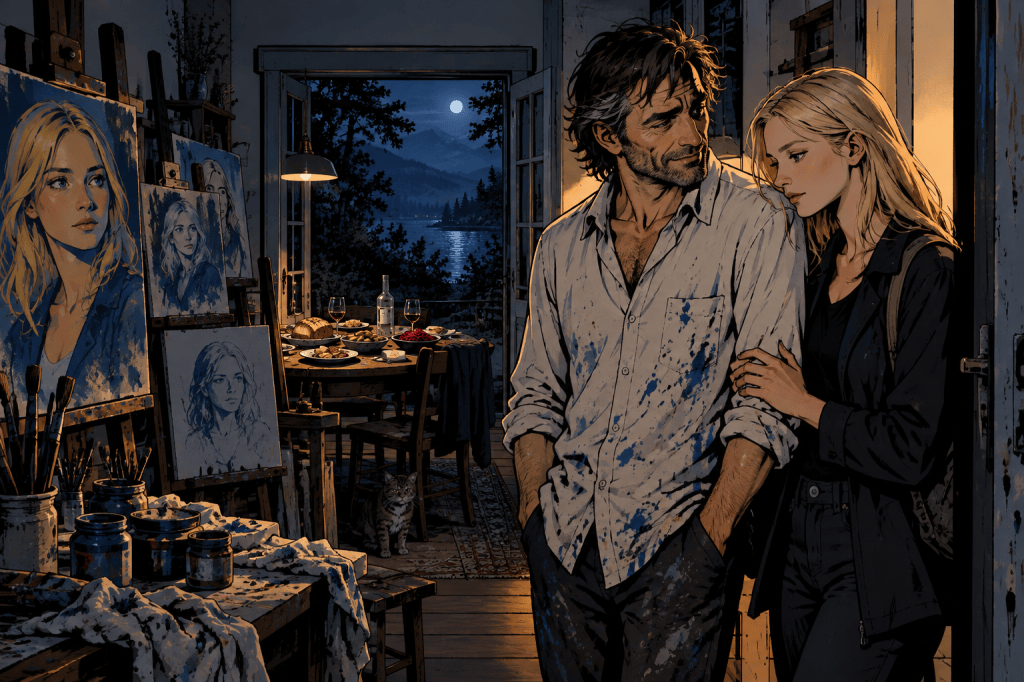
Inside, the rooms are dignified but not precious, white-walled and sunlit by day. Canvases everywhere. It’s unsettling, almost comic, how many bear my face. Me caught at twenty—lips bitten from too much tea. Me at thirty—blurred and bold in a fugue of indigo. Recent versions—wary, searching. Miro claims he never paints the same soul twice. The multiplying selves unsettle me, as if each painting remaps the boundaries of who I am.
Dinner unfolds like a slow opera, each note deliberate. Sandi marvels at the cheeses; Bartek studies the wine with the same calculation he gives the exits. There’s vodka—no Polish night without it—and enough fresh bread and roast beetroot to suggest Miro hoped, or feared, we’d stay the week.
Miro demands stories, so we offer them, each as outlandish as the last. Bartek, emboldened by drink, slips into old jokes so local they resist translation. Sandi laughs in a key I’ve never heard. I study the choreography—the passing of the bottle like a minor holy relic, the way we all keep half an eye on the windows even as the bottle goes round. Danger glimmers just outside, never quite erased, only rearranged.
Sandi
The studio, thick with the musky breath of oil paint and coal dust, closes around them. Sandi glances at the wall, uneasy at the rainforest of Elenas gazing down—then is pulled back to the far simpler mystery of Bartek, chest pressed to her back, breath hot against her neck.
Bartek’s hands, calloused and sure, slide beneath her blouse.
“Forget them,” he growls. “Tonight isn’t haunted unless you want it to be.”
She lets him turn her, studies his face—the sated predator, the barely-leashed pagan. Her lips curve: “There’s always something watching, Bartek. Kalevi’s ghosts, your gods, my shadow.”
Bartek laughs low, unashamed, already working the button on her jeans. “Let them watch, then. Maybe they’ll learn something.”
He leans down, capturing her mouth—deep and possessive, tongue tangling, fingers relentless. Each stroke winds pleasure tighter until, on the brink, he stills, looking down with a tenderness tinged by something darker—a weight of memory, a question of future.
“Sandi,” he rasps, brushing her hair aside, “I meant it. I would sacrifice everything for you. Even this devil’s freedom.”
She’s undressed him before, but now—caught in the blue dusk and the reckless edge of flight—she hesitates, fingers resting against the rough waistband of his trousers. His body is a wildland, muscle beneath ink, and the promise there is unequivocal. When she draws him out, a flash of wicked humour: Well, this would make a good excuse if I ever need one.
She quirks an eyebrow, meeting his gaze. “You do realise men have started wars with less.”
Bartek, flushed and half-grinning: “I’m willing to surrender—no negotiation.”
She laughs—low, fierce, hunger sharpened—and slides down to meet him in the half-dark. Her palms rest at the line of his waistband, feeling each breath. No mask, no border; just her hands and his waiting body, muscle taut beneath skin inked with old bravado and new worship.
She frees him, savouring the shape and weight, biting back a laugh—equal parts mischief and triumph. Gods, he is beautiful like this: utterly willing, wanting, trusting her lead.
He grins, surrender blooming in the dusk where his mouth drifts over her shoulder. “I’m willing to negotiate terms—preferably naked.”
The air between them tight as a coiled spring. She sinks down—mouth and hands greedy, worshipping his heat, mapping old territory anew. Sex is rough, urgent—teeth at his throat, laughter bright matches her own. She rides him, his hands clutching her hips, gasping her name between reverence and ruin.
After, tangled together, Bartek’s hair wild against the sheets, he strokes her spine and speaks with a cracked, aching seriousness: “I’d give it all—my badge, my gun, my damned soul. Name it.”
Sandi lets silence settle, her fingers sliding over the tattoo on his flank. Untangling just enough to keep him guessing, she grins: “Don’t start counting your sacrifices, Bartek. I only let trickster gods in my bed if they make me laugh. And you—” her hand slips low once more—”just barely made me giggle.”
Miro and I talk, and talk: stories tumble out, half in jest, half confessional. His laughter is as generous as his canvases, and the house suffuses with his peculiar warmth—each guest for a night, woven into the story of the place. Outside, the garden whispers through open French doors; the lake’s faint shimmer glimpsed through the trees, promising a pause from the world’s demands.
Beyond the garden, the lake sprawls—silver and sullen under the moon—while foothills loom, indifferent, ancient, as if we’re guests at a festival long ended. I am present, yet apart. My body stirs spoons in weak tea, voices compliments for the food, but my mind collects haunted glints of glass, unfinished brushstrokes, the tattooed hush before someone dares the unsayable.
The last laughter fades into corners of Miro’s white house as guests peel away—some drifting to the kitchen for vodka, others already claimed by sleep. With practised subtlety, Miro corners me in the studio doorway, turning the brass handle with paint-splattered fingers.
His English, rugged and embroidered with Polish vowels, is as vivid as his presence. He gestures at my scattered, unfinished portraits. “Och, Elena…” His grin is round-cheeked, eyes bright below madcap brows. “When I say, ‘come always,’ I mean—you. Not…” He waves a dismissive brush. “Not team… your security man, Pan with gun, Arabian stallion… and Sandi—she make nice mess, yes?”
He laughs, a musical, open sound, and mimics whisking, painting.
“I make good food, vodka, maybe cake! Always for you. For talk, not… work.”
I smile, fond and faintly apologetic. “They’re my company, Miro. Life’s complicated now. You know why I travel this way.”
His face crumples and smooths, childlike and shrewd. “Och, Elena, always complicated. But you—” he points, trembling brush, “—before, you laughed in my kitchen. You walked alone in garden, early. Not always so busy—with politics and ghosts…” Another laugh trails off, softer. “I paint you because you never stay in one memory. So many faces.”
Leaning in the doorframe, paint-stained shirt untucked, his eyes crinkle with sadness and understanding.
“I am—old fool, maybe. I wanted a friend, not adventure story.” He shrugs. “But you come. That’s enough—I forgive your circus.”
I touch his arm, squeezing gently. “You have me, Miro. Even if it’s only in pieces, sometimes surrounded by chaos.”
He laughs again—soft, forgiving, och-Elena laughter. “Is how I paint, yes—little pieces. Always together, for you. If you come alone, maybe I create a big portrait—one of peace. Do you think I can?”
It’s here, in this absurd little limbo—between the vodka and the weed, caught in the alchemy of late-night mountain air, classical music, and shabby domesticity—that clarity comes. Suspended between absurdity and nostalgia, laughter and lies, we become ourselves: fugitives, lovers, witnesses, pilgrims at a table built from the wreckage of better plans.
Tarmo’s face flickers through my mind—fierce, elusive, irresistible as winter sun on old ice. Then, just as suddenly, unease. Tomorrow the business resumes; tonight we borrow joy and pretend the world isn’t closing in. I resolve: bed.
As Miro’s snoring echoes down the hallway and I linger in his chaotic, paint-thick space, my mind drifts sideways to Tarmo, not forward to tomorrow’s trouble. There’s always a part of me—no matter the city or the company—that glances back for him. Nostalgia wraps my ribs: a longing for the rare hours we weren’t dodging shadows, when Tarmo’s presence protected and provoked at once.
Lost in my brain labyrinth? Start with the compass →
© 2026 I.Ph. de Lange. All rights reserved. Published by CYcrds OÜ.

