“South on paper, east in truth. Tangier to Sijilmasa — old caravan logic. The medieval boys used it as the staging point to cross the Sahara. We’ll do the same, just with better suspension and worse politics.”
Previously
A writer crosses the Strait of Gibraltar to Tangier, looking for people she once invented. She finds them: Hasna, sharp as ever; Youssef, lankier now, with new scars. They are real, and they remember her. She has come for a lost city in the Egyptian desert, and for a man she left sleeping there. Then she pushes too hard and falls. She wakes in a Tangier hotel with an archangel and a wolf at her bedside, and her body doing something she thought it had finished with.
前情提要
一位作家渡过直布罗陀海峡来到丹吉尔,寻找她曾经虚构出来的人。她找到了他们:哈斯娜,依旧锐利;优素福,更高更瘦,身上多了伤疤。他们是真实的,而且他们记得她。她为埃及沙漠中一座失落的城市而来,也为了一个被她留在那里沉睡的男人。后来她用力过猛,倒下了。醒来时,她躺在丹吉尔的一家旅馆里,床边守着一位大天使和一匹狼——而她的身体,正在做一件她以为早已结束的事。
The boy from Tangier
In 1325 a twenty-one-year-old law student left Tangier to make the pilgrimage to Mecca. He came home twenty-four years later, having walked, sailed and ridden further than anyone of his age.
His name was Ibn Battuta, and one of the places he reached was China. He landed at Quanzhou (泉州), which he knew as Zaitun, and called its harbour one of the greatest in the world. He marvelled at Chinese porcelain, shipped as far as Morocco, at paper money, and at how safe it was to travel. He said a lone traveller carrying wealth could cross the whole country without fear.
Tangier and Quanzhou are joined by one man’s feet.
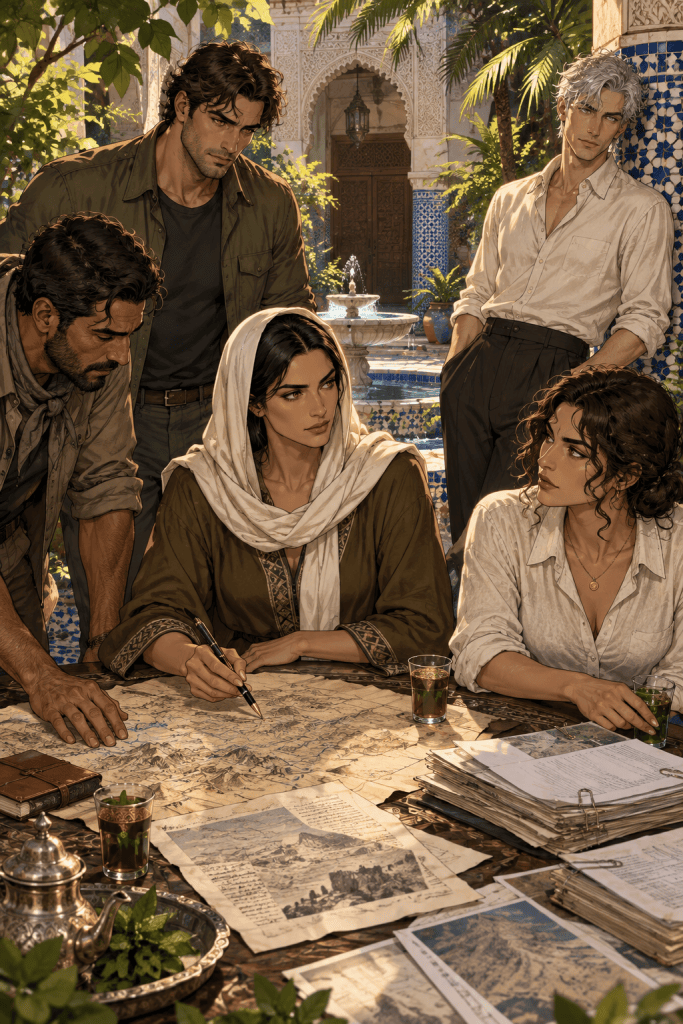
Sijilmasa, the gate of gold
After China, Ibn Battuta made one last great journey, south across the Sahara to the Mali Empire. In 1352 he left from Sijilmasa.
Sijilmasa sat on the edge of the Tafilalt oasis in south-eastern Morocco. For six centuries it was the northern door of the gold road. Salt went south and gold came north, and caravans of thousands of camels left from its walls. Today it is a field of eroded earth walls near Rissani, and you can walk across it in an afternoon.
In this chapter, the writer chooses Sijilmasa as a starting point on purpose. Old routes have old logic. Wells are where they have always been.
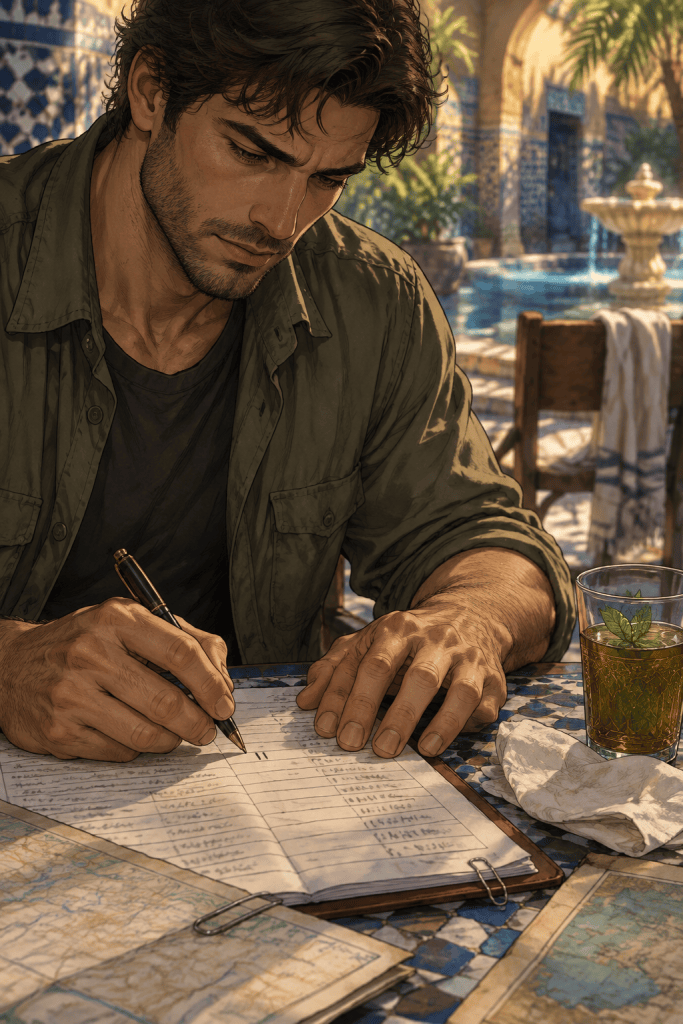
Chinese tea in a desert glass
There is one more thread between Morocco and China, and you drink it.
Moroccan mint tea, atay, is not made with Moroccan leaves. It is Chinese green tea, gunpowder tea (珠茶), rolled into tight pellets, steeped with fresh spearmint and a great deal of sugar, and poured from a height so it foams. The leaves reached Morocco through British trade in the nineteenth century, and Morocco is still one of the largest buyers of Chinese green tea in the world.
So when the writer sits in a Tangier patio planning a crossing of the Sahara, and the mint tea turns her stomach, the tea in her glass has already crossed half the world.
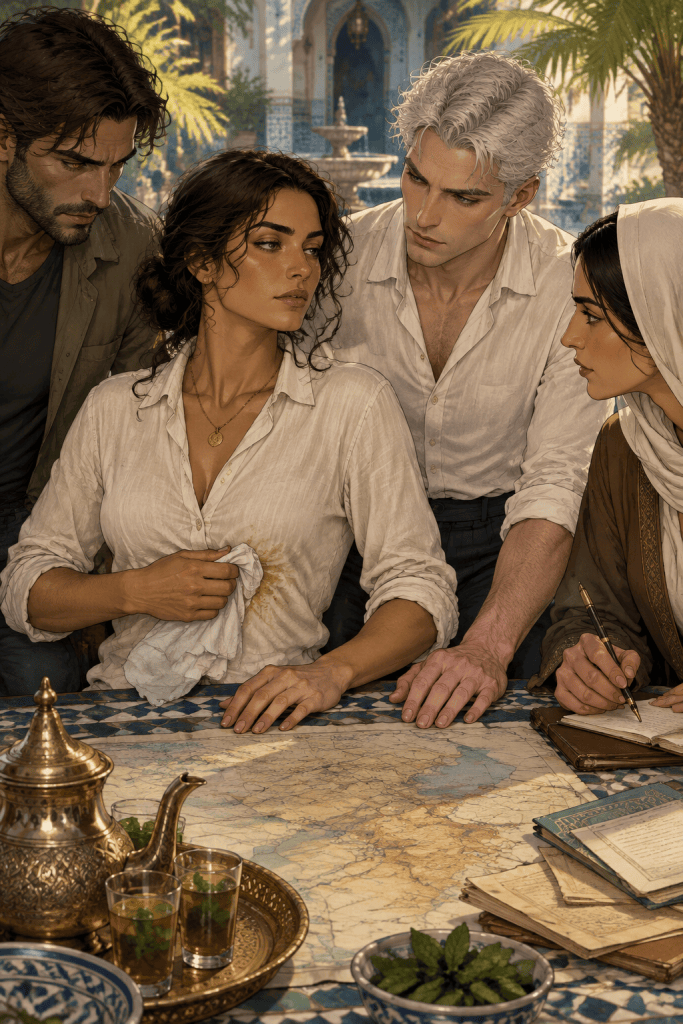
“I’m assuming they can’t resist a pattern,” I say. “We give them seven. Let them waste days working out which one is the wolf.”
© 2026 I.Ph. de Lange. All rights reserved.

