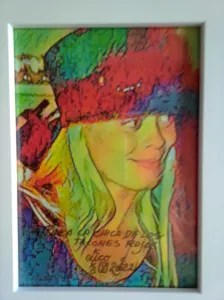
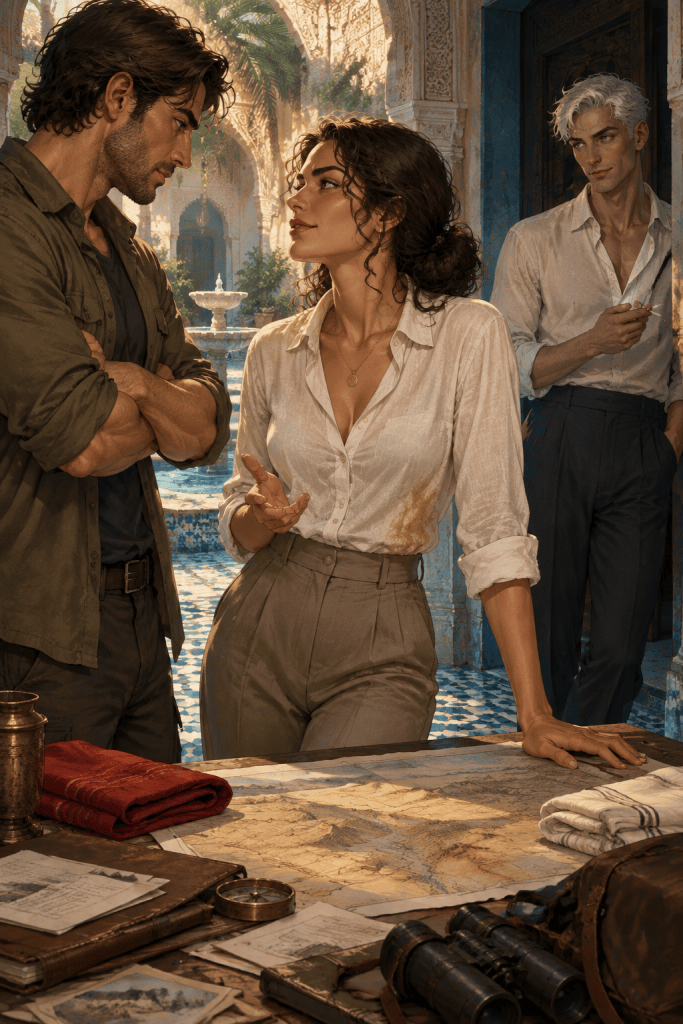
“Red means you. If I wear red at night — scarf, shirt, whatever — you sleep beside me. No debate, no sulking, no territorial grunting.”
“White means him. Archangel on duty. Same rules. No scenes.”
Previously
A writer crosses the Strait of Gibraltar to Tangier, looking for people she once invented. She finds them: Hasna, sharp as ever; Youssef, lankier now, with new scars. They are real, and they remember her. She has come for a lost city in the Egyptian desert, and for a man she left sleeping there. Then she pushes too hard and falls. She wakes in a Tangier hotel with an archangel and a wolf at her bedside, and her body doing something she thought it had finished with.
前情提要
一位作家渡过直布罗陀海峡来到丹吉尔,寻找她曾经虚构出来的人。她找到了他们:哈斯娜,依旧锐利;优素福,更高更瘦,身上多了伤疤。他们是真实的,而且他们记得她。她为埃及沙漠中一座失落的城市而来,也为了一个被她留在那里沉睡的男人。后来她用力过猛,倒下了。醒来时,她躺在丹吉尔的一家旅馆里,床边守着一位大天使和一匹狼——而她的身体,正在做一件她以为早已结束的事。
Who owns the tent
Two men, one woman and a desert crossing: in this chapter, the writer settles the question of who shares her bed with a colour code. It is funny. It is also older than it looks.
Among the Tuareg, the Kel Tamasheq of the central Sahara, the tent traditionally belongs to the woman. Her family makes it for her marriage, from her side of the household. If the marriage ends, she keeps the tent, and the man leaves it. Descent and status in many Tuareg groups run through the mother’s line. A woman receives visitors, plays music and recites poetry in her own tent, and choosing whom she receives is hers.
The men who veil
The most famous image of the Tuareg is a man in an indigo veil, the tagelmust, wound around the head so that only the eyes show. Young men take it up as adults and wear it in front of elders, strangers and in-laws. The dye rubs off on the skin, which is why outsiders called them the blue men.
The women do not veil.
When Ibn Battuta crossed the Sahara in the fourteenth century, he stayed among the Massufa, a veiled desert people related to the Tuareg. He was scandalised. Women had male friends and spoke with them freely. Inheritance passed not to a man’s own son but to his sister’s son. The well-travelled jurist from Tangier did not know what to do with a society where the women held the keys.
Letters the women keep
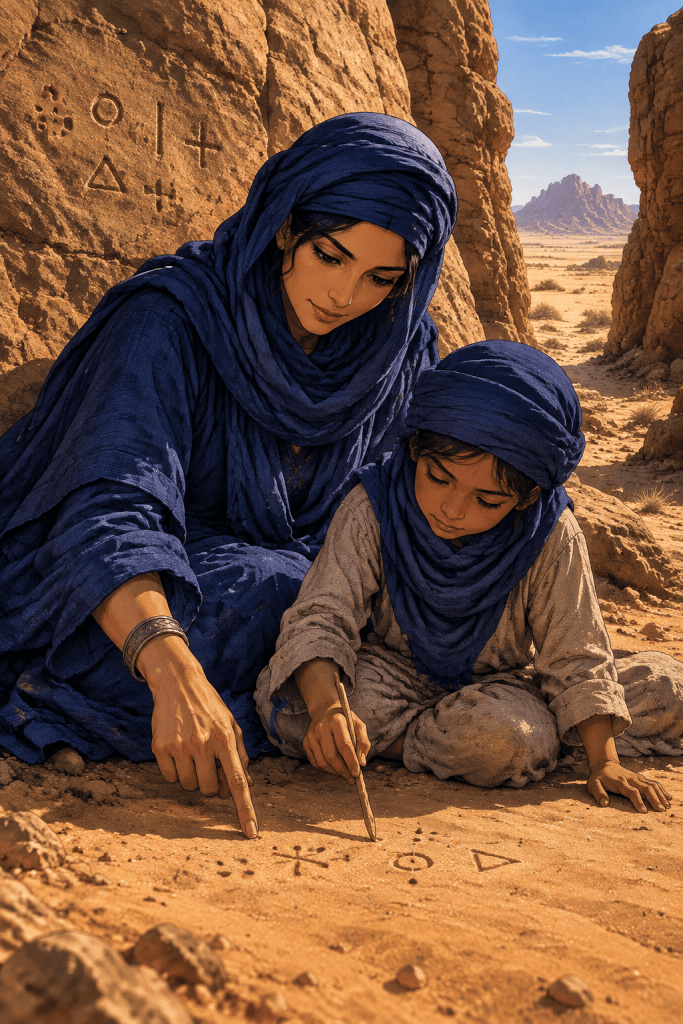
The Tuareg write in Tifinagh, one of the oldest alphabets in Africa, a script of dots, circles, lines and crosses. It appears on rock faces across the Sahara, some carved thousands of years ago, and it is still in use. Traditionally it was the women who taught it to children, and it was used for love messages, riddles and poems.
In the chapter, a guide is needed for the last stretch of the journey because the way is marked, and the marks are in a script most explorers could not read.
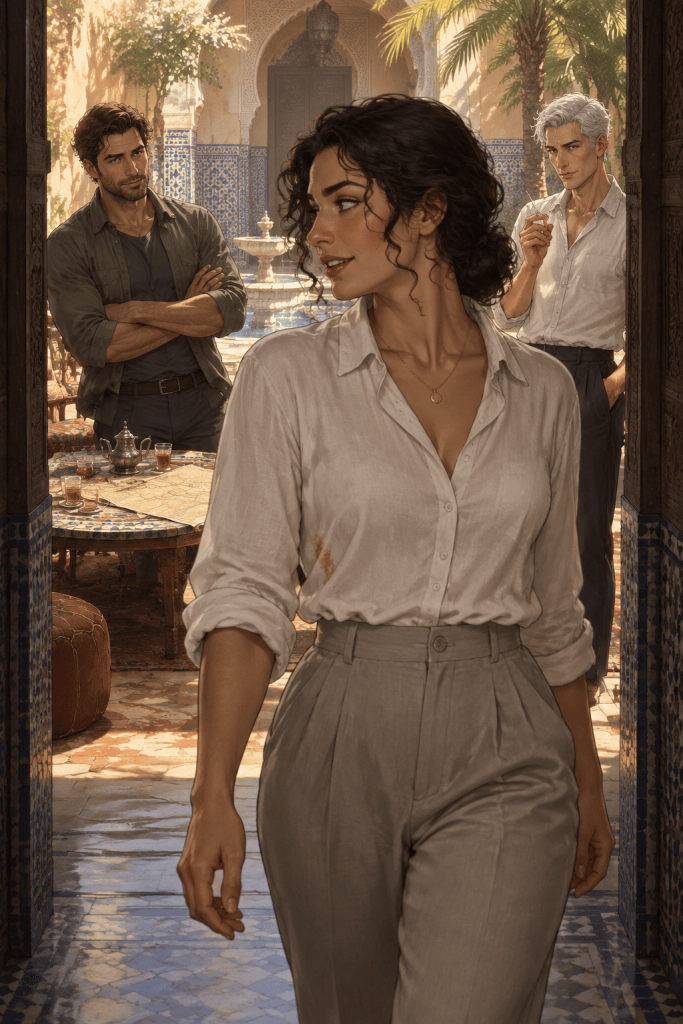
“Oh,” I add over my shoulder, “and if I wear nothing at all, it means I’m actually sleeping.”
Neither of them argues.
© 2026 I.Ph. de Lange. All rights reserved.

