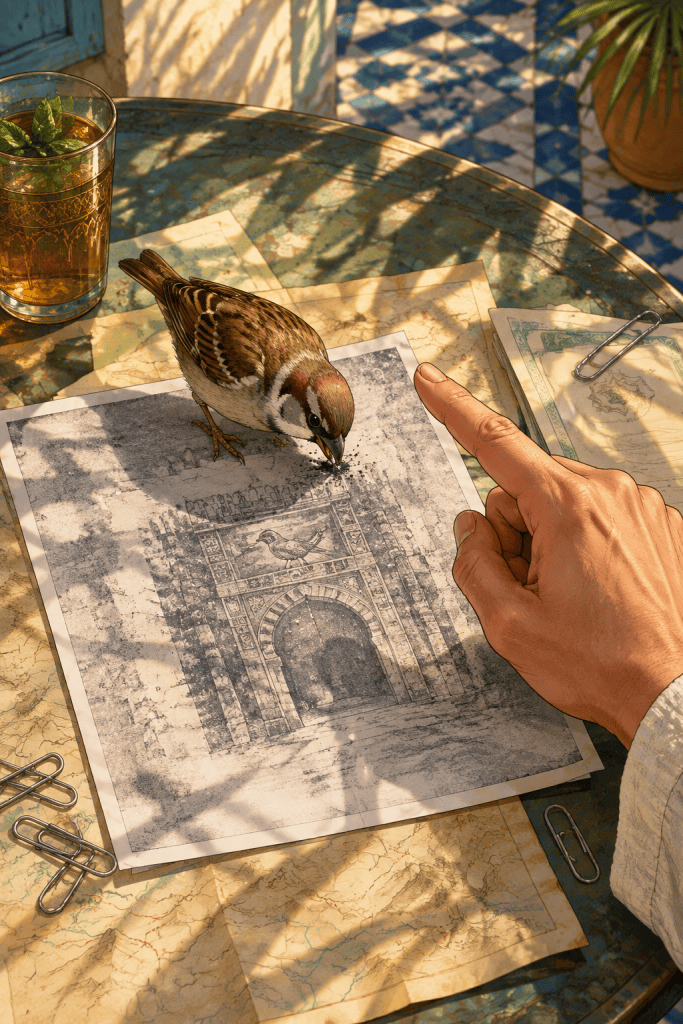
A sparrow drops out of the palm onto the table. It hops across the Gilf Kebir, over Hasna’s paperclips, and stops on the photocopy, on the line about the bird carved on the gate.
“Don’t,” I tell it.
It doesn’t listen. Nothing in this book listens.
Previously
A writer crosses the Strait of Gibraltar to Tangier, looking for people she once invented. She finds them: Hasna, sharp as ever; Youssef, lankier now, with new scars. They are real, and they remember her. She has come for a lost city in the Egyptian desert, and for a man she left sleeping there. Then she pushes too hard and falls. She wakes in a Tangier hotel with an archangel and a wolf at her bedside, and her body doing something she thought it had finished with.
前情提要
一位作家渡过直布罗陀海峡来到丹吉尔,寻找她曾经虚构出来的人。她找到了他们:哈斯娜,依旧锐利;优素福,更高更瘦,身上多了伤疤。他们是真实的,而且他们记得她。她为埃及沙漠中一座失落的城市而来,也为了一个被她留在那里沉睡的男人。后来她用力过猛,倒下了。醒来时,她躺在丹吉尔的一家旅馆里,床边守着一位大天使和一匹狼——而她的身体,正在做一件她以为早已结束的事。
A manual that promised a key
In fifteenth-century Egypt, treasure hunting was a trade, and it had its handbook: the Kitab al-Kanuz, the Book of Hidden Pearls. It is part directions, part spell, part con. Most entries tell you where to dig and what to burn so the guardian spirit looks away.
One entry is different. It describes a city in the western desert, white as a dove, with a bird carved on its gate. Put your hand to the bird’s beak and you will find a key. Open the gate. Inside, a king and queen lie asleep in their castle. Do not go near them. Take the treasure, and leave.
The city is called Zerzura.
A fisherman, a cave, peach blossoms
Chinese readers will already know this story under another name.
In 421, the poet Tao Yuanming (陶渊明) wrote of a fisherman from Wuling who followed a stream of falling peach blossoms to a narrow cave. On the other side lay a valley of fields and quiet houses, inhabited by people whose ancestors had fled the wars of the Qin and who had not heard of any dynasty since. The fisherman was fed and sent home. He marked his path carefully on the way out. He never found it again.
Zerzura works on the same rules: a hidden entrance, sleepers outside time, and a warning not to disturb them. Above all, it cannot be found twice. Two civilisations, at opposite ends of the old trade roads, dreamed the same dream about a place you are allowed to see once.
Place of little birds
The name probably comes from the Arabic zarzur, a small bird, a starling or sparrow. Zerzura is the place of little birds.
The British traveller John Gardner Wilkinson heard about it from Bedouin guides in the 1830s: an oasis two or three days west of the road between Dakhla and Farafra, with palms, springs, and ruins. In the 1930s a group of explorers, the Zerzura Club, went looking for it by car and by light aircraft over the Gilf Kebir, a sandstone plateau the size of Corsica. They found rock paintings of swimmers in a land without water. They did not find the city.
In this chapter, the writer reads the Kitab aloud in a Tangier patio, and a sparrow lands on the word for bird.
Asleep. That’s one word for what I did to Tarmo.
© 2026 I.Ph. de Lange. All rights reserved.

