Some protections look like abandonment from the outside.
The wolf walks beside me at dawn.
Not pacing. Not testing the borders of the camp. Just there: broad flank against my leg, breath clouding the cold Welsh air, as if companionship is a thing he has chosen rather than a thing we have forced upon him.
Drina has already given us the direction.
“His chains aren’t Louhi’s alone. Follow the mother’s blood south, to the tattooed ones. They marked him before they left him. Find out why.”
South, it is then.
Not toward answers in books. Not toward anything my pen can summon, revise, soften, or undo.
Toward skin. Ink. Mothers. Old damage made in the name of survival.
The wolf under the tarp
At Hull, Wolfgang crosses the border beneath a weighted black tarp marked Service Animal.
It is absurd, of course. A creature too intelligent to be called a dog, too dangerous to be called ordinary, too deeply loved by us to be left behind. Django keeps the lead SUV steady. The Spanish secretary deploys her silver tongue. An envelope crosses a desk. A stamp lands on paper.
The official does not ask questions.
In appearance borders are guarded by law. In reality they are guarded by paperwork, fatigue, and the proper amount of cash.
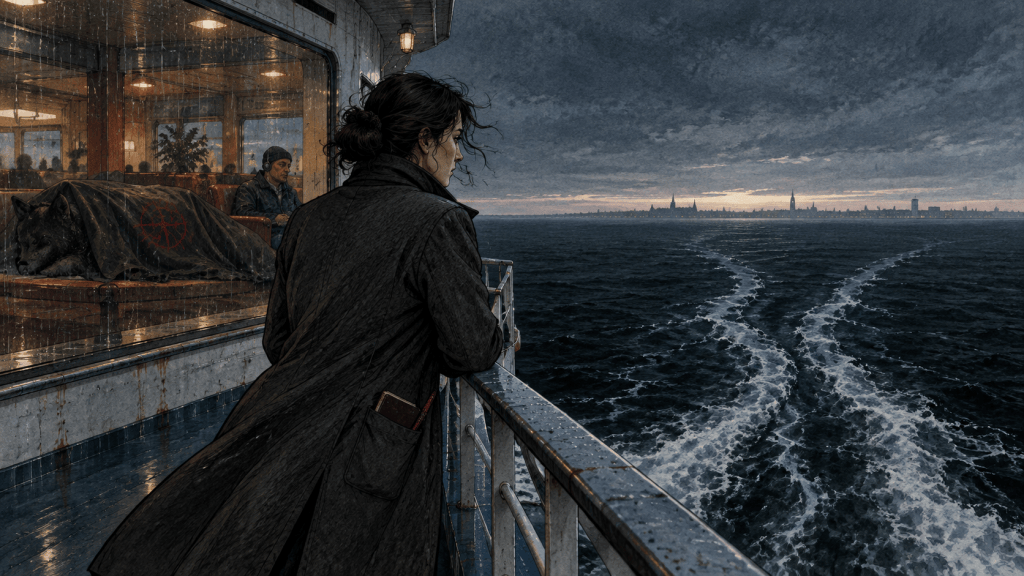
The North Sea takes us through the night.
On deck, I stand alone above the black water and watch the ferry carve its pale wake through the dark. Somewhere below, Wolfgang sleeps—or pretends to. I can feel the pen in my pocket, heavy with all the interventions it has made before.
For once, I leave it alone.
Whatever was done to him began before words.
Herengracht morning
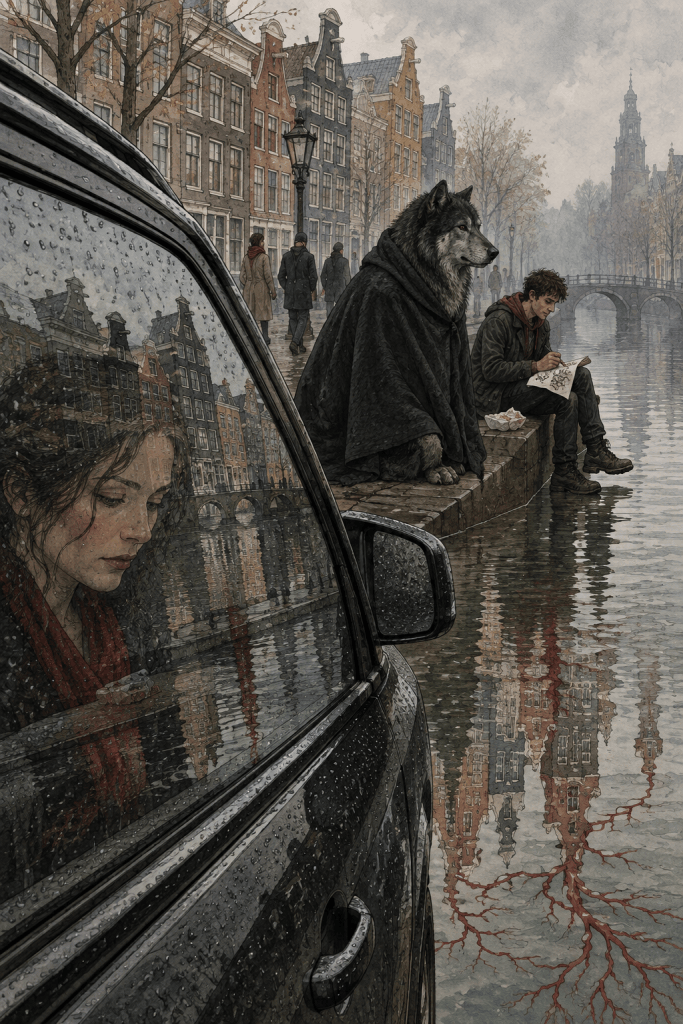
Amsterdam receives us in mist.
We stop at Herengracht 376 only long enough to refuel, breathe, obtain what the twins insist is necessary for civilisation—marihuana and hashies—and pretend this is not a family pilgrimage disguised as a criminal logistics operation.
The canal water trembles in the car window.
Something in me stirs.
Not a memory exactly. More like recognition without proof.
“This place smells of home,” I say.
Darian is drawing sigils on a napkin, presumably with the solemn concentration of a prophet. Then he eats the last piece of spacecake, which rather undermines the effect.
Wolfgang waits beneath a borrowed blanket on the quay. Pedestrians avoid his eyes and continue walking. Amsterdam has seen weird and worse at that hour.
Then we leave again.
The road turns south-east. Flat Dutch land becomes German speed, then forest, rising ground, smoke, cloud, and the first pull of the Bavarian foothills.
What the ink remembered
The elder familiar waits south of Munich in a low-beamed parlour dark with old smoke.
Her arms are covered in thorn tattoos.
She sees Wolfgang and says only:
“Her son.”
Not the wolf.
Not the boy.
Her son.
She opens a ledger of infant marks: spirals for concealment, knots for memory, black gates for crossing between forms. The answer is there, though no answer arrives without a wound inside it.
The tattoos were never a prison.
They were protection.
Wolfgang’s mother had been hunted. Her line had been exposed. The registry gave him mortal papers and broke the visible trail. The wolf-form became the failsafe: a body able to survive when the magic in him became too much for a child to carry.
No cruelty, the elder says.
Calculus.
But survival does not erase loss. A child can be saved and still be left. A mother can love fiercely and still make the choice that breaks him.
Roots, not words
To unbind Wolfgang, the familiars do not ask for an explanation.
They ask for blood.
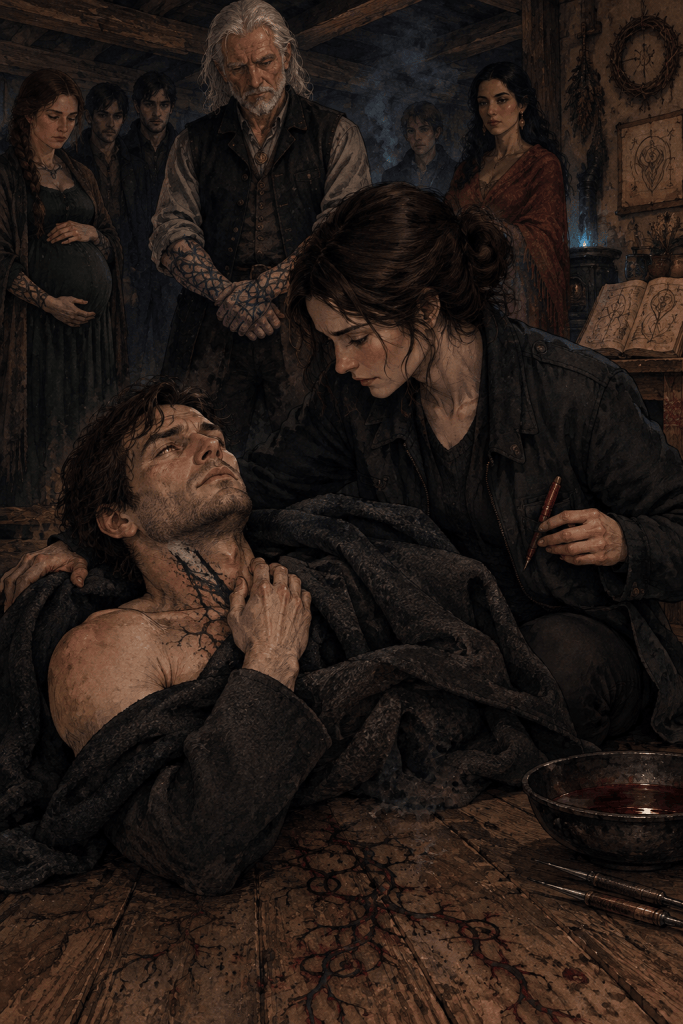
They heat needles over a blue flame. Old marks rise through fur like drowned roots returning to the surface. The chant begins in a language I cannot write, and perhaps should not try to.
The counter-ink moves backward.
The wolf shudders.
The body remembers another shape.
When it is over, a man lies on the floorboards with one hand against the fading mark at his throat. He is trembling. He is breathing. His eyes open, and the gold is still there.
I cover him with my coat.
My hand reaches toward the pen automatically.
It remains silent.
This freedom has not come from words.
Roots have spoken.
A note from the Writer
This chapter of Quantum Gravity travels through several kinds of border: the official border crossed with forged calm and stamped documents; the geographic border between rain-soaked Wales, canal-bound Amsterdam, and the Bavarian foothills; and the far more difficult border between the story a child tells himself about being left and the truth he may not be ready to forgive.
Wolfgang’s return is not a neat cure. It is a re-reading.
The ink says that survival was once chosen for him. What he does with that knowledge—what any of us does when love and harm arrive braided together—is another journey entirely.
The pen stayed silent. Roots had spoken.
Quantum Gravity is an ongoing work of anthropological fiction, myth, memory, language, wolves, inherited bonds, and the strange mathematics of belonging.
Start the series here → https://www.kobo.com/ca/en/ebook/the-european-records
© 2026 I.Ph. de Lange. All rights reserved. Published by CYcrds OÜ.

