
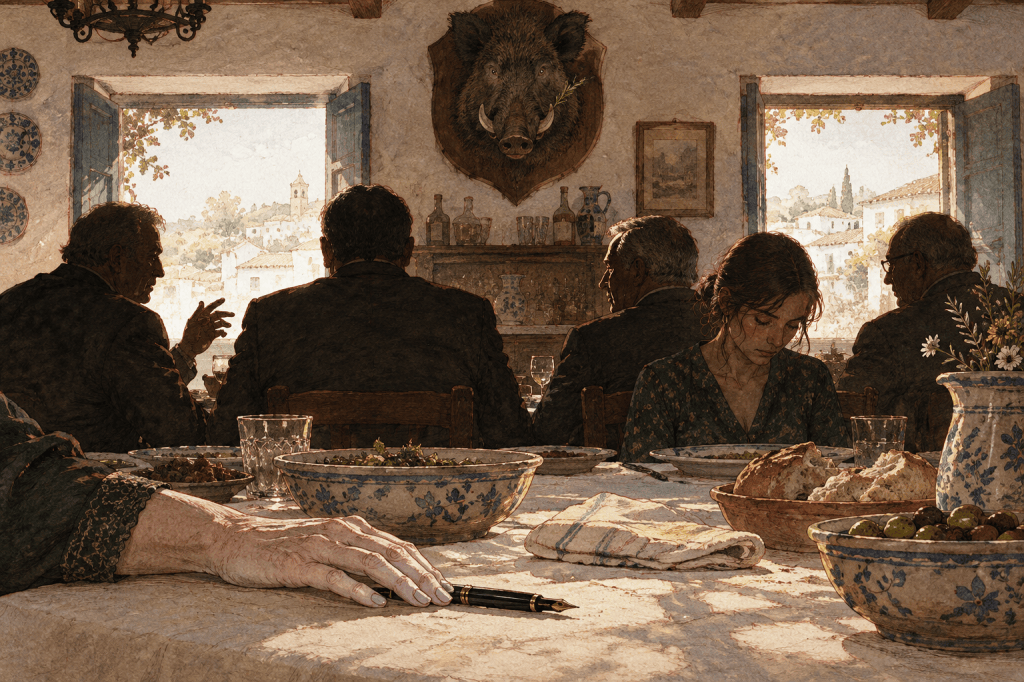
Family is the first place we learn what contracts look like.
Not the ones with signatures, clauses, or lawyers. The older kind: written into who sits at the head of the table, who serves, who jokes, who is expected to listen, and who is congratulated for doing well—for a girl.
At a village restaurant, a dead boar watches from above the bar. Rosemary is tucked behind one yellowed tusk. Below it, a daughter speaks into a pause.
“Sunday there’s a caza,” she says. “Partridge, up by the old terraces.”
“Your father leads,” Grandfather says, without looking at her.
Some rooms explain themselves.
The old contract is clear: she works like a man, obeys like a girl, and absorbs everyone’s moods for free.
But a contract can be refused even before it is dismantled.
Sometimes refusal begins with a spoon set carefully beside a bowl of lentils.
“She does not need help. She needs terms.”
The terms are spoken aloud by dessert. They are not accepted. Not yet.
But they are in the room now.
Author’s Note
Power Has a Cost
A woman can win the argument and still leave with cold fingers.
There is a particular exhaustion after refusing the script everyone hoped you would smooth over: the old paternal joke, the family demand disguised as concern, the expectation that you will translate everyone’s feelings into peace.
The body keeps the invoice.
In Quantum Gravity, after lunch, the writer presses her cold hand against a Mont Blanc until the feeling returns. The pen is not incidental. It is the instrument of writing, naming, signing, refusing.
Sovereignty is not always a crown.
Sometimes it is a hand that hurts after holding the line.
Start the series here → https://www.kobo.com/ca/en/ebook/the-european-records
© 2026 I.Ph. de Lange. All rights reserved. Published by CYcrds OÜ.

