
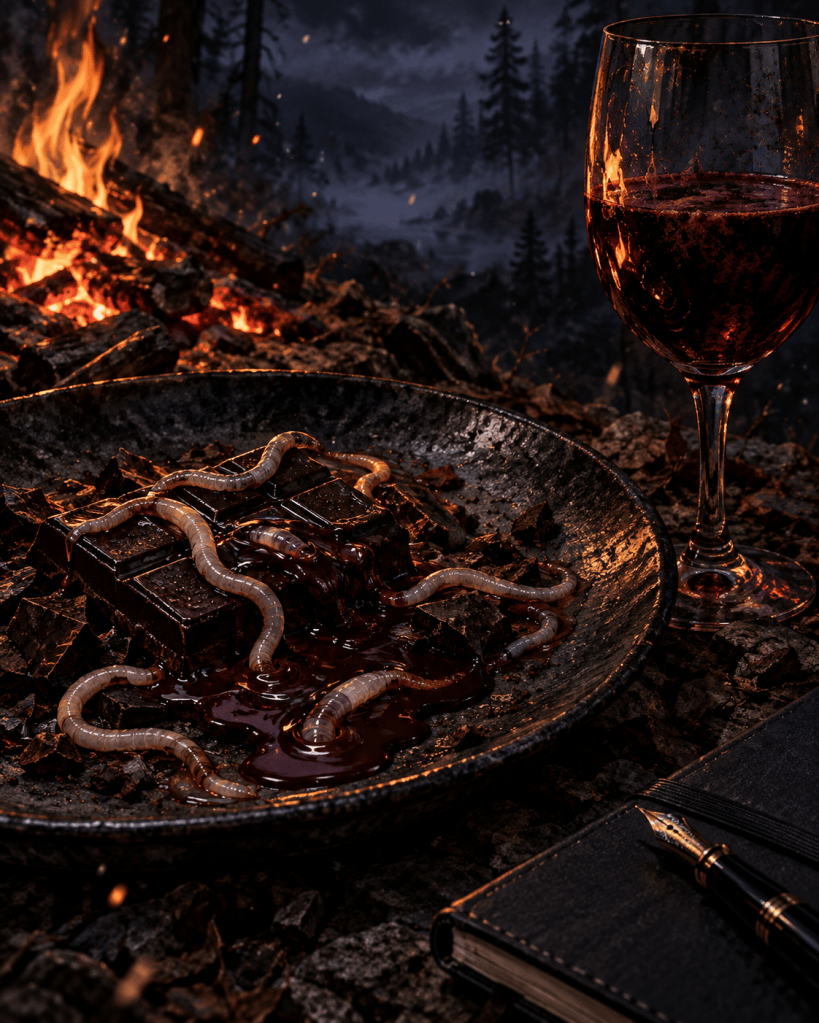
The worms writhed faintly in the firelight, slick and pale against the melting chocolate. The sour wine exhaled its ghost of sweetness, turning the air metallic.
Some betrayals do not announce themselves with thunder.
They do not arrive as obvious cruelty, a shouted accusation, or a door slammed hard enough to shake the house. Sometimes betrayal comes quietly. It enters through a story you once told with love. It takes a symbol that mattered to you, wears it like a borrowed face, and turns sweetness rotten from the inside.
In Quantum Gravity: The Betrayer’s Omen, the narrator recognizes that the omen before her is not simply about decay.
It is about deceit.
The chocolate is no longer comfort. The wine is no longer communion. Both have become evidence of something intimate being altered, consumed, and returned in a form that cannot be trusted.
“This is how she shows herself: perverted grace. Every time I give her meaning, she remakes it to suit her convenience. She weaponizes my truth.”
Sandi is not dangerous merely because she lies. She is dangerous because she is flakey—unreliable, evasive, present when there is something to take and absent when loyalty requires substance. She moves through the narrator’s world by borrowing language, myth, attention, and emotional labour. She imitates what she cannot create.

That is why the confrontation is not a battle of force.
It is a battle over authorship.
The narrator must understand that continuing to write Sandi into the myth—even in grief, anger, longing, or nostalgia—can become another invitation. Every attempt to preserve the old bond gives Sandi another opening into the page.
Drina understands this immediately:
“Then you must learn to close the page without burning the book. Retract the invitation, not the existence.”
This is the heart of The Word of Detachment.
Detachment is not denial. It is not pretending that someone never mattered, never wounded us, or never occupied space in our personal mythology. It is the refusal to keep providing the gravity that allows another person to orbit our light.
“Sandi orbits because I shine. Let her circle fade.”
The boundary that follows is both spell and self-reclamation:
“You take, you flake, you imitate what you cannot create. I release you to your echo—not my light, not my place. Find your own gravity, or drift alone.”
To release someone to their echo is not revenge. It is an ending of false responsibility.
The narrator does not destroy Sandi. She does not erase her. She refuses to be Sandi’s source of illumination, identity, mythology, or power.
And when the invitation disappears, the omen changes. The worms stop. The spoiled wine clears. The wolf relaxes into the earth. The notebook closes. The pen becomes light again.

Not innocent.
Not untouched.
But hers.
“The horse stood riderless, waiting for paths unchased by ghosts.”

Quantum Gravity: The Betrayer’s Omen is a chapter about betrayal, myth, memory, and the brutal tenderness required to reclaim one’s own narrative. Sometimes the most powerful magic is not summoning. Sometimes it is the word that finally says: you may exist, but you may no longer enter here.
Start the series here → https://www.kobo.com/ca/en/ebook/the-european-records
© 2026 I.Ph. de Lange. All rights reserved. Published by CYcrds OÜ.

