It has slipped behind the wardrobe sometime between the last move and the last argument, wedged in that thin strip of dust where objects go when they are not ready to be thrown away, but no longer wish to be seen. I am looking for nothing in particular — an excuse to delay answering an email — when my fingers brush old cardboard. The lid comes away with the soft, papery sigh of another decade.
Inside lie the Oxford notebooks, stacked like sedimentary layers: faintly warped covers, dog-eared corners, the occasional coffee halo. I recognise my own handwriting on the spines, the careful, hopeful labels of a younger self: Thule. Cape Town. Louhi / wolf. Columns – Drafts. I smile despite myself. The arrogance of believing one could label reality and keep it on a shelf.
One notebook sits slightly askew, as if it had turned in its sleep. I pick that one first. The cover is more worn than the others, the cardboard softened by years of being opened, closed, reconsidered. When I crack it, the smell rises at once: old paper, skin oil, a trace of something metallic underneath, like a coin warmed in a fist.
The Ink is alive?
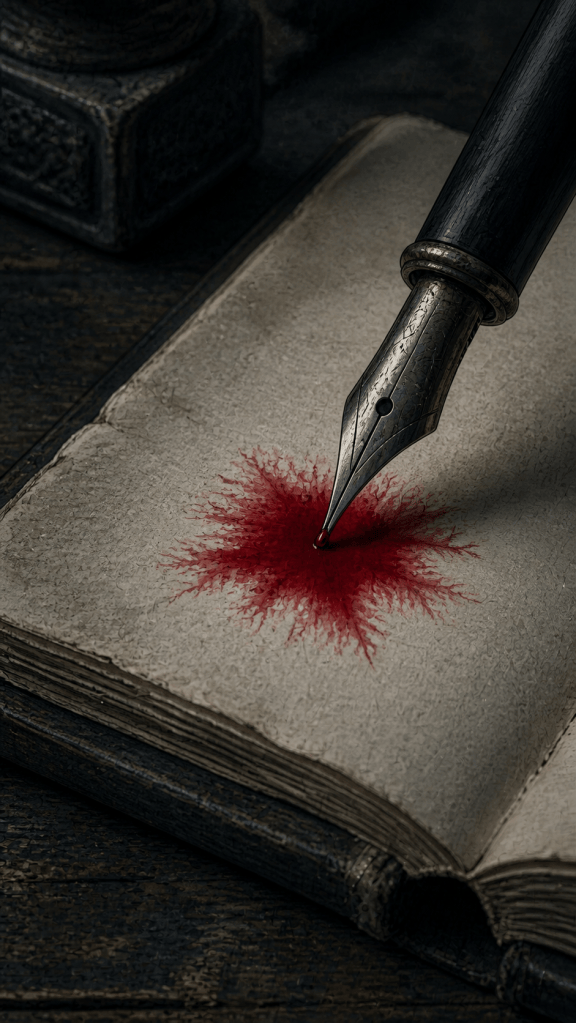
For a moment my brain insists it must be the light, or dust on my lenses. I always write in black — blue on indulgent days, when hope runs higher than discipline. But here, line after line, the words march across the page in red. Not the polite burgundy of school corrections, nor the cheerful pop of a cheap rollerball. A darker red, dried now to the colour of old sealing wax.
My Montblanc left these tracks. I know the curve of the letters, the slight pressure mark where I always press too hard at the start of an L or a K. But I have no memory of ever loading it with red ink.
I read a line at random. A column draft, addressed — as so many things apparently were — to Indra and Kendra. The date in the corner says 1971, though I know perfectly well I wrote it four decades later. Or did I only copy it? Quote it from somewhere I should not have been able to reach? The words on the page don’t answer; they simply glow more insistently in that dark red.
I flip ahead. Thule, again. A reference to Cape Town that makes no chronological sense. A note in the margin: Zerzura? Not desert – lattice. Another page: Mikhael – not lost. Held. Purgatory is a corridor, not a room. Someone — myself, but not in any age I can immediately place — has been here before, mapping the same puzzle.
Only at the centre of the book do I find the first mention of the wolf. Not Wolfgang yet; just the wolf in the skin that is not his own. Underlined twice, in the same red. Beneath it, in smaller, more hurried script: Louhi cannot birth. She can only bind. The writer births.
My chest tightens, the way it does when a memory rises too fast. The red ink is not just a whim, then. It’s a flag. A signal left by a version of myself who had already walked further down this corridor, who knew that one day I would go hunting for the missing piece and ignore everything else until I found it.
I turn the Montblanc over in my hand, suddenly conscious of its weight. How many realities has this pen already written through? Black for the days that obey calendars; blue for the days that flirt with hope; red for the days that tear a hole straight through the fabric and write in both directions at once.
“Of course it was red,” I murmur, half to the empty room, half to the girls who are not quite gone. “Bloodline, blast line, deadline.”
Somewhere between Thule and Zerzura, an archangel paces a corridor that refuses to end. Somewhere in a city not yet born, a wolf shifts under the wrong skin and waits. And here, in a room that exists in both realities by sheer force of habit, I finally understand that the first door was not a portal or a spell, but a notebook I once abandoned behind a wardrobe.
I set the red-ink book aside, separate from the others. This is not research. This is evidence.
More notebooks passages to come. Follow along as the corridor keeps writing itself. I.Ph.
Start the series here:https://www.kobo.com/ca/en/ebook/the-european-records
© 2026 I.Ph. de Lange. All rights reserved. Published by CYcrds OÜ.
Author’s Note
On Thule and Zerzura
Both names in this chapter borrow from real legend. Thule was the name Greek and Roman writers gave to the farthest known land in the north — first described around 320 BC, later guessed to be Iceland, Scandinavia, or Greenland, but never fixed to one place. It worked less as a location than as a direction: north, away, beyond the edge of the knowable map.
Zerzura is a legendary lost city said to hide deep in the Sahara — a white city with a sleeping king and queen, guarded by giants. Unlike Thule, no serious geographer ever believed in it, and its most “documented” sighting was likely invented in the 20th century by a writer chasing a good story. That’s what drew me to it: a myth that, dug one layer down, confesses to being made up.
Thule dissolves because no one agrees where it was. Zerzura dissolves because someone admitted they invented it. The notebook lives in that gap.
I.Ph.

