
When a curse reaches its vital point, language must decide whether to wound, bind, or heal.
The Right Translation
Some stories begin with a door.
Others begin with a word spoken too carelessly.
In the next movement of Quantum Gravity: The Clearing by the Manor, the Writer confronts a question that has been following the story from its first fracture: what happens when language no longer describes reality, but changes it?
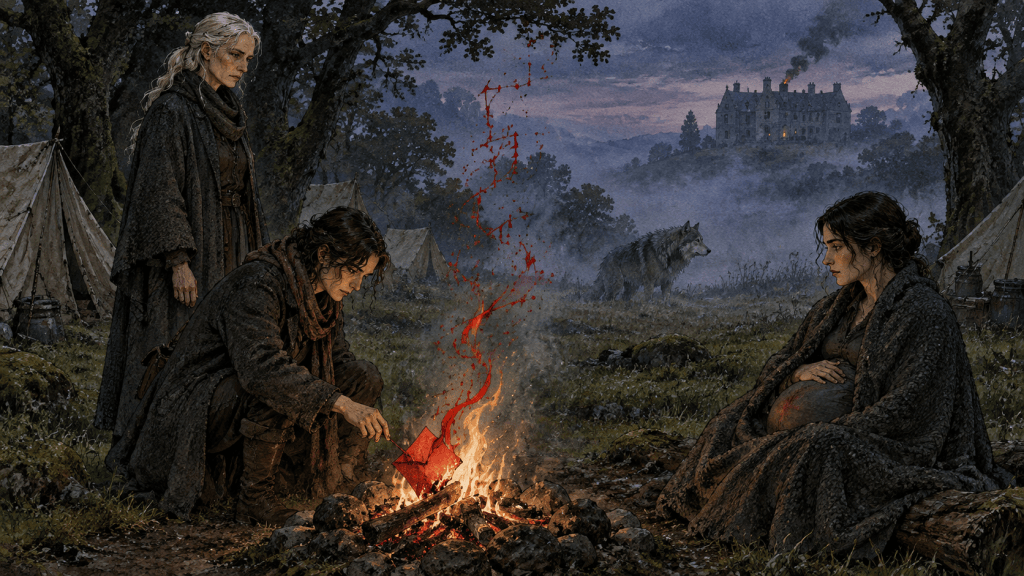
A letter to Louhi burns in a Welsh clearing. Its red ink rises with the smoke. Esmee carries an impossible life. Wolfgang waits beyond the tents, held in wolf-form by a sentence that may once have meant protection—or may have become a prison through grief, fear, and mistranslation.
The manor watches from the distance like a thought no one has dared to finish.
A curse as mistranslation
In Quantum Gravity, magic does not arrive as spectacle. It works through memory, attachment, storytelling, inherited symbols, and the dangerous force of names.
A curse is never merely an act of cruelty. Sometimes it is a word that has travelled too far from its original intention. Sometimes it is love turned possessive. Sometimes it is a promise that no longer remembers whom it was meant to protect.
That is the real contamination in this chapter: not simply evil entering from outside, but meaning bending under pressure.
A blessing can become a wound.
A bond can become a cage.
And an attempt to preserve someone can become a refusal to let them change.
The fire horse
Drina’s warning returns:
“Do not silence the fire horse. Guide its direction.”
The fire horse is language itself—the force that carries prayer, accusation, desire, grief, oath, and story from one person into another.
Words are never entirely obedient. Once released, they collect history. They arrive carrying the voices of those who have used them before: mothers, lovers, prophets, judges, the abandoned, the furious, the dead.
To write is not only to create.
It is also to take responsibility for what a created thing may become.
The verb Louhi had used meant to bind: to fasten, to hold, to keep from leaving. But every binding contained another possibility. A knot could restrain; it could also join. A cord could be a tether, a bandage, a promise not to abandon what had been wounded.
Belong was not its blood-relative. I knew that. The scholar in me knew it; the Writer in me knew that magic had never been obliged to obey the genealogies of scholars.
In magic, resemblance could become kinship.
If I spoke carefully enough, if I brought the words close without forcing them to lie, perhaps bind, bond, and belong could begin to hear one another.
Perhaps the curse could remember that holding someone was not the same as imprisoning them.
“I will not break you,” I whispered.
The wolf looked up.
“I will return you.”
What it means to return
The Writer does not seek to destroy Louhi’s curse by force.
She tries to translate it.
That distinction matters.
Breaking a curse can repeat the violence of the curse itself: one will imposing itself upon another. Returning someone asks a harder question. Who were they before fear named them differently? What does liberation look like when neither love nor memory is erased?
Wolfgang’s transformation does not need to be a clean escape from the wolf. The wolf is not only punishment. It is memory, instinct, survival, debt, protection, and the part of him that endured when language failed him.
The curse does not snap.
It bends.
It begins to unlearn itself.
Perhaps every curse waits for the right translation.

From the clearing
This chapter continues the larger inquiry at the heart of Quantum Gravity: whether stories are shelters, traps, maps, or living organisms that outgrow the people who first imagined them.
The answer, perhaps, is that they are all of these at once.
And so are we.
Irena Phaedra de Lange.
https://www.kobo.com/ca/en/ebook/the-european-records
© 2026 I.Ph. de Lange. All rights reserved. Published by CYcrds OÜ.

