The jet is private, paid for with Amellal money passed through three shell companies and a prayer. I sit alone in the cabin and watch the land change beneath me. Siberia gives way to steppe, steppe to dust, dust to the harsh brown edge of Africa.
The war in my head does not stop. It just settles in, like a noise I will have to learn to live with.
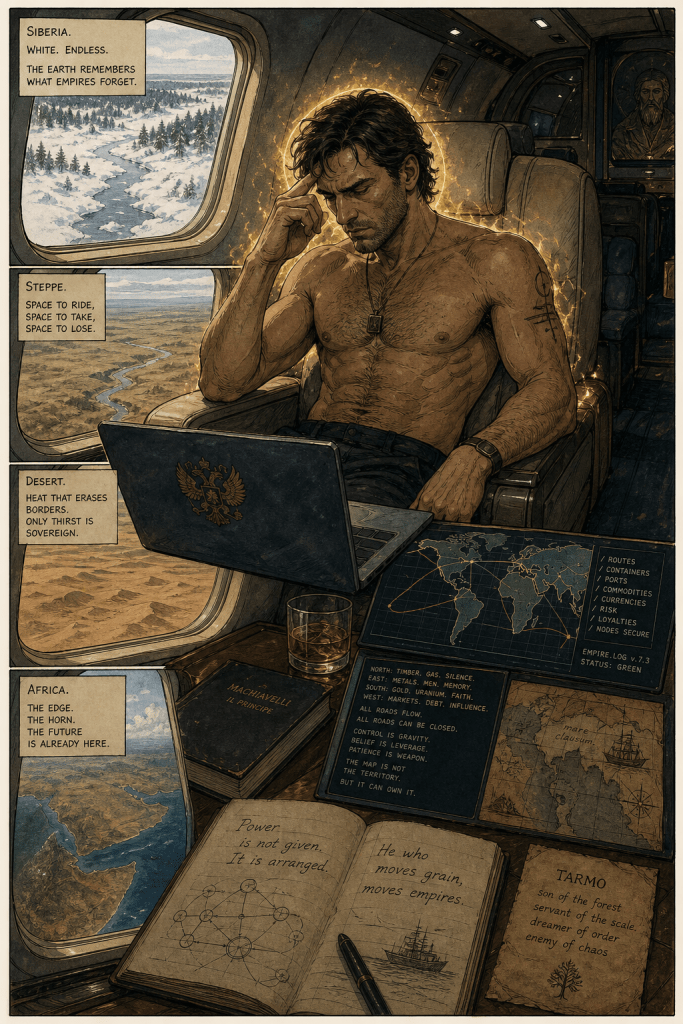
Son of the sun. Servant of war. Dreamer of order. Enemy of chaos.
That’s Tarmo Amellal in four lines, and it’s closer to the truth than anything he’d say about himself. He dies, wakes, and discovers that rebuilding an empire is easier than understanding what to do with a child.
Who Tarmo Is
He is the kind of man who thinks in shipping routes, shell companies, ports, leverage — who turns infrastructure into power and power into permanence without blinking. He rose from the waters of Lake Baikal altered: two gods sharing his skull, and a question in his chest no amount of money can answer. What does a father owe his child, when he is world’s predator?
The Amellal Trust isn’t a fortune sitting still. It’s a machine, and he knows exactly how to keep it alive through bad weather, bad governments, bad faith. But Baikal didn’t just give him his life back — it gave it back with interference. Something older moved into the seams of him. He’s still himself. Not safely so.
Power without fracture is predictable. Power with fracture is a different animal entirely.
The Gods In Him
Rha speaks in blood, continuity, legitimacy — wants Tarmo to become a founder, a father of structures, a man whose bloodline justifies a future. Odin is colder, sharper: consequences, tradeoffs, what can be studied or weaponised or sacrificed if the spiral demands it. Neither is sentimental about the child, or the world, or Tarmo’s reluctance to choose.
He hears both of them. He has stopped simply obeying either.
Why Fatherhood Changes Everything
The daughter isn’t a plot point. She’s the first thing in this story that can’t survive being reduced to transaction — Tarmo caught her weight in his hands before the world became war, myth, and logistics, and that moment outweighs every boardroom and every compound he’s built since.
A man who can justify anything for empire is a familiar shape. A man who has to ask what kind of world his child will inherit is something else. His humanity lives in the refusal to let her become either ornament or instrument — not because fatherhood softened him, but because it moved the axis he measures every decision against.
Why He Matters
Geopolitics. Logistics. Myth. Bloodline. Fatherhood.
He’s the bridge between all of it — between ports and prophecy, between the machinery of the world and the cost of staying human inside it. Powerful enough to shape events. Not powerful enough to escape being changed by them.
What Comes Next
Right now he’s arriving in Hargeisa while a ship carrying his daughter moves toward him through a map full of threats. The compound is ready. The routes keep shifting under him. Rha and Odin haven’t agreed on what kind of man should be standing there when she arrives.
The real question was never whether he can command a room.
It’s whether he can stay human when the room is his family.
Elena.
I have to think her name twice before it comes into focus. The last time I saw her—did I? At the lake? Before the lake? Everything from that day comes back in splinters.
Odin thinks she is dead. Rha thinks she is moving through the dark in ways I cannot yet see.
I think I don’t know enough.
Neither god has an answer for that one. There’s a reason it’s the one thing they agree to disagree on.
Find out why → The Corridor Chronicles: Notes on an Enforced Itinerary
I’ve spent thirty-three years watching fieldwork subjects reckon with what they owe the people who came after them. Tarmo is the first character in this series who’s had to ask that question with a god arguing in each ear — and I didn’t plan that, it just kept happening on the page. If his contradictions feel like they’re carrying weight from somewhere you haven’t seen yet, they are. Start with Zavet – The Corridor Chronicles if you want the ground he’s standing on. Irena Phaedra
© 2026 I.Ph. de Lange All rights reserved. Published by CYcrds OÜ.
 The Memory Cartographer