Reincarnation meets geopolitics in my universe, but sometimes the most brutal politics are cosmic: a universe that keeps stealing a woman’s children mid-birth, then demands she rewrite the landscape in return.
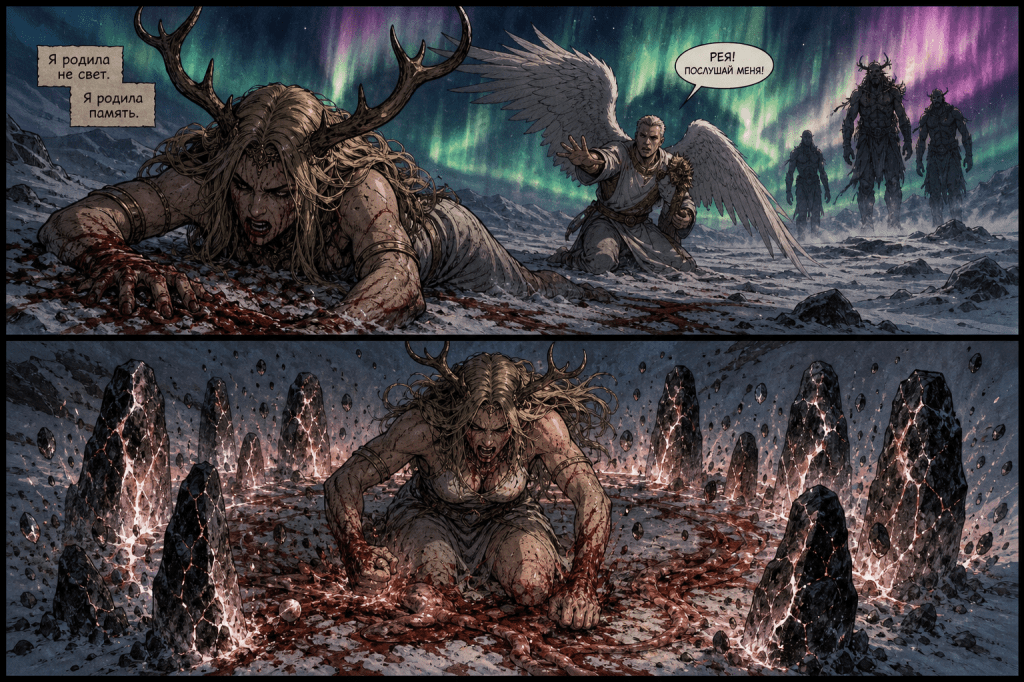
Today’s field note isn’t gentle. It’s the chapter where Elena — in her Rhea form — gives birth, is torn out of time again, and answers the theft by raising a circle of standing stones out of rage and afterbirth on a primordial tundra.
This is the moment the earth itself becomes a witness.
The Axis: Birth, Theft, Stone
Three things happen here in one continuous, feral movement.
A birth that never finishes properly. Elena screams her daughter’s name — Kendra — and the universe answers by shattering the room into light and geometry while the umbilical cord is still attached. Her postpartum body is dragged through a quantum singularity without mercy.
A jump into a world that hasn’t learned “night” yet. She lands in what will one day be Norway: ice and volcanic scorch, aurora as weather, giants watching from the distance. Mikhail — ex-KGB angel, mechanical anchor — arrives with her, but for once he isn’t the one in control.
A megalith born out of rage. On her knees, bleeding, placenta steaming in the snow, she pounds the ground. Not ritual, not spell — pure fury at a cosmos that has stolen a child mid-birth. The earth responds. Stones tear themselves from the mantle, drink her blood, and arrange themselves in a circle because her rage has geometry.
This isn’t tidy fantasy. It’s messy, embodied myth: grief, biology, and tectonics in one breath.
Giants and Architectural Threat
The second half of the chapter shifts from eruption to confrontation.
Giants — proto-beings who haven’t yet calcified into myth — arrive, drawn by the violence and the newness of what she’s done. They speak in pre-linguistic vibration that still somehow carries “Fee-fi-fo-fum” long before any English nursery rhyme exists. They smell the blood of a god-born one.
Her answer is sardonic and lethal: “Who wants to get pounded on the head with a stone?” She doesn’t need to move. The threat is architectural now — written into the way the stones lean toward the giants like teeth.
Mikhail, wings shaking, manages a clipped “Третий раз… Хватит”Third time… enough already.” He’s counting the stolen births. He knows this circle isn’t just landscape — it’s grief.
“Proof,” she says, when he asks what she’s just built.
By the time the giants retreat, what’s left isn’t victory. It’s a place no human will ever map, nine thousand years from now — the first wound, the hidden axis, the spot where a mother’s rage taught the earth a new way to remember.
Why I’m Sharing This Chapter Now
I’ve spent months wrestling with how to present this universe — a long-running series built from real anthropological fieldwork, arcs that run from frozen lakes to African night markets, from London drawing rooms to crossroads where old gods still collect their due.
This chapter is one of its axis points. It shows you what “magic” costs in this world — not clean spells, but biological and territorial consequence. It shows you Elena as she actually is: a cynical anthropologist whose feelings live in cognition, tallying her losses like data even while bleeding into the snow. And it anchors everything that comes after — this is where the earth first learned to carry her grief.
If you’ve been circling this world via Pinterest fragments, consider this your first full plunge into Quantum Jump.
Read the full chapter — The Leap, Primordial North, The Raising, and The Challenge — and meet the same cell moving under the same brutal, cosmic logic: Elena, Mikhail, Tarmo, Asdar, Karim.
[Start the series here →]
© 2026 I.Ph. de Lange. All rights reserved. Published by CYcrds OÜ.

