Field Notes from the Indecently Green Roads: Travellers, Harbingers, and One Very Opinionated Horse
The choreography of avoidance
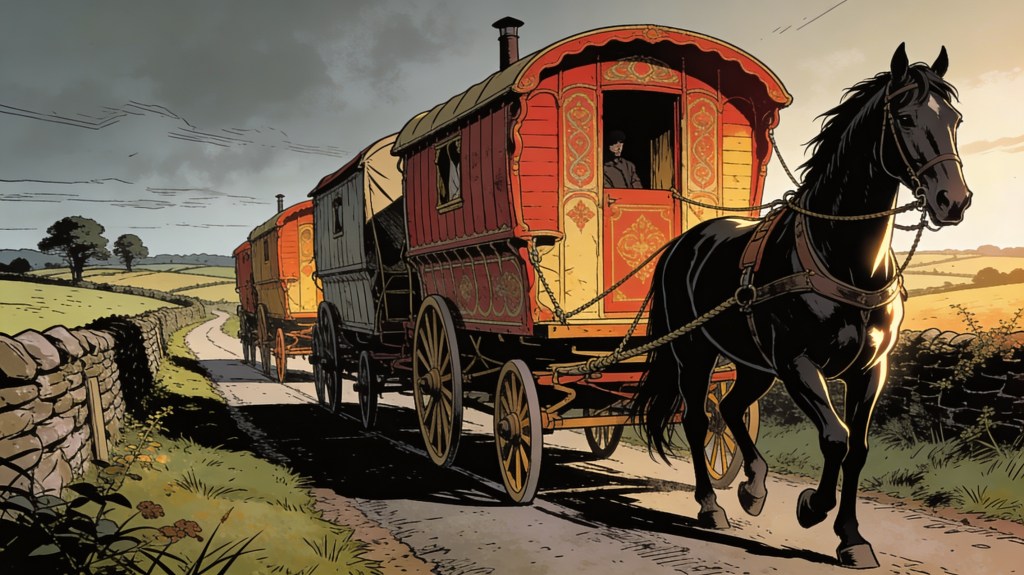
The Travellers move with the quiet assurance of those familiar with shadows, their horse-drawn carriages gliding softly over the back roads while early dawn cloaks the countryside in muted greys and gentle mist. Their pace is deliberate but unhurried, blending with the rhythm of the earth beneath hoof and wheel.
This is not tourism. It is a choreography of avoidance.
Settlements are skirted, not entered. The soft thud of hooves on less-travelled paths replaces the clamour of bustling market squares. Rest happens in secluded clearings or forgotten farm tracks, where horses graze beneath the arms of ancient oaks and fires are banked low, embers barely glowing — signals of life with no invitation attached.
Conversations stay low. Words are chosen like careful footsteps that refuse brittle twigs. Music functions as anaesthetic, not performance: whispered melodies as private solace, never thrown wide enough to catch on a stranger’s ear. Food appears by barter and discretion — a basket at a back gate, a nod in passing, no theatre of coin or voice.
Apparel is almost deliberately forgettable: plain, worn clothing that blends with hedgerows and cattle, faces turned down or shaded by hats to avoid becoming anecdotes in someone else’s narrative.
In this world of subtle movements and quiet survival, the Travellers become ghosts in the landscape, threading along the lanes with the patience of the earth itself, intent only on the horizon and the long road ahead.
And then there is Karim.
3jeeb: indecently green
Karim, born and bred in Antwerp and convinced it counts as “the world,” believes he has seen things — Tangier in his youth, Elena in the saunas of Estonia, Russia’s network, crossing Lake Ladoga to Finland, Poland with its spies and artists, those theatrical Transylvanian hills. Africa, from kidnappers in the Sahel to pirates off Dakar.
For him, England arrives not as a postcard but as an offence: indecently green.
He does not enter the scene as a neutral observer. He arrives as a horse.
Drina, the Travellers’ matriarch, has limited patience for his dramatics.
“Horses don’t talk. You already draw too much attention with that Arabian fluff you call a hide, and stop swinging your dick. Not impressing anyone.”
Esme, nursing baby Liam, quietly disagrees. “I aaam,” she mouths against his flank.
Karim prances anyway. He refuses to pull the carriage, so Drina ties him to the back – like a stallion for sale. He declares himself “enamoured with the land of the Bretons.” Esme counters, dry as flint:
“As am I with SpongeBob and Obelix, go figure.”
His showmanship throws the Travellers’ quiet strategies into relief. His multilingual swearing and theatrical complaints mark the tension between survival mode and the human need to perform being alive.
When he shifts back into human form in a field – putting on his pants while the caravans roll on without him – the landscape insists on entering his body.
The grass verges along the lane are indecently green. He tries not to look at them directly. In Africa the grass was dry and yellow, tasting of dust and obligation — knowledge etched into the body, not the mind. This grass is different: cold, fat, heavy with rain. His mouth fills without his permission.
He swallows. Looks away. Adjusts his borrowed jacket.
How memory tastes.
The robin, the falcon, and natural causes
The coaching inn is textbook rural England — low beams, roaring hearths, roast beef, mashed potatoes, the aroma of stewing meats and ale. For a moment, the Travellers inhabit a space designed exactly for their kind, at least historically.
Except Liam, the baby, is too beautiful not to disturb the design. Waitresses and other guests become infatuated. Beauty becomes risk.
Tobar, the eldest son, murmurs to Drina. She rises. The Travellers leave — not in panic, but with efficient unanimity.
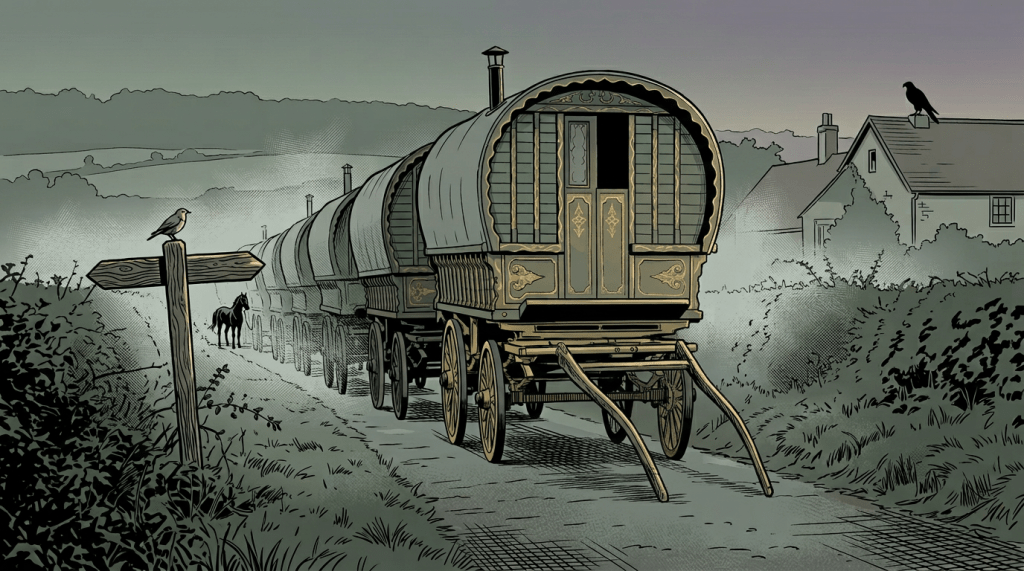
Outside, a robin perches on the inn’s sign. Out of season. Head cocked. Eyes too bright.
“Wrong time of year for that,” Esme mutters.
Karim begins: “It’s just a —”
“It’s a harbinger,” Drina says. “Move.”
She whistles, barely audible. From a rooftop, her falcon drops like a falling shadow.
“Natural causes,” she remarks, turning back to the vardos.
A strike. A cry cut short. Red feathers drifting in twilight.
The Travellers move with practised ease — hitching horses, securing loads — as if nothing has changed. Esme holds Liam closer. Karim swallows stolen bread.
“Natural. Right.”
For an anthropologist, this is the hinge: the way a group manages threat without ceremony, the way “natural” is invoked to sew over deliberate action. He knows what natural causes looks like on paper. He just watched what it looks like in practice.
The hayloft and the grammar of belonging
At one farmstead, Karim and Esme slip into the hayloft. The afternoon light comes through the slats in long stripes and the hay smells of summer three weeks past. What happens there is uncomplicated and good and belongs entirely to them — no kidnappers, no pirates, no paperwork.
“Are you sure about this?…” he breathes. “What if Drina finds out?”
Esme laughs low, a velvet sound against his throat.
“You talk much and know little. She knows gajin.”
Gadjie. Gajin. In Romani usage, the outsider — the one who is not us. Drina does not perform outrage when they return, hay in their hair, something new in the air between them. Her black eyes flicker with an approval she will never name aloud.
She knows outsiders. She also knows when intimacy strengthens a group rather than weakening it.
What the field note is really about
Strip away the narrative skin and this section of Quantum Jump offers a compact set of observations:
Spatial practice — skirting towns, low fires, hidden clearings, the careful use of inns. How Travellers manage visibility.
Economy of voice and music — words and songs as private commodities, never public performance.
Threat management — a robin in the wrong month read as omen, removed by falcon, framed as natural. Language erasing agency.
Embodied memory — Karim’s reaction to English grass as a record of past landscapes written into his body. How environments insist on entering us.
The grammar of belonging — how outsiders are named, teased, tested, folded in, and tacitly endorsed.
A brief note on the term:
Today, “harbinger” usually means “forerunner, omen—something that signals what is to come.”
It comes from Middle English herbergere, the person who arranged lodgings (from Old French herberge, lodging). Originally, a harbinger was the one who went ahead to secure shelter. Over time, the practical “forerunner” became a symbolic “omen.”
The terms “gadjie” and “gajin” echo real Romani usage:
In many Romani dialects, gadjo/gadji refers to a non-Romani man/woman—an outsider to the group.
In my spelling, “gadjie” and “gajin” are fictionalised forms but carry the same weight: the ones who are not us.
A people who skirt visibility, bank their fires low, and refuse the theatre of contact nonetheless carry their own fluent ways of reading signs — a robin in the wrong month, a baby too beautiful, a horse too noisy, a man who runs faster on two legs than four, a woman who has lost enough to know exactly what kind of warmth she is choosing.
Karim’s sardonic eye punctures the romance of England. But it also reveals the cost of staying alive in a world that wants you either picturesque or gone. The Travellers choose neither.
They choose motion, ghosting, and the occasional falcon.
If you’ve made it this far without developing an inexplicable fondness for a shapeshifting Arabian stallion with strong opinions about English grass and a complete inability to pull a caravan, click the button below.
Irena Phaedra
Quantum Jump is Book VI of The Memory Cartographer series by I.Ph. de Lange, published by CYcrds OÜ. © 2026 I.Ph. de Lange. All rights reserved.

