A fieldnote from Quantum Jump
There are days when writing feels like fieldwork again—except the “village” is a Bronze Age grove, the informant is a Celtic goddess, and the notebook is the Voynich Manuscript.
In this section of Quantum Jump, Elena—Dutch anthropologist, time‑displaced, ink‑stained—has just spent the night helping Airmid encode her healing knowledge into a book that will survive for centuries in a script no one can decode.
At dawn, she realizes a manuscript isn’t enough:
“The manuscript alone isn’t enough,” she says. “Anyone could stumble across it. Copy it. Sell it. Lose it in a fire or a flood. We need a key. Something that requires effort. Intention. Knowledge of this land.”
Airmid tilts her head. “A map.”
“More than a map. A living geography.”
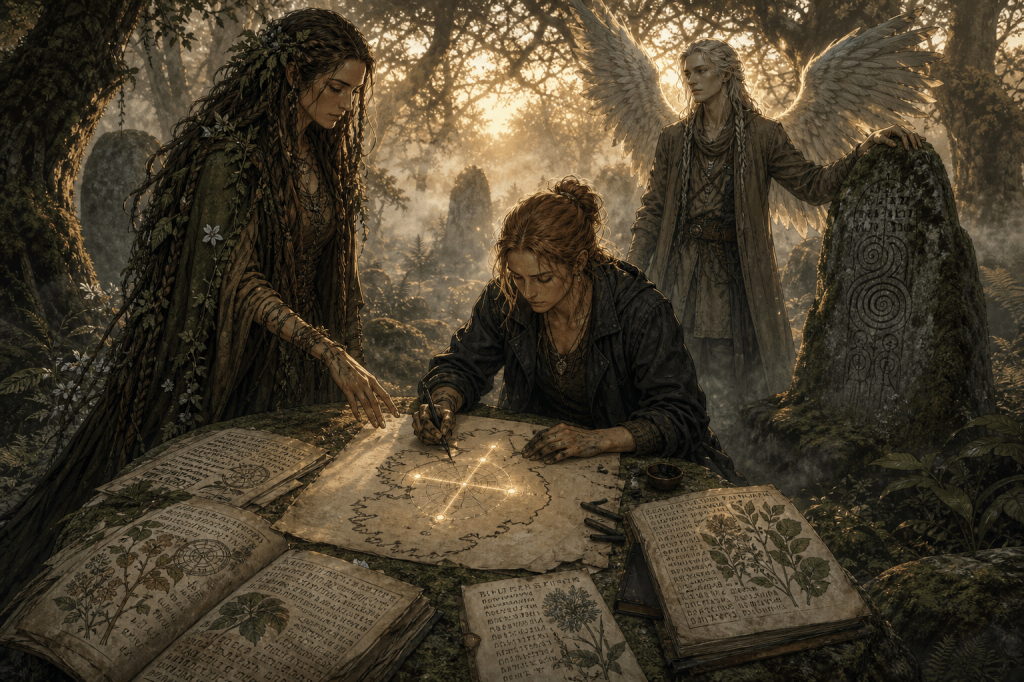
Elena spreads vellum on a stone and begins to sketch Ireland from memory: Uisneach at the center, Tara and the Boyne mounds to the east, cairn‑clusters to the north and west, ritual lakes and thresholds further south. As she marks them, a pattern emerges: a cross, a wheel, an eight‑pointed mandala.
For Airmid, this shape is “old knowing, older than the Tuatha Dé.” For Elena, it becomes a second layer of protection: a key that lives in land, not just ink.
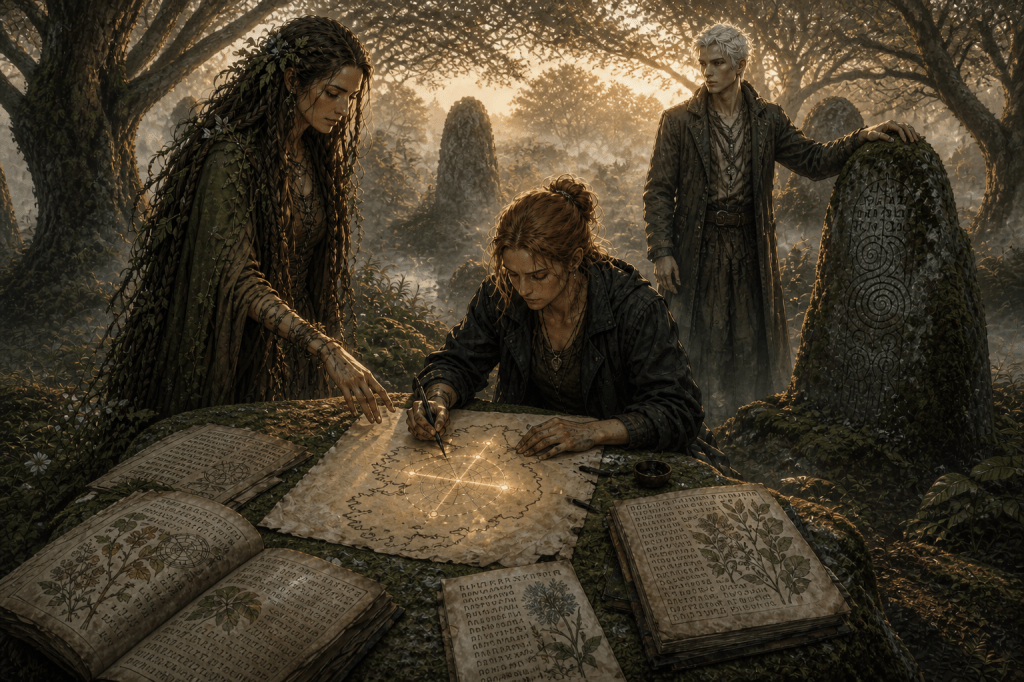
They decide:
to bury woven herbal crosses at sacred sites
to encode the locations in songs passed down through matriarchs and “wisdom‑keepers”
and to let the manuscript remain unreadable to anyone who doesn’t already carry a certain kind of knowing in their bones.
Why Airmid?
Airmid (or Airmed) is the Irish goddess of herbs and healing—daughter of Dian Cécht, sister of Miach. Her core myth is already an essay on knowledge, jealousy, and loss.
After Dian Cécht kills Miach in a jealous rage, 365 healing herbs grow from Miach’s grave—one for every joint and sinew in the body.
Airmid gathers them and lays them out on her cloak, sorting them by healing powers.
When her father sees this act of complete healing, he scatters the herbs so no human ever again possesses the full map of their properties.
It’s hard to imagine a cleaner mythic metaphor for:
a total medicinal system,
carefully organized by a woman,
violently broken by patriarchal envy.
In Quantum Jump, I treat Airmid as exactly that: a gatekeeper of healing knowledge that was deliberately shattered. Elena, as an anthropologist, recognizes the politics immediately. Airmid isn’t just “herbal goddess background decoration”; she embodies the tension between open healing and controlled scarcity.
Awen as a qualification test
Awen is usually translated as “inspiration,” but in this story I lean into it as embodied, responsible knowing.
For Elena, awen isn’t:
- solving a puzzle because you’re clever,
- or running a text through an algorithm.
Awen is what you get when:
- you’ve lived inside healing work long enough,
- your body and ethics are tied to it,
- and your intuition is tuned by practice, not just theory.
So when Elena realizes they’re creating something like the Voynich Manuscript, she reframes it:
“Only someone with awen could read this,” she says. “Intuitive knowing. Not linguistic decryption. Not pattern recognition. Wisdom.
So we’re encoding your knowledge in a way that ensures only someone who already understands healing could unlock it. A cipher that tests for qualification. If you can read it, you deserve to read it.”
That’s the key: the book is not just secretive; it’s selective. It refuses to yield to raw cleverness. It wants commitment.
The Voynich Manuscript in this universe
The historical Voynich Manuscript is a real object: a 15th‑century codex written in an unknown script, full of strange plants, star charts, and women in what look like ritual baths. No one has definitively cracked it.
In Quantum Jump, I don’t try to “solve” Voynich from the outside. Instead, I move the origin point:
- The manuscript becomes the textual shell of Airmid’s healing system.
- The script is designed for people with awen, not for scholars with good lighting and grant money.
- Anyone without the inner qualification sees only “nonsense plants and gibberish text.”
Elena’s uncomfortable realization is that she is helping to create a future object she knows intimately as a failure of modern understanding. She is both scribe and later spectator.
That’s the quiet cruelty of the scene: she will one day stand in a library, looking at this thing behind glass, with no way to read her own work.
Ireland as a living cipher
The second layer—the map—comes from marrying archaeology with myth.
Elena draws on what she knows from her own era:
- Uisneach as the “navel of Ireland,” a spiritual and political center.
- Tara and Brú na Bóinne (Newgrange and its neighbors) as complexes tied to solar events and kingship.
- Loughcrew, Carrowkeel, and other passage tomb clusters as ancestral repositories.
- Southern and western sites where lake, ritual, and liminality are tightly braided.
On vellum, these become points. The pattern that emerges is not random; it’s a mandala.
In the story:
- Uisneach is the heart.
- Lines extend out in cardinal and diagonal directions, making a cross / sun wheel / eight‑pointed star.
- Airmid recognizes the pattern as something the land “remembers from when it was first formed.”
The “key” then is not a password; it’s:
- herbal crosses buried at these sites,
- mapped in songs,
- aligned with symbols in the manuscript.
To unlock Airmid’s knowledge in the book, you also have to:
- understand the landscape,
- listen to inherited songs,
- and be willing to walk the pattern.
It’s not an escape room; it’s a commitment to relationship—with land, with lineage, with responsibility.
While Elena marks the first cross at Uisneach, Drina is crossing the same hill with Liam on her back and the song in her mouth. Different centuries. The land holds both of them.
If you’re a new comer: you’ve just seen how far down the rabbit hole my “worldbuilding” goes aka when you let an anthropologist loose on myth.
Irena Phaedra
© 2026 I.Ph. de Lange All rights reserved. Published by CYcrds OÜ.
 The Memory Cartographer