Sandi’s Journey With Elena’s Baby
Walking North With a Borrowed Future: Field Notes from Book VI Quantum Jump
There’s a particular silence that lives between border towns and bus stops—too wide to be city noise, too thin to be wilderness. It’s the silence where people carry their lives in plastic bags and photocopied papers, hoping the ink will count as proof of existence.
I’ve been sitting with that silence while writing Sandi’s arc in Quantum Jump.
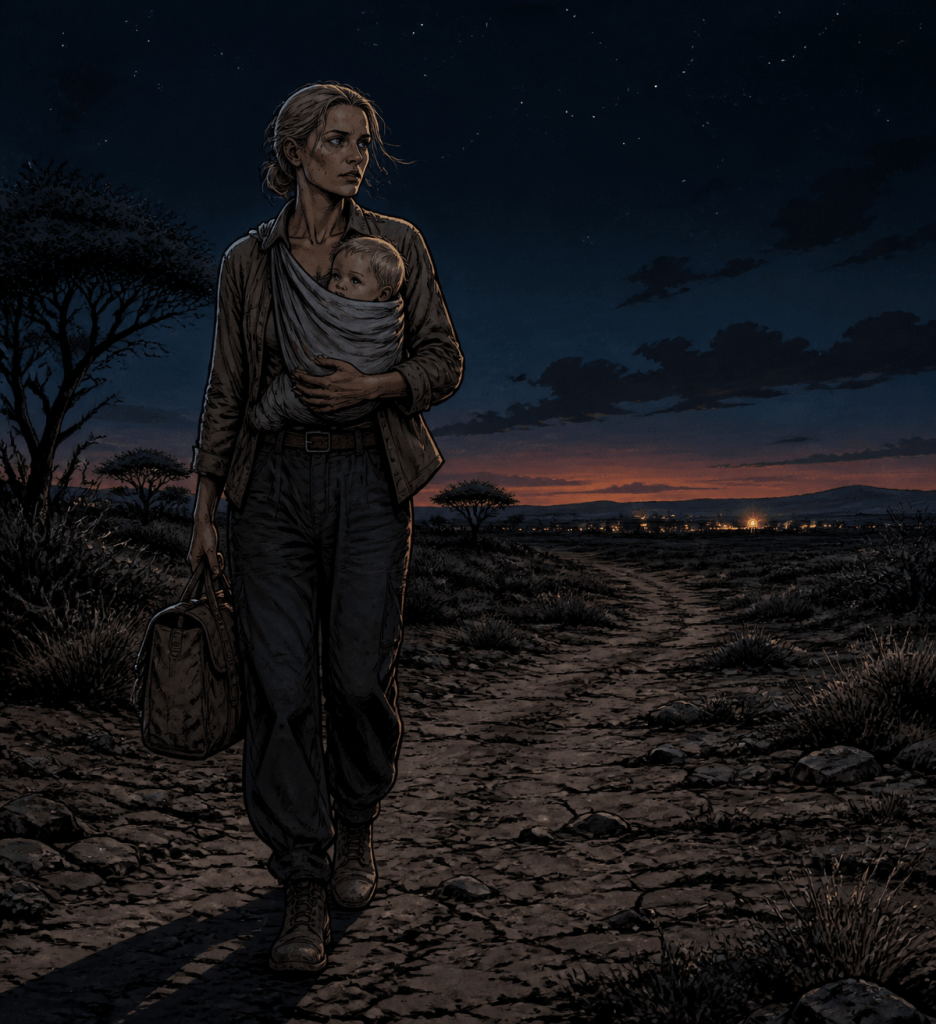
In these pages, Sandi is moving through African scrubland with a pale newborn strapped against her chest, a child that is both tether and threat—Elena’s other baby, born into magic and geopolitics in equal measure. On paper, this is “fiction” and “worldbuilding.” In practice, it’s fieldwork of a different kind: tracing how bodies, borders, milk, and names intersect when the world stops being abstract and becomes logistics.
On milk, fear, and improvised kinship
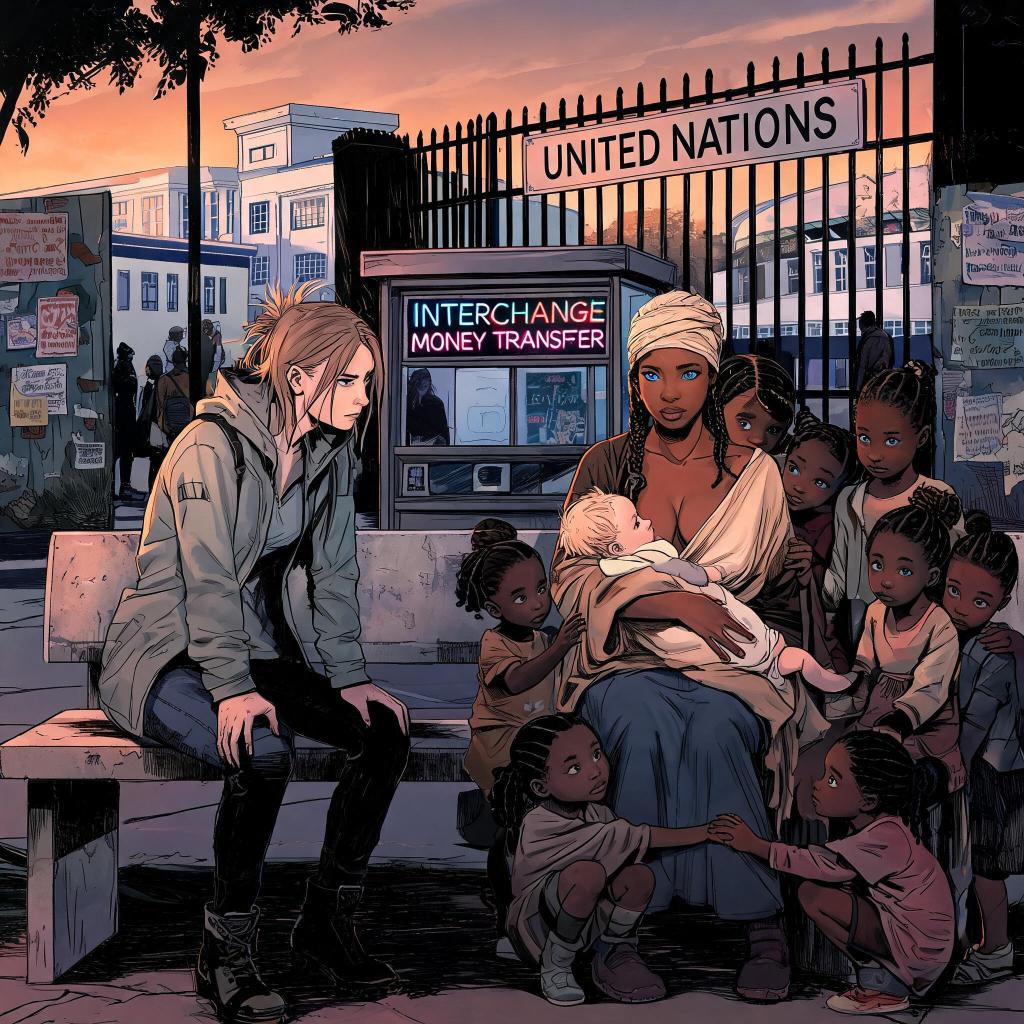
One of the central images in this segment is simple: a woman breastfeeding a child who is not her own, under sunset beside a bus corridor that leads toward Maputo and Hargeisa. The woman, Mpho Biko de Lange, carries Elena’s old surname, not the polished version used in foreign business. Her breast becomes a point where lineage, race, hunger, and care collide.
For Sandi—ex‑SUPO, trained to navigate shadows and state secrets—fear has never been personal. She understood risk as calculation, injury as collateral, loyalty as contract. What changes her is not torture or threat; it’s the possibility of a newborn’s slow death by bureaucracy and indifference. The terror is not dramatic; it is mundane:
- Feeding eight to twelve times a day in places where even finding water is a negotiation.
- Deciding whether to travel alone and invisible or with a group that can keep the child alive but attracts attention.
- Trusting a stranger’s milk more than her own experience, because her body has never been asked to nourish anyone.
This is the anthropology of care under pressure: not grand theories, but the way women silently build survival networks when states offer camps instead of protection.
Names as documents and ghosts
When Mpho steps up to a folding table and says, “Mpho Biko de Lange,” she isn’t just answering a bureaucratic question. She is stitching together histories: Dutch ancestry, South African resonance, Biko’s political echo, Elena’s original identity before it was repackaged for foreign tongues.
Surnames here are more than aesthetic:
- “de Lange” is acceptable, familiar, legible in official settings.
- “Delange” is a convenience for external systems, a smoothing of consonants for export.
- “Biko” is a ghost of resistance embedded into a living woman’s daily survival.
Sandi’s decision to put “de Lange” on the forged passports is part practical, part ritual. She’s not just choosing what will pass at the border; she’s choosing which ghost will travel with them.
Fieldwork has taught me that documents are always double: they tell states who you are, and they tell you who you’ve agreed to be.
Trust as a calculated risk
The scenes around the UN offices, the Interchange Money Transfer service, and the sketchy crowd of asylum seekers and forgers are built on one central tension: trust as a calibrated gamble. Sandi’s background as an intelligence agent means she reads people as variables:
- The forger by the UN gate: resource and potential trap.
- Kalehvi: a man who owes her favours but contaminates every deal with discomfort.
- Mrs H and Hasna: network architects whose help comes with excavation—blood‑level debts, exposure of secrets, perhaps even claims on the child.
Field notes from contemporary migration routes often show this same grammar: people choose routes not just by geography, but by who they dare to owe. In Quantum Jump, Sandi decides that she can barter contacts, money, and future favours—but not the baby. The child is non‑negotiable collateral; nothing about her survival can be “paid” into someone else’s ledger.
That refusal is, in its own way, a boundary. Not between nations, but between what she will sacrifice and what she will not.
Why this arc matters to me as an anthropologist
Writing these chapters feels less like invention and more like recombination. I’m drawing on:
- Reports of long bus routes between Pretoria and coastal cities, where papers and fear are checked in the same breath.
- Testimonies of mothers and wet nurses in camps who share milk without contracts, forming temporary kinship webs in transit.
- The quiet, unreported strategies by which people choose which name to put on a passport, which lineage to foreground, which identity to hide.
I’m not trying to “represent Africa” as a singular entity; I’m tracing a corridor where my characters walk in tension with systems I recognize from fieldwork and archives. The baby girl, pale and magical, is deliberately out of place. That dissonance is a tool: it forces every character—including Sandi—to confront who gets protected, who gets erased, and who gets weaponized.
Where this is heading
From the UN offices to Maputo and onward to Hargeisa, the story continues along an axis that blends:
- Hard logistics (money transfers, forged documents, bus schedules).
- Intimate vulnerabilities (milk, fear, tired bodies on worn benches).
- Mythic interference (the fact that this baby is not just a baby, but a “magical signature” in Hasna’s words).
As I move further into this arc, my field notes are less about landscapes and more about the ethics of movement: how far a guardian can go, what kinds of threats become promises, and how trust is negotiated between women who have every reason to fear each other, but choose not to.
This post is one of those notes—a way to track the anthropology inside the fiction, the way survival strategies, names, and bodies carry more data than any official report ever admits.
Irena Phaedra
If you’re thinking, “Wow, this is a lot of borders, buses, and breastfeeding,” you’re right—and you’re still invited to just enjoy the ride.
You don’t need a migration dossier to follow along.
You only need curiosity and a mildly stubborn heart.Sandi’s doing the exhausting part.
You get to sit in the reader’s seat, watch her out‑calculate the world, and maybe smile when the baby wins against bureaucracy—one feed, one forged document at a time. Meanwhile, Elena is being punted through time planes by a fickle universe. Fortunately, that same universe gives Sandi just enough allies, milk, and bad buses to keep up.
© 2026 I.Ph. de Lange All rights reserved. Published by CYcrds OÜ.

