Field Notes: The Agabara Cronicles – book V part II
Edge of the highlands
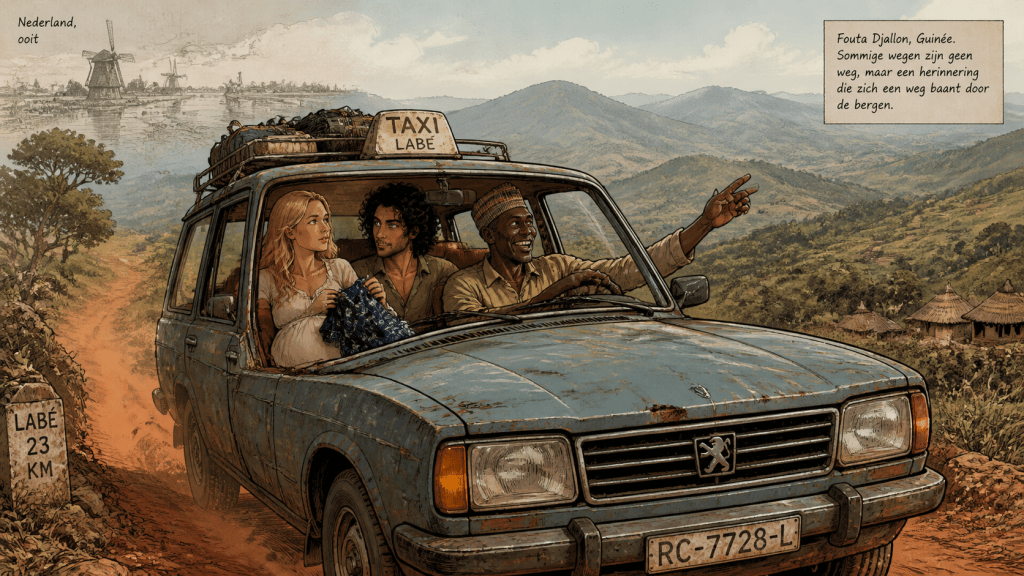
By the time Elena’s rattletrap plane bumps down onto the airstrip near Labé, she’s already crossed miles of red earth and Sahel dust. The Fouta Djallon rises ahead of her like a new country for her bones.
“Outside, Labé greets us in a riot of colour and dust. Motorbikes zip past in clouds of red earth. Vendors call out offers of fruit and roasted peanuts, while weary taxis line the roadside, cracked paint and patient faces behind the wheels. Unlike Conakry’s humid ocean-soaked air, here the atmosphere is thinner, more transparent, sharper against my skin.”
Karim feels the shift too; for him, this isn’t just another town, it’s the hinge between city and highland.
Machines, people, and climbing anyway
At the taxi rank, her fieldworker’s eye is still alive under the fatigue – and so is her sarcasm.
“I study the car — the cracked windshield, the backseat barely covered in fraying fabric — and arch an eyebrow at Karim. ‘Do you think it’ll make it up the mountains, or shall we push when the engine gets bored of the incline?’”
Karim answers with the kind of quiet faith that has very little to do with engineering specs.
“‘It will carry us. Machines here are like the people — they go further than they appear able.’”
“Hollandé”: almost same word, complete different world
It’s only once they’re on the road that the real field note arrives, tucked inside a taxi driver’s curiosity. He hears something in Elena’s accent and takes a guess.
“He glances back, curious. ‘Madame, you are from Holland? The Netherlands?’
‘Originally, yes.’”
That’s when he drops the word that re-wires the landscape for her.
“He grins, delighted, gesturing broadly at the green ridges rising ahead of us. ‘Then you must know — in Pular, our highlands, the Fouta Djallon, we call them Hollandé.’ He taps the steering wheel with satisfaction. ‘The high country. Same word, different world. You are not so far from home as you think.’”
For once, the connection between “home” and this road isn’t metaphorical. It’s literally embedded in the local language.
“I stare at the ridges. Karim watches me stare at them.
I say nothing for a moment.
‘Well,’ I manage finally, ‘that’s either a remarkable coincidence or the universe has absolutely no sense of subtlety.’”
Why this matters for Elena’s road
For Elena, “home” has been a shifting concept: Netherlands, field sites, temporary flats, a Russian fugitive’s shoulder on a train, Karim’s arm in yet another hotel. On this stretch of road, the Fouta Djallon quietly decides to meet her halfway by sharing a name with the low, wet country she left behind.
“Hollandé” becomes more than a joke between her and the taxi driver. It’s a reminder that the road is not just about leaving; sometimes it’s about finding echoes of home in places that have all the right not to resemble home at all.
This field note drops into the middle of Elena’s long road – Marrakech to Kayar, Tichit to Labé, and on toward the Fouta highlands. If you’d like to follow the route from the beginning, you can start the journey here.
© 2026 I.Ph. de Lange All rights reserved. Published by CYcrds OÜ.

