
Field Notes from Labé: Where Stories Keep Time
Book V – Part II
There’s a point on Elena’s road through West Africa where, for the first time, she isn’t interviewing anyone, recording anything, or proving she has a right to be there. She’s just standing at the edge of a village square in Labé, listening.
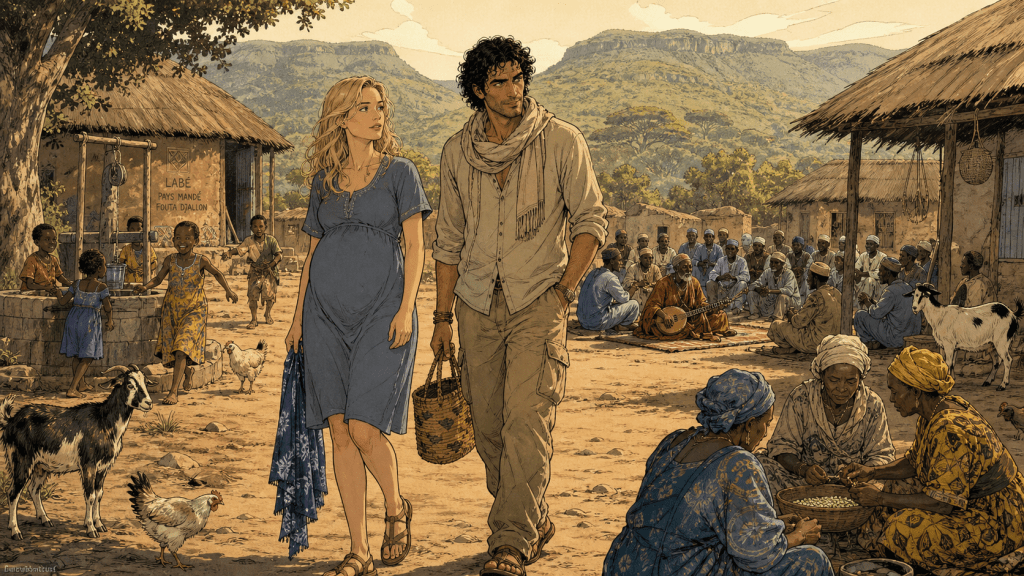
In Chapter Fifteen, “Gawlo,” she’s too pregnant and too tired to climb the hills above the town, so she abandons her own plan and wanders instead: dusty lanes, flowering hedges, kids shrieking around the well, older women shelling beans together in the afternoon light. The Fouta Djallon – that highland spine of central Guinea – moves at its own gentle pace.
“Near the central square I hear it first — a low melodic voice, nearly a chant, threading words and music together in a way that feels both ancient and immediate. A circle has formed around a man seated cross-legged with a stringed instrument, his voice spinning out a fable in the rolling cadences of a practised storyteller. A griot — though here, I will learn, they’re called gawlo.”
He’s a griot, but here they call him a gawlo – a praise-singer and memory-keeper. In Fulɓe communities, gawlo carry lineages, local histories, and moral tales in their throats, not in archives. Kids learn who they are at a cadence, sitting on the ground under the open sky; adults are reminded, gently or sharply, of what their elders expect them to remember.
Why this chapter matters to the road
From a plot perspective, “Gawlo” is quiet: no bullets, no kidnappings, no wolves. But it marks an important turn in Elena’s inner road. The Fouta Djallon feels ancient and almost Jurassic to her – cliffs, red earth, dinosaur footprints not far away – and it’s one of the first places where she lets that depth simply wash over her instead of immediately trying to catalogue it.
“The plan — as I’d promised myself back in Conakry — was to hike the hills above the village.
‘What was I thinking,’ I mutter, looking up at those long inclines, my belly full and heavy with new life. Sometimes the world demands patience more than it rewards sheer willpower.”
Bringing it “home” to Karim
When she wanders back to Hotel Tata, Karim has been pacing at the gate, already halfway to worrying himself sick. His first question is exactly what you’d expect.
“Elena, where did you go? You were gone so long — I started to worry something had happened.”
Inside the bungalow I describe to him the people I met — the Fulɓe women gathered in clusters, children darting past in play, the gawlo enthroned in the village square, elders watching with eyes that carried centuries of memory. I try to share how the land itself feels ancient and wild — rocky, lush, almost primeval, red earth underfoot, dense green tangles, cliffs looming just beyond the village.
“It all feels Jurassic,” I say. “Like the world hasn’t changed here since the dinosaurs roamed. There are actual dinosaur footprints not far from here — imagine, Karim, walking where those giants once walked.”
Karim, still looking relieved, cuts me off gently.
“That all sounds remarkable, Elena. But before you sit and tell it all — you need to answer your satellite texts and missed calls. Mrs H, Tarmo, and Hasna have all reached out. Each has called me too.”
I sigh, rolling my eyes with a lopsided smile. “Fine. Let’s reassure the home front. But after that, you get the real story — told just for you.”
“For readers who like their other worlds tangled with this one: reincarnation meets geopolitics, shapeshifter old gods, and a pregnant traveller caught between them.”
© 2026 I.Ph. de Lange All rights reserved. Published by CYcrds OÜ.
 The Memory Cartographer