Previously: Quantum Gravity ended with the writer collapsed in a Tangier hotel room, having reached too far across time, with Wolfgang and Mikhail keeping watch at her bed. Chaos Magic opens the moment she falls asleep and lands inside a scene she wrote years ago, in the body of her own character.
“The rage doesn’t build. It detonates.”

“My magic has mass,” I say, “and grief—grief has mass.”
Inside her own pages
Every writer knows a scene they could barely stand to write. The writer in Chaos Magic doesn’t get to reread hers. She lives it, from the inside, in a body that isn’t hers, at the beginning of the world. She knows every line before it’s spoken, because she wrote them, and knowing doesn’t help.
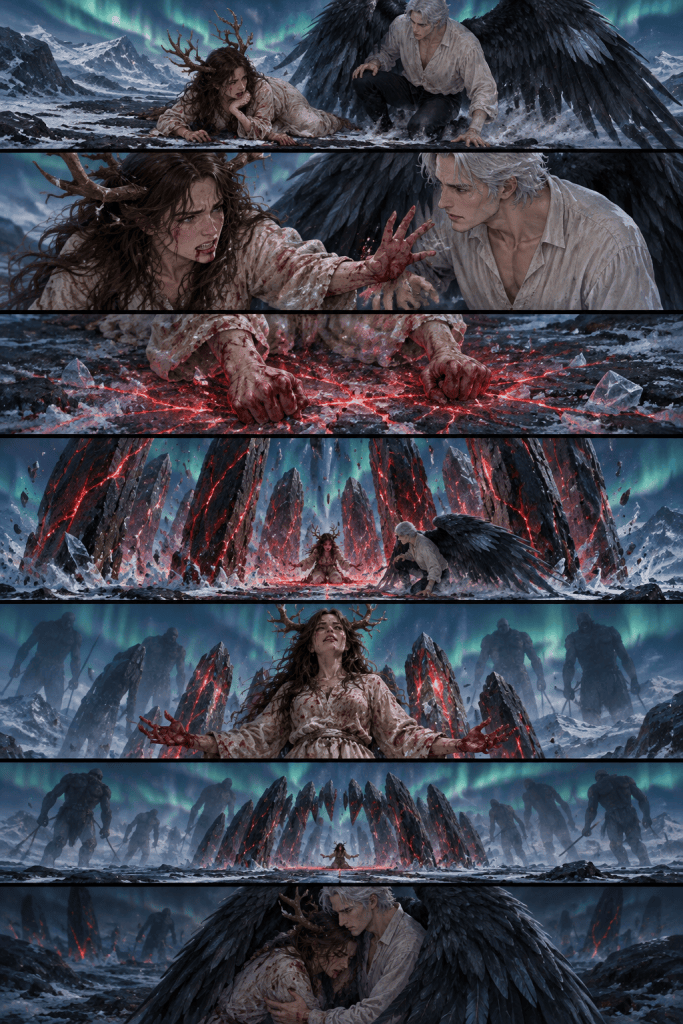
The scene is a birth that goes wrong in the cruellest way possible: a mother holds her newborn daughter for three seconds before time tears them apart. What follows isn’t a spell. It’s grief with nowhere to go, pounded into frozen ground until the ground answers and black stones tear themselves out of the earth and close into a circle.
精卫填海
Chinese readers know the story of Jingwei. The Yan Emperor’s daughter drowned in the Eastern Sea and came back as a small bird, and every day since she has carried pebbles in her beak and dropped them into the water, trying to fill the sea that took her.
It’s the oldest shape grief takes: stones, carried and set down, because the loss is too large to do nothing with. In this chapter it runs the other way. It’s a mother, not a daughter, and the stones don’t fall into the sea, they rise out of the earth. But the logic is the same. Nobody who builds such a thing expects to win. They build it so the loss has a weight the world can’t ignore.
[Start the series here →]
© 2026 I.Ph. de Lange, published by CYcrds OÜ

