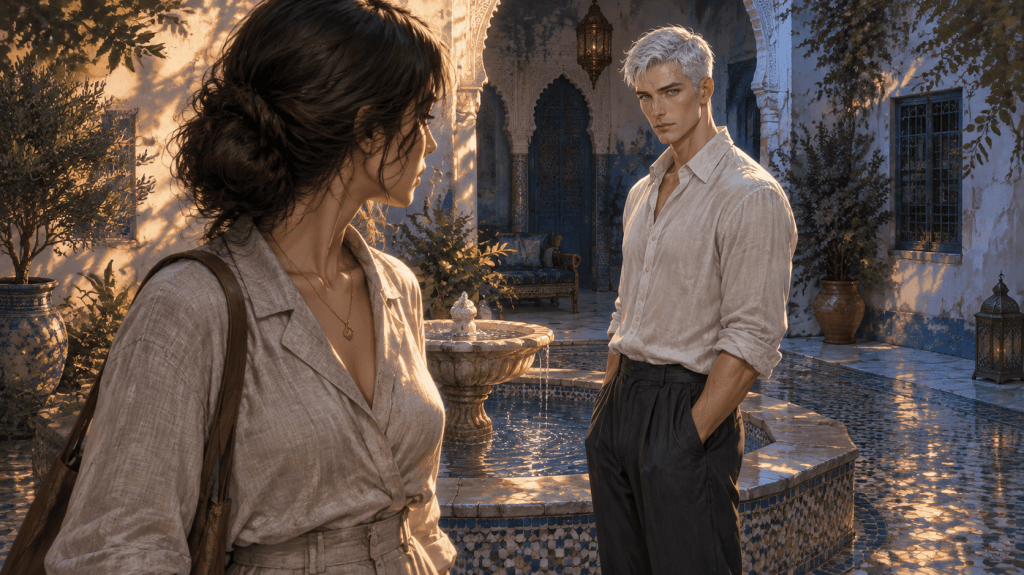
“Explain to me what this project is exactly about. And while you tell me, feel the eyes tracking us.”
A city built to be watched
Tangier has always been looked at. For three decades it was an International Zone, governed by a committee of foreign powers, and every one of them kept people in its cafés. Diplomats, smugglers, writers, informers, often the same person on different days. The city learned early that a stranger at the next table is rarely there for the tea.
The medina remembers this in its stones. Alleys twist and narrow, fold back on themselves, end in doors that open only from inside. Houses turn their blank walls to the street and their faces to a hidden courtyard, the sahn, where a fountain murmurs and nobody passing can see in. Privacy here is architecture.

The great recluse
There is an old Chinese line for this: 小隐隐于野,大隐隐于市. The lesser recluse hides in the wilderness, the great recluse hides in the marketplace.
Anyone can disappear on a mountain. Tangier asks for the harder thing: to vanish among vendors calling, scooters whining past, laundry snapping overhead, the air thick with cumin, exhaust and salt. You do not escape the crowd. You become a ripple in it.
Two men turning in circles
In this chapter the writer walks into the medina with someone who knows that art far better than she does. Behind them, two men in too-neat jackets keep their distance, wires in their ears, eyes on her back.
Then, between one step and the next, there is nothing for them to follow.
I won’t tell you how. What stays with me is the watchers themselves: the moment a professional realises the street has closed over his quarry like water, and he is the only one standing still.
“A few metres away, two men in too-neat jackets have stopped dead. They talk urgently into their wrists, fingers at their earpieces, turning in tight circles, scanning the crowd for a couple who vanished in plain sight.”
[Start the series here →]
© 2026 I.Ph. de Lange, published by CYcrds OÜ

