They wanted to save lives with ancient knowledge—but underestimated the cost.
They wanted to give healing away. They had not planned for what came next.
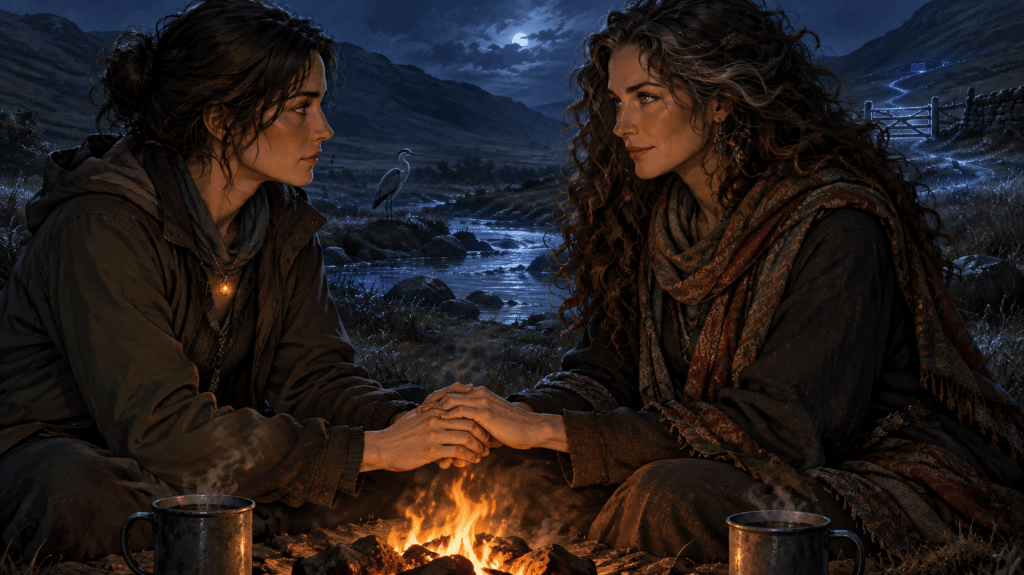
The writer sits beside a low fire in a Welsh glen. Across from her is Drina, a matriarch of the Travellers, Britain and Ireland’s nomadic people. She has roads, people who trust her, and no interest in waiting for powerful men to approve her work.
“We brew, we heal, we teach. No fanfare. Just results.”
Between them lies a promise: they will put an extraordinary inheritance to use. Not for prestige or for a company, but for the sick, the overlooked, and the people who have run out of places to ask for help.
It sounds like the beginning of a revolution. It is also the beginning of a problem.
An old story about lost cures
In Irish myth, Airmid is a goddess of healing. Her brother Miach was a healer too, a better one than their father, Dian Cécht, and the father killed him for it.
From Miach’s grave grew three hundred and sixty-five herbs, one for every joint and sinew of the human body. Airmid gathered them and laid them out on her cloak in order, so their uses would be known. Her father scattered the cloak. The knowledge was lost.
Chinese readers will recognise the shape of this. Like Shennong tasting the hundred herbs, it is a story about the price of knowing what heals. But Airmid’s version ends in loss: a powerful man would rather the cure disappear than belong to someone else.
In Quantum Gravity, that scattered knowledge comes back.
A manuscript crosses the divide
In this chapter, Airmid’s herb law passes from Ma’am’s side of the divide to Indra and Kendra’s, in 1984. Ma’am knows exactly what she is letting go of:
Tonight the law goes into the Kenbak, every leaf of it, for the girls on the other side. Once it’s through, it’s theirs. There’s no redlining the world once it’s printed, girl.
On the other side, it arrives as a printout.
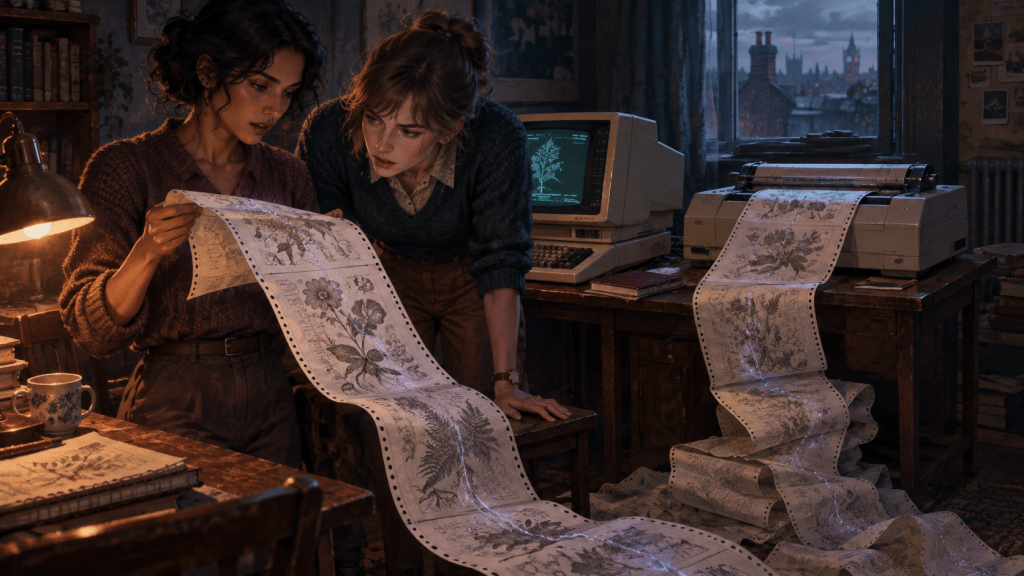
Forty pages where Ma’am’s columns usually run four, curling off the terminal onto the floor. Kendra fed it through twice to be sure.
Something impossible has become something they can hold, copy, teach—and perhaps misunderstand.
Two ways of carrying a legacy
Drina takes the knowledge along her travelling routes. Her work happens beside fires, near wagons, among people who come because somebody they trust told them to.
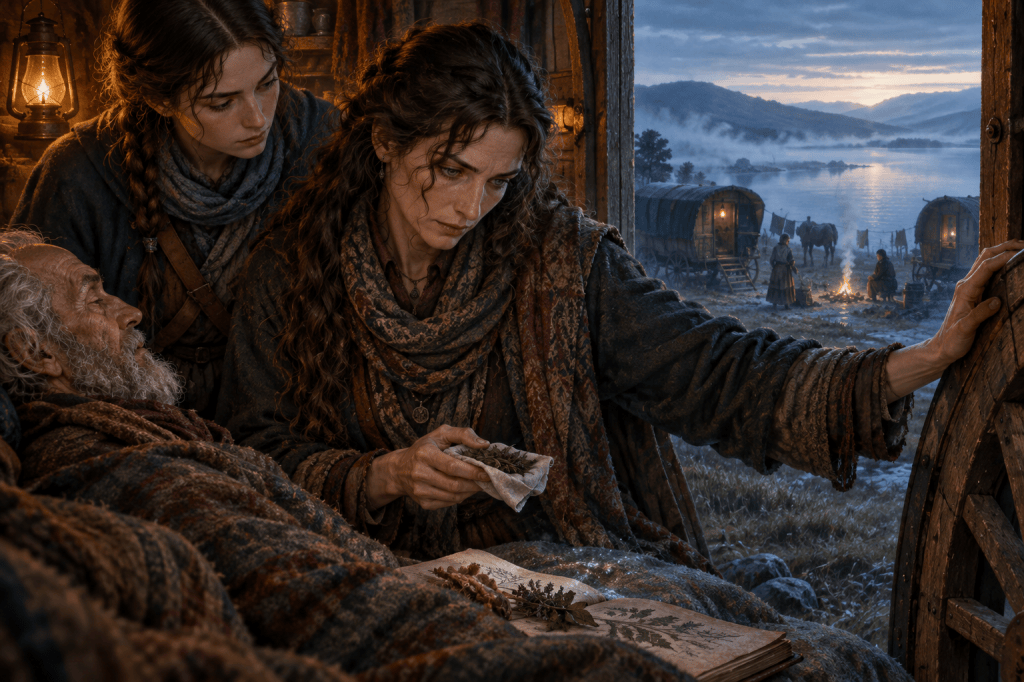
She teaches through proximity. A girl stands beside her. A patient lies before them. There is a particular body, a particular danger, and a decision that cannot be made by reading alone.
“That one’s for hearts,” she tells the girl. “Too little and he drowns where he lies. Too much and it stops him. Watch my hand, not the book.”
Healing costs her something:
When Drina stands, she needs the wagon wheel to do it. Her hands shake until noon.
Indra and Kendra face a different question: how do you make this knowledge available to more people without handing it to those who would sell it back to them?
Indra sees a route through education: teacher training, night classes, schoolrooms. Let people learn young and carry the knowledge home.
“Schools are the soft square. Nobody guards a cookery class.”
Kendra sees the flaw.
“Anything given away for free gets picked up by someone who’ll charge for it, Indra. Your father would have bought it by Thursday.”
Good intentions meet an actual classroom
By autumn 1984, the plan has reached a school basement in Glasgow.
Thirty teens—braces glinting under fluorescents—crush herbs for tinctures, the air thick with chamomile steam cutting through dinner-hall bleach.
I like that collision: extraordinary knowledge meets an ordinary room. No ceremonial doorway, no audience waiting to applaud. Just young people at tables and two women convinced they have found a way forward.
Then something goes wrong in that room.
Chamomile is a daisy. So is ragweed.
The question changes. It is no longer whether the knowledge can spread, but whether they have earned the right to spread it this way.
I wanted to leave that uncomfortable. In that basement, distrusting the powerful does not make Indra and Kendra incapable of causing harm. Holding something precious does not mean they understand every responsibility that comes with it. Being right about exploitation does not make their own answer safe.
Who owns what the dead leave behind?
Under the herbs, the manuscript and the impossible transmission, this chapter is about inheritance.
What do we owe someone whose work survives them? Do we protect it by keeping it close, honour it by sharing it, or change it so it can survive in a different world?
Miach’s cures came out of his grave. Airmid tried to keep them in order, and her father scattered them. Centuries later, Ma’am and Drina swear to put that inheritance back to work.
“Sworn, in his name,” I murmur.
“Sworn, in his honour,” the matriarch answers.
Indra and Kendra inherit what that promise sends them without ever hearing it made.
There is affection between them, and disagreement. One wants to move faster. The other wants her to look harder at the risks.
“One generation at a time,” Kendra murmurs. She doesn’t sound as if she believes it.
Meanwhile, the world has its own plans for their generosity. A copied page can travel farther than its teacher. A beautiful label can hide where the knowledge came from.
By the following Christmas, a firm in Los Angeles is bottling Celtic Herbal Wisdom at $14.99, with a harp on the label.
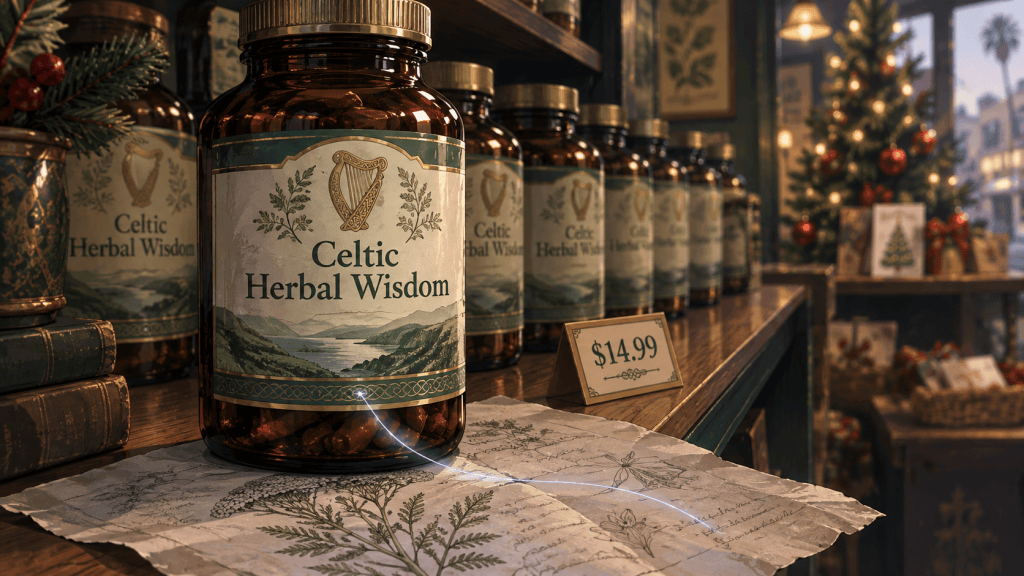
Apparently, even a miracle needs to read the small print.
A call that cannot arrive
If you are entering Quantum Gravity here, you do not need every detail of its wider mythology to recognise the human situation.
Someone has left you something important. You want to do something worthy of it. You discover that love is not a complete set of instructions.
We ring Ma’am’s line from a phone box on the corner, knowing she can’t hear us. I feed it ten pence anyway.

After all the effort to send knowledge across the divide, what they want to send back is much smaller, and much harder.
Their own voices.
The Plan Forged follows that distance: between a promise and its consequences, between the page and the hand, between those who leave an inheritance and those who have to live with it.
— I.Ph. de Lange
Copyright line
© 2026 I.Ph. de Lange All rights reserved. Published by CYcrds OÜ.

