Coffee Arrives With Double Trouble
An Azad household field note.
“Consider this step one of communication training. Lesson one: if you want to be taken seriously as my magical interlocutor, you may not smell like a crime scene.”
Cheap apple shampoo does not stand a chance against a determined barnyard reek. I want that on record before anything else.
There is a particular kind of man who appears in a doorway holding two mugs precisely when a scene has become the funniest thing he has witnessed all week, and does not bother hiding it.
Asdar has that timing down to an art form.
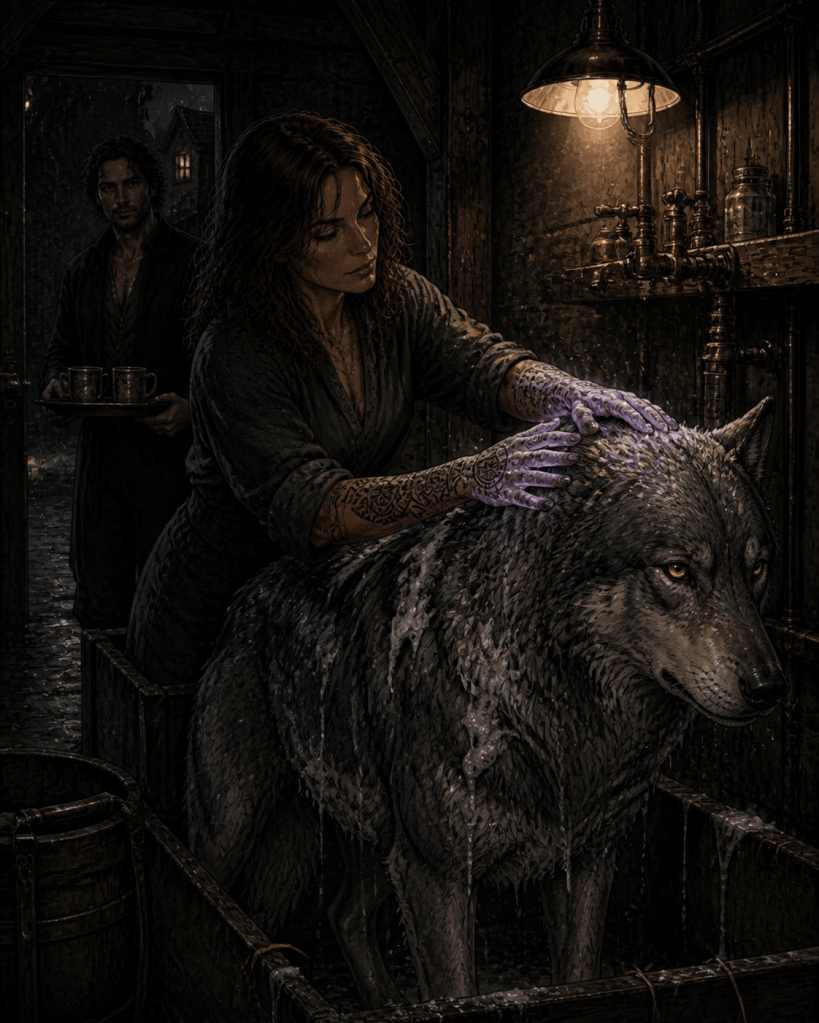
He leaned against the frame of the wash bay, tray balanced in one hand, smirk already in place, and asked me—with the studied innocence of someone who had watched the whole disaster develop—whether everything was under control.
It was not, strictly, under control.
I said so.
He did not believe me for a second. He was right not to.
Some conversations can only be had properly while one is up to the elbows in cheap shampoo suds, hosing down an enormous, deeply unbothered animal with opinions about being washed and no shame whatsoever about expressing them.
The wolf had decided that the wash box was an insult to his dignity, the hose a personal betrayal, and the shampoo an inexplicable but not entirely unpleasant ritual devised for his benefit.
Asdar had never once, in all the time I had known him, allowed a promising moment of chaos to pass without examining it from the safest possible distance.
Usually with coffee.
The Trouble With Being Watched
He has a habit—I know it is an old one, going back further than I have known him in his tangible form—of calling me things that sound like teasing and are not quite.
“My goddess.”
He said it over the rim of a coffee mug, with one eyebrow raised and that infuriating small smirk already waiting at the corner of his mouth, as though the words had cost him nothing.
They came with a hefty cost.
They had belonged elsewhere before they reached me.
That was the difficulty of Asdar: even his lightest words could arrive carrying the weather of another world. He could make a joke sound like a memory, a memory sound like a challenge, and a challenge sound almost gentle if you were not listening carefully enough.
I had learned to listen carefully.
The wolf, meanwhile, had discovered that a bath could be mistaken for devotion. He leaned shamelessly into the attention, eyes half-lidded, vast black tail making a damp and highly indiscreet sweep through the air whenever the water reached a particularly satisfying patch of fur.
Asdar noticed.
Of course he noticed.
He looked pleased with himself for noticing.
I attacked a patch of dried egg as if it had personally wronged my ancestors and pretended not to hear him.
This did not work.
It never does.
Boundaries
We agreed, in the end, that a plan was needed: for magic, for wolves, and for exactly where a tail is permitted to point while its owner is communing with forces beyond polite conversation.
“Boundaries,” Asdar said, with the particular relish of a man who enjoys naming a problem more than solving it.
I shut the shampoo bottle with more force than the moment strictly required.
“You are insufferable,” I told him.
“I am correct.”
This was unfortunately true.
One disaster at a time.
We start with his.
Author’s Note: On Reality and Truth
We are taught to treat reality as if it were a fixed country: mapped before we arrive, guarded at the borders, explained by people who claim to know where the roads end.
But much of what we call reality is only repetition. It is the accumulated force of things said often enough to become unquestioned: this is possible; this is not. You are this kind of person. Your place is here. You may go no further.
Some boundaries are real. A locked door is real. Hunger is real. Grief is real. The consequences of harm are real. We do ourselves no favours by pretending otherwise.
But many boundaries are made of habit, fear, inherited obedience, and the private convenience of those who drew them. They survive because we mistake familiarity for truth.
Truth is something else.
Truth begins in the quieter, more difficult place where we admit what we know about ourselves: what we love, what we cannot continue to tolerate, what has already ended even if nobody has announced it, what we are willing to build, and what we must stop asking permission to become.
To create a reality that is truthful is not to invent a fantasy and demand that the world obey it. It is to remove, carefully and sometimes painfully, the false structures that have kept us from seeing the life already asking to be lived.
There is courage in that removal. There is also responsibility.
Because a boundary erased in honesty is not the same as a boundary destroyed in denial. One frees us to meet the world more fully. The other merely leaves us lost.
This is one of the questions beneath Azad: what happens when a person, a story, or a world begins to refuse the limits assigned to it? What remains when the categories we relied on—author and character, real and imagined, past and present, possible and impossible—become less secure?
Perhaps reality is not the opposite of imagination.
Perhaps reality is what becomes visible when we finally have the courage to be truthful.
Irena Phaedra de Lange
Before magic, wolves, and old worlds become anyone else’s disaster, begin with The European Records.
Start the series on Kobo →https://www.kobo.com/ca/en/ebook/the-european-records
© 2026 I.Ph. de Lange. All rights reserved. Published by CYcrds OÜ.
 The Memory Cartographer