Some absences are not empty. They are still working on the world.
There is a Japanese word, yohaku (余白), often used for the expressive blank space left around an image, a page, or a line of calligraphy. It is not waste. It is not what remains after meaning has finished. The unfilled space gives shape, tension, breath, and attention to what is present.
I have been thinking about yohaku while writing the gaps in my narrator’s memory.
She has lost more than pages. She has lost the reliable border between a written world and a lived one. Characters she thought she created appear to possess histories that existed before she named them. Events she wrote in one reality have consequences in another. A pregnancy has left her body. A wolf lies beside her at night, alive but caught in a form that is not fully his own.
The blank places do not stay blank.
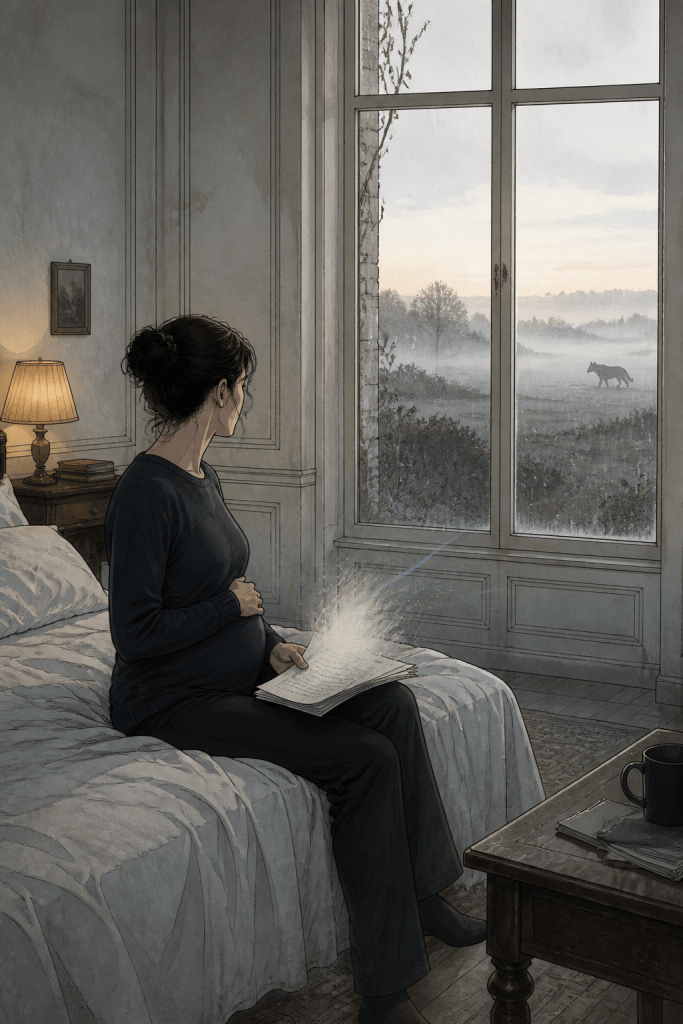
Waking alone felt wrong in all the familiar ways. The space on my stomach where his head had rested all night was suddenly cold.
Dawn had peeled him away, the way it always did — hunting hour. I could picture him out there, black against the fields, doing the uncomplicated work of teeth and instinct while I lay here doing the complicated work of thinking.
My hand went automatically to my own belly.
Empty. Not just in the ordinary way.
This is not emptiness as a simple lack. It is an active outline: the shape left by a body, a child, a remembered life, a possible future. The coldness is evidence. The missing space tells its own story.
That is the unsettling promise of yohaku. A gap can frame what surrounds it, but it can also become a doorway. If the boundary between realities has weakened, an absence may be less like a deleted file than a passage still open in the dark.
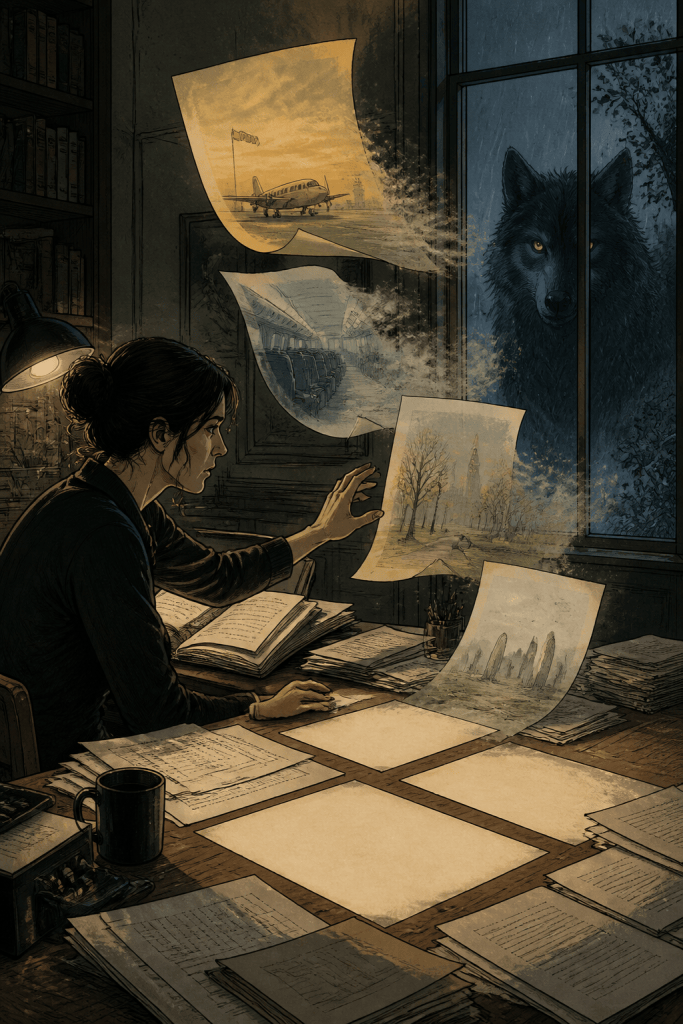
Ink on the page had stood up and walked into my life. Characters I had created in one realm were drinking my coffee in another. Whole sections of my own written past : Zavet Records, Hargeisa, the full story of Sandi becoming Louhi — slid out of my mental grasp like fish.
No copies left when I fled to Overton. A clean slate that kept failing to stay clean.
A clean slate sounds liberating until it begins to write back
The narrator wants a stable explanation: a beginning, a source, a clean division between author and character, body and vessel, this world and the next. Instead, she finds traces. The people she remembers as inventions behave as though they were always real somewhere nearby. The worlds she has visited refuse to remain politely parallel.
“Hang on,” I muttered to the ceiling. “Those are my characters. Their history. Their world. Not mine.”
The thought was not comforting. If anything, it made the air feel thinner.
Because something about it rang crookedly true: the more I wrote them, the more the world behaved as if they had always been there. As if authorship was not creation from nothing, but the act of remembering people who had always existed in some adjacent file.
For me, this is where writing becomes less about invention and more about attention. A story may not fill the blank space. It may simply show us where the blank space has been speaking all along.
The same is true of Wolfgang. His silence is not proof that there is nobody there. It is a charged interval: memory, instinct, fear, devotion, and language not yet translated into a form the narrator can safely receive.
Beings I wrote did not stay on the page. Realms I visited did not stay politely parallel.
“Pfff.” I scrubbed my face with both palms. “Well. First things first.”
Somewhere outside, a wolf was tracing invisible paths through mist and hedgerows, his mind partly open to mine now, whether either of us liked it or not.
“Before I go hunting witches, goddesses, or my own missing chapters, I learn to speak wolf.”
Not every gap needs to be filled at once. Some must be approached slowly: one channel, one memory, one signal at a time.
I.Ph.
Start the series here: Kobo, Book 1 (The European Records):
https://www.kobo.com/ca/en/ebook/the-european-records
© 2026 I.Ph. de Lange. All rights reserved. Published by CYcrds OÜ.

