Most people expect magic to arrive in clean lines—sigils, prophecies, a neat spell book. Mine arrives in bodies: milk, tattoos, scars, teeth, lullabies screamed over African lakes.
Book VI of Quantum Jump has been all about that: what happens when myth refuses to stay in the museum and starts leaking into logistics—feeding a newborn, calling in favours, booking a plane out of a war between gods and rivers.
Below is a glimpse into one of the threads we’ve been editing lately: Asdar, Karim, a blond baby boy, a python god, and the quiet, stubborn magic of people who keep each other alive.
Kalderash camp: milk and survival
In the Kalderash camp, anticipation hangs thick in the air. Asdar and Karim wait anxiously by the side of the track, the baby boy, restless in Asdar’s arms.
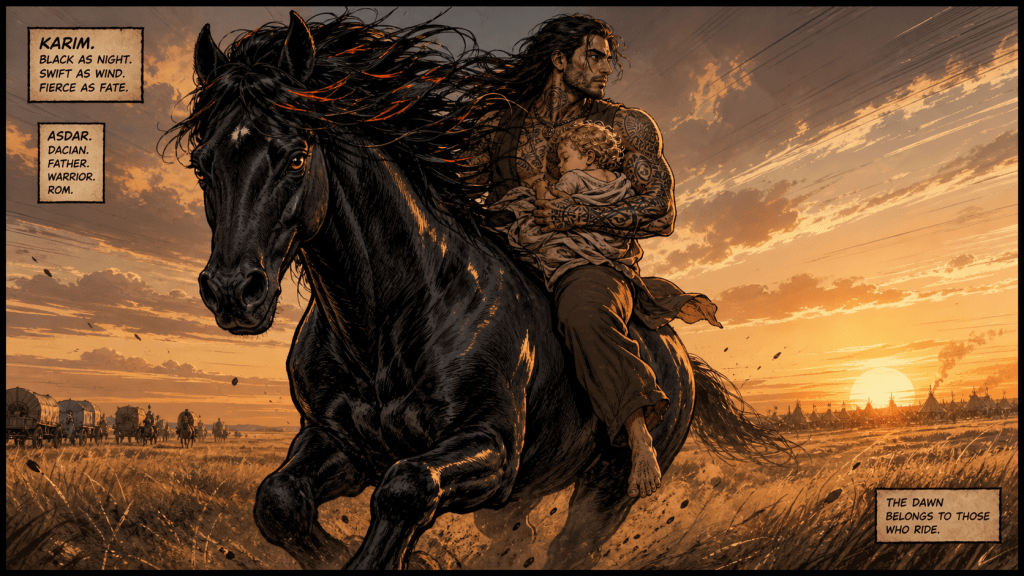
After a frantic, hungry night, they’ve managed to secure formula, but the newborn, who has already endured hours on horseback without his mother’s milk, turns his head from the bottle. No coaxing, no pleas, not even Karim’s careful hands can persuade him to feed. A thread of real fear creeps into Asdar’s voice as he murmurs to the baby, “If you want to meet your mother, little one, you have to eat—if not, you won’t be the only one who doesn’t survive.”
Before despair can settle, a gentle hand finds Asdar’s shoulder.
A young Romani woman stands beside him. “Avela mange, Asdar. Dza mande, shavo,” she whispers, her voice gentle but insistent—Come with me, Asdar. Come, boy.
Karim starts to rise, but the woman holds out a hand. “Tu te besh, na dza tu.” — You sit, you don’t come.
Inside the tent, another woman sits on a patterned rug, breast already offered to her own baby. When she sees Asdar, she lifts her gaze and speaks softly: “Dik, nai duma. Ov mange besh.” — Watch, no shame. Let him stay with me.
The first woman gently takes the hungry boy, guiding him to the other breast. “Nai korkoro, shavo,” she murmurs. You’re not alone, little one.
For a heartbeat, the baby resists, whimpering. Then he latches on and begins to suckle—hungry, desperate, alive.
Tears sting Asdar’s eyes. Relief crashes through him as he whispers, “Sastimos, phen. Soh bai, tu si amare rat.” — Thank you, sister. I am obliged, you are our blood.
He steps back out into the morning light, flushed and humbled. Inside, the camp’s old traditions quietly keep a child—and a father—anchored to life.
Identity crises in three languages and two species
Karim is on his feet the second Asdar appears.
“Well?”
“He’s feeding.” Asdar’s voice is hoarse. He flexes his empty hands once, twice. “They’re… he’s with them.”
Karim exhales hard, drops back down. “Christ, there I go again. The shifting’s turned me into a pagan. Could’ve grown tits by now, saved us needing a stranger.”
“Christian, not pagan,” Asdar says. “You’re confused.”
“Same thing when you’re a horse.”
“What do you mean I’m confused? I’m no confused horse—I’m a proud Arabian stallion, big balls and all.”
Asdar stares at him for a long moment.
“You just invoked Christ while complaining about turning pagan, then defended your manhood by referencing your horse genitals.”
“Your point?”
“My point is you’re having an identity crisis in three languages and two species.”
Karim considers this, then shrugs. “Fair.”
Around them, the camp moves at its usual pace—children darting between caravans, an older woman stirring something over a cook fire, the smell of coffee and woodsmoke. No one stares. No one asks questions. They simply… allow.
From inside the tent comes the faint sound of an infant feeding—not crying anymore, just small wet noises and the low murmur of women’s voices.
Golden milk, wolf hides, and an archangel’s problem
Asdar and Karim settle just outside the tent, relief making them both boneless.
“At first, I thought Africa gave me the gift,” Asdar says. “The strength to wear the wolf’s hide and walk the plains. I was raised with rituals, prepared for the priesthood since I was a boy. We honoured the wolf, I got the tattoos. But I never truly shifted until I drank that golden milk.”
Karim goes very still. “She always called me her Arabian stallion. I thought it was just teasing.” His voice drops. “The first time I was truly separated from her, I shifted. And I’d been drinking her milk, too.”
The silence between them stretches taut.
Elena’s magic—older than anything Mikhael brings—has changed them both. If he is truly an archangel and her milk carries power from before gods had names, maybe his flight wasn’t enough. Maybe the old magic tangled with his wings, crossed wires with whatever passes for physics in angel bones. Maybe their escape went somewhere even angels can’t predict.
If her milk changed Asdar and Karim, what could it do to an archangel?
Planes, wet nurses, and the long way to London
Eventually, the “borrowed” phone bleeps:
Landing at Air Force Base Makhado at 1400 hours local time. White van by the eastern hangar. Stay sharp.
Asdar looks up at Karim, who exhales heavily.
“That’s our ride,” Asdar says. “Not much time.”
“Harry’ll meet us there,” he adds. “The Kalderash elder’s bringing that old van, so you won’t have to shift mid-trip or carry me and the boy on your back again.”
“Thank God for that,” Karim mutters. “I’m still burping grass from last time.”
Farewells are short but heavy: elders’ nods, women’s bundles, children’s wide eyes. A mother asks, What are you calling him?
“I don’t know yet,” Asdar admits, looking down at the sleepy blue eyes. “But we will soon find out.”
Later, on the stairs of a chartered plane, Harry Boswell grins at them, big and ruddy and unexpectedly soft when he sees the child. Esme, the wet nurse, takes the baby and latches him on with practiced grace.
“Wow, that’s what I call a popular welcome,” Karim murmurs.
They lift off from Africa into the afternoon sky. The land of the Python shrinks beneath them—where they have wandered, wondered, worried, and warred. Above, the engines hum softer than expected; inside, milk and metal and old favours all do their quiet work.
“Ha, the land of the Celts,” Karim exclaims hours later, green eyes bright as the Thames glints below.
Asdar snorts. “There’s a first time for everything. Hold on to your breeches.”
Karim glances at him sideways. “What if I betray your trust someday?”
“Trusting you is my choice,” Asdar says. “Proving me wrong? That’s yours.”
They share a crooked grin and, because some habits never die, make the Vulcan salute.
Why I’m sharing this
This slice of Book VI sits where myth, logistics, and found family collide:
- A child’s survival depends on Kalderash women who don’t ask too many questions.
- A pair of shapeshifters realise their bodies were rewritten by Titan milk.
- A very practical Anglo gangster (Roger Boswell) pays off a control tower so a python god’s war doesn’t swallow everyone whole.
If you’ve travelled with Elena and Mikhael this far, you already know: the magic here isn’t clean. It leaks. It stains. It leaves people burping grass and arguing about theology in three languages.
If you’re new and somehow started at Book VI… you’re brave. Welcome.
I.Ph. de Lange
© 2026 I.Ph. de Lange All rights reserved. Published by CYcrds OÜ.
 The Memory Cartographer