The Day My Angel’s God Didn’t Exist Yet – Book VI Quantum Jump
This is an excerpt from my in‑progress novel: a sardonic anthropologist, an ex‑KGB archangel, and a sideways fall into the Bronze Age steppe, where the body and the cosmos argue through milk, blood, and hooves.
Context: Elena has just fallen into a world that looks suspiciously like Yamnaya territory. Mikael—the archangel—finds himself out of contract with a god that hasn’t been invented yet.
I walk over open land that stretches without end. Grass grows knee-high, yellow-green under a wide, blunt sky. Low paths of packed earth run between hollows dotted with herds—horses, goats, cattle—moving slowly, heads bent to graze. The air smells of dung and sun-dried grass, smoke from distant fires carried thin on the wind.
A cluster of shapes breaks the horizon ahead: huts—low, mud-dark, half-buried, roofed with hides and reeds. Smoke climbs from small pits at their centers. Dogs bark, thin and sharp. People appear, first as silhouettes, then as solid forms—broad, sun-burnished, wrapped in fur and woven cloth. Children trail behind women who haul clay pots, the slosh of water marking rhythm against the wind.
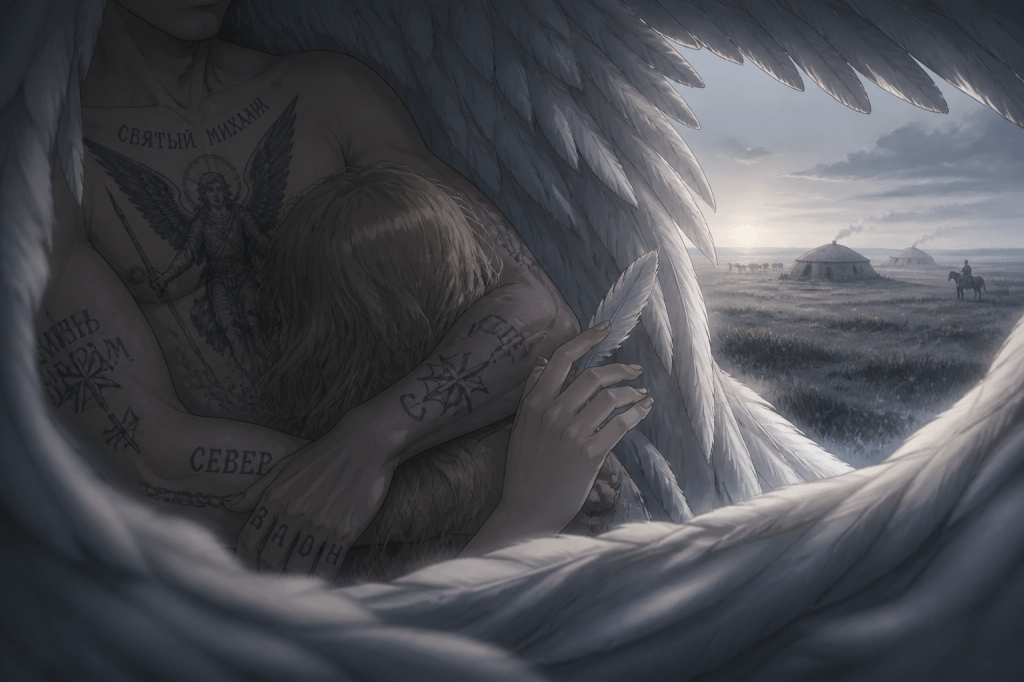
Mikael walks beside me, tall, bare, silver-eyed, his skin patterned in black lines and beasts. His hair is cropped short and pale, his muscles drawn tight in the cold air. I’m aware of my own body—the pull of my long hair in the breeze, the stickiness of golden milk drying on my skin. Naked, unhidden, we must look unreal together, too pale, too strange.
As we approach, movement stills. A herder straightens, resting a hand on his staff.
A woman murmurs, “Who comes, naked like gods?”
Another voice, low and wary: “Milk shines gold—woman glows like sun.”
“Marks on man’s skin—war signs, not our kind.”
“Eyes of water… eyes of storm… what omen this?”
Their language is simple, hard-edged, consonants striking like stones—clipped breaths, short sounds, vowels stretched like the land itself.
I don’t understand the words, yet I feel their meaning. Suspicion. Curiosity. Fear.
An older woman steps forward, ochre streaked on her cheeks, strings of shells and teeth at her throat.
“Speak,” she says, voice rough from wind and firesmoke. “Why come naked? What you bring—curse, storm, or gift?”
The circle tightens around us. Their eyes move first to Mikael—his height, his unfamiliar markings, the silver flash where his eyes catch the light—then to me: hair like wheat, skin pale as bone, golden traces across my chest. I stand still, feeling their gaze move over me, heavy and ancient, weighing what I am.
Goats bleat. A horse stamps, snorts.
The smell of fire and wet clay thickens.
Mikael leans in, his voice low, his accent clipped. “We no threat. We cold. We find clothes.”
The words make them pause. Murmurs ripple out again. They look back at us—not with peace, but with the wary patience of people used to reading omens in the bodies of strangers.
He places his hand flat to his chest, then spreads both hands wide, palms forward. He bends slightly, points to my bare arms, rubs his own skin, shivers, pantomimes pulling something over his shoulder—cold, need for clothing.
We stand awkward and exposed in the center of the settlement.
My nerves make me giggle. I yank Mikael’s hand and whisper, “Show them your wings.”
He shakes his head, not meeting my eyes.
“Not good. Make invisible.”
I blink. “Say what now? Since when do your wings do that?”
My voice comes out too loud, too quick. Mikael just squeezes my hand, his own words clipped.
“любовь, stop talking. Please.”
I catch the stares—women, men, even children—all looking at us. Two naked strangers. Mikael gestures at me: points to my breasts, golden colostrum still dripping; curves his hand around my belly, pantomiming pregnant. No need for words.
The oldest woman steps forward and says something hard and rough—voice low, consonants crushed tight. She glances over us, then snaps a command to younger men.
Their reply is quick: “Woman gold, man mark. Need cover.”
They vanish into a hut and return with wraps of brown wool and leather, eyes still wary.
I exhale, hands trembling.
They dress us in scratchy wool tunics and rough leather wraps. We’re led to the fire—smoke rising, goat bones charred black in the flames. Elders gesture for us to sit. Someone offers me a shallow bowl: steaming chunks of meat, sharp-smelling white milk in a half-baked cup. I accept, grateful. The meat is gamey, salty—goat, maybe, though my tastebuds falter. I eat and drink, hungry.
Mikael refuses, jaw set, eyes hard. He sits close, protective, his arm wrapped around me.
The people watch, muttering quietly—words clipped, rolling, rhythmic. Their eyes keep flicking to the gold stains on my tunic.
Night falls. The older woman beckons. I follow her into a low hut. Inside, the space is dark, smoky, alive with breathing. Women lie together in a loose heap, bodies pressed close for warmth, some curled on their sides, others flat on their backs under heavy hides. The only light comes from the glow of embers at the center, shadows moving across rough faces and tangled hair.
I curl up between them, listening to their breathing, staring at the hides above me.
I settle in, feel the chill of the ground underneath, fur against my skin, the press of strangers on either side. My body remembers fieldwork in jungle villages—bamboo walls, hammocks and mats, the always-damp heat, children piled together for comfort. In those tropics, everyone sleeps touching, the night thick with insects, voices, laughter. Cow dung burned for smoke, half-dreams filled with frogs and drums.
Here, it’s all different. No humidity, no insect drone, no green. The air is bone-dry, prairie-cold, the soundscape reduced to breathing and the grumble of someone’s stomach. No one whispers stories or sings—just sleep, survival, the collective warmth of bodies. I scan for clues: hides, coarse woven cloth, a small bundle that might be dried cheese or millet, a baby strapped to someone’s chest.
It’s a strange fusion—communal sleeping, yes, but in a land that’s flat, harsh, raw-edged. No beds, no platforms, no walls to divide or soften the space.
I think of Central Asian yurt camps, the open huts of the Nilgiri hills, the Mongolian steppes where women huddle under fur coats beside the fire, whole families sharing heat.
Slowly, it seeps in: this feels older, rougher, pared down to absolute need. Subsistence, not comfort. Drift of animal scent, tang of metal and milk, the outline of a life that hasn’t changed for thousands of years.
The knowledge lands hard—this looks like the Bronze Age. Not a modern village at all, but a living fragment of another epoch.
My mind circles: where am I, what time is this, and how did I fall so far through the layers of the world?
Another cosmic joke of bad taste, me on the receiving end.
Later, in the dark, Mikael finds me. He’s silent, silver eyes glowing. He pulls me away from the other women, lies beside me, wings wrapping around us both.
He kisses my forehead, breath hot.
“Allow me, please.”
My eyebrows shoot up. Allow what the fuck?
Before I can protest, he latches onto my nipple, drinking with feverish urgency. The shock almost makes me shriek. He repeats the motion on the other side. When he stops, breath slowing, I glare.
“If you’re this hungry, you know you could have eaten the food. It wasn’t that bad.”
Mikael shrugs, face unreadable. “Need… magic more power than divinity.”
He leaves the hut, and I try to get comfortable on the hard earth beneath the tangled hides, the warmth of sleeping bodies pressing in.
Easy sleep: impossible. My mind spins—soft wings from my ex-KGB archangel, gold milk, strange land. How ridiculous has my life become?
Suddenly the voices start marching in my head.
Mrs H first, crisp and British: “Well, my dear, what did you expect, jumping around Africa pregnant?”
Nina interrupts in rapid Spanish: “Rubia, ¿cuándo vas a aprender?”
Roger Boswell follows, voice all gruff care: “Darlin’, all will be ticketyboo.”
Their accents and worries tumble through my mind, each chastising, each trying to comfort.
I roll my eyes in the darkness as Roger’s voice blurs last. The familiar chorus settles, half real, half dream.
I finally drift toward sleep, my anthropologist’s brain muttering its own question: Where on earth am I—and how did I end up exactly here?
Around the huts, goats graze and horses paw at the grass. No fences, no boundary, no hint of any female statues. Everything is open, shifting, ready.
“I have to pee,” I mutter.
Mikael nods. We walk out together, Mikael just a step behind. I’m glad—he understands I need to be seen, need to look in control.
As we return, a sudden commotion breaks—voices, sharp and layered. The women have come back; they’re shouting at each other, the eldest clutching a limp child whose head dangles backward. She gestures toward me, desperate.
Mikael starts to move in front of me, protective by instinct, but I catch his arm and make him pause. He hesitates but, at my touch, holds back.
I step forward, hands open, palms out in the oldest “I can help” sign I know. I point to the little girl, pantomime cradling, gesture to my breast.
Mikael rumbles low—a warning in Russian. “Действие, реакция, любовь моя.”
Action, reaction, my love.
“We need action,” I whisper back.
The women argue, voices rising—fear, hope, suspicion all wound tight. Then Mikael lets out a sound—low, unearthly, unmistakably not human. The argument breaks; even the men stand and shift as if ready for a fight.
The eldest woman doesn’t flinch. She steps forward and hands me the child, trusting or resigned.
I kneel, pull out my breast, press the nipple to the girl’s mouth. At first, nothing—her lips slack, her body limp. I hold my breath. Then, just as the seconds start to drag into eternity, she latches on and starts to drink.
Slowly—almost imperceptibly—color creeps back into her cheeks. Her eyelids flutter, then open.
A ripple of murmurs swells through the camp, quiet at first, then spreading—a tide of awe and uncertainty pulling everyone closer.
I see goats still wandering the edge of the huts, heads down, chewing. I hide a tired grin.
Well, I beat you there, Bella the goat.
My other breast starts leaking heavily. Mikael mumbles, “Hungry and can’t eat, you feeding the locals.”
“There’ll be enough for you if you stop moping. But I have to do something—unless you’re about to fly us out of here?”
After the little girl is steady on her feet again, they keep bringing me more children, all sizes. I notice they’re all girls. I just hope I’m in time for each of them.
Night falls. My stomach growls. I could eat a horse—if it wasn’t that I’d prefer to ride them. Luckily, they bring me food. They offer some to Mikael too; he gives me a look and I nod: yes, I still have some for you. He refuses their offer.
The night deepens. Women come and go through the hut—judging by the sounds in the darkness, I guess it’s mating season. Mikael slips inside again, wings curving around us. He nurses hungrily, then sighs, satisfied.
He asks, in Russian, “Why?”
“Zugzwang,” I mutter.
He shakes his head. “I abhor it—and worse, being a toy for ungodly goats…”
I grin. “Listen. I know you tried to keep me safe at the lake, but my magic interfered, right?”
He nods once.
“So now we’re here, in the Bronze Age, and if I’m calculating right—these are Yamnaya people.” Mikael just stares, silver eyes unblinking. “Reckon your KGB training didn’t cover that, nor your crash course in angelic intervention.”
He still looks lost.
“Let me spell it out: you crave my milk because your god hasn’t been invented yet. You’re not just an outlier—you’re out of your cosmic contract. You, Saint Michael, are cheating the system.” I smirk. “If I want the cosmos to throw us a bone, I keep lobbing facts until something changes. Cause and effect, featherboy.”
I pause, then grin wider. “So, if we want to get the cosmos to react and improve our odds, I’ll just keep tossing out facts until the universe picks one and sends us a sign.”
A new idea sparks. If I really want to change history, I need more than miracles.
“I’m going to teach the women how to ride,” I say, reckless.
Mikael sighs, long-suffering.
He mutters in Russian, “Занимайтесь любовью, а не войной.”
Make love, not war.
I shoot him a look. “Come on, featherboy. If we want matriarchs riding into legend, we have to shake up the whole steppe, right?”
He only shakes his head, lips twitching—resigned, curious, maybe a little impressed.
The next day arrives way too early. I’m really getting too old for this shit—sleeping on the ground. Mikael, fresh as a daisy, really irks.
“Go make yourself useful,” I mutter. His grey eyes say everything he doesn’t bother to.
“Sorry, but I really want a shower and a bloody porcelain toilet—with toilet paper. Best invention ever, I realize.” I grumble, half to him, half to myself.
Then my brain clicks: water. That’s it. If I’m right, these people will soon cross a body of water—the Volga, maybe the Dnieper, even the Black Sea. And what haven’t I seen among their tools?
Mikael just stares, waiting for the revelation.
“A fishing rod, ha!” I announce, hopping from one foot to the other.
“So that’s what you, Mr Saint, are going to do today. Meanwhile, I’ll try my luck with one of those scruffy four-footers. Besides, a bit more dust in my fanny won’t kill me.”
(I hope.)
© Irena Phaedra 2026. All rights reserved.
Please do not reproduce this text elsewhere online without permission. You’re welcome to link to this post if you’d like to share it.
 The Memory Cartographer