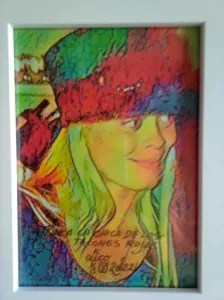
Daan de Vylder
’98.
Eight months back in the country where I was born. Not the coast—no bridges, no coffeehouses, no salt on the windows. A border village instead. Meadows, woods, a low sky that made everything feel provisional.
I was in a one bar- town. For men.
Jan had redone his backyard in honour of my mother’s visit.
I came home one afternoon to find garden furniture in my backyard, as if the house had quietly decided to become hospitable in my absence. The rest of those days—clinics, hospitals—I won’t unfold. They sit behind everything like a low hum.
My housemate and keeper, Inez, had arrived from Spain to help with school runs for Aikira.
My daughter had learned to bike.
Inez had learned to run—not to keep up with her, but to keep the angry geese at bay. They considered the pond and the paths entirely their own. It was a ridiculous sight: geese nearly a metre tall, and Inez maybe fifty centimetres above that, sprinting with actual fear in her eyes. Later I taught her to ride a bike. The geese still bit her.
The local culture councillor asked if I would make a sand sculpture for Christmas. In the east they had never seen such a thing; on the west coast they held real competitions. I said yes. The shopkeepers sponsored me—a wooden shack, spatulas, knives, the basic tools of a temporary cathedral.
The result: television, newspapers, interviews. Familiar strangers pointing cameras at an unfamiliar stranger.
One interviewer had to reschedule. The war in the Balkans was more important than my sand Madonna. Of course it was.A few days later he arrived unannounced.
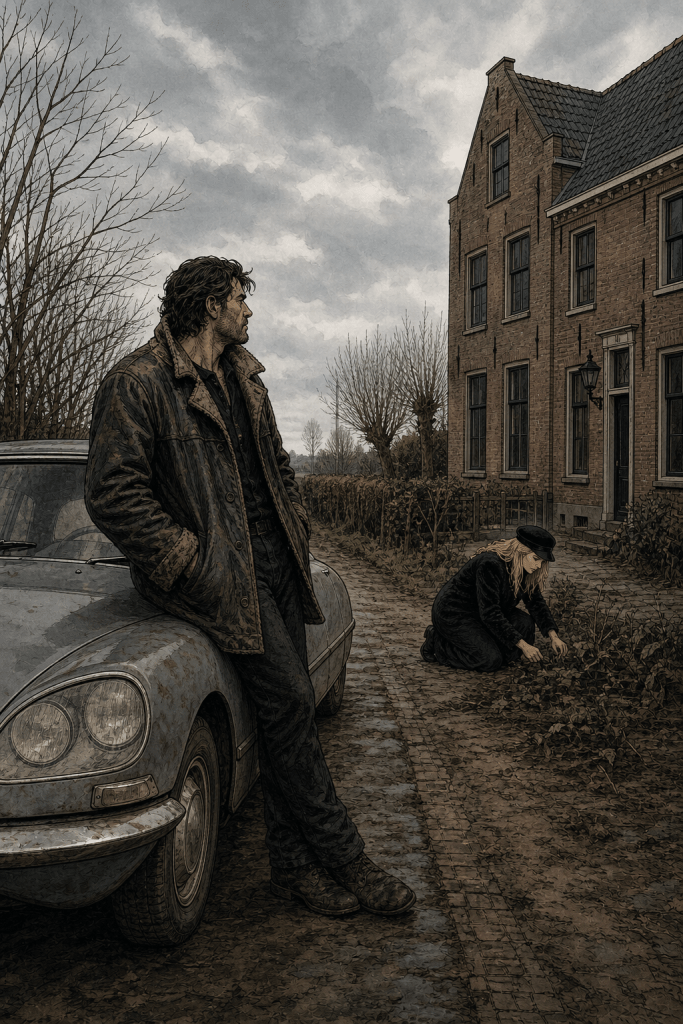
I was on my knees in the garden, trying to bring some order to the hedge, when a battered Citroën bumped almost straight into it. Out stepped a big, rugged man in a leather jacket as old as the car and cared for with the same indifference. He introduced himself. While I washed the earth off my hands, he sat on the couch and calmly read my diary. It lay there closed; he was undaunted.
The interview happened anyway. Afterwards he told me he liked my flowery writing. He was what they call in journalism a woordsmid — a word-forger. That was the best he could do.
Then he asked if he could take me out somewhere with decent music.
So we went from writing to wrenching.
I discovered he was still married—and, more to the point, still living with his wife.
That added another layer of drama on top of a life where drama was already standard issue. It doesn’t compare, of course. The theatre around an affair is nothing beside the theatre around a child who has almost died more than once, or the daily grind of people born with bodies that don’t match the script they were given. Most parents don’t become broader in their thinking, or more generous, because of suffering.
I understand. Watching someone else obtain what you begged for and didn’t get flattens every note of harmony.
I never learned how to protect myself from hatred and envy. The days in clinics and hospitals were exhausting because I had to play both hands at once. The cards were, at best, bottom-dealt.
In Spain I could walk in and out of the ICU as I pleased, unlike other parents. I had argued with the director and the head of the team until they conceded. I’d made a tape, my own voice singing to the neonates.
In the Netherlands I managed to convince them that Liam deserved more, and better, and that he was worth the budget risk.
Maybe that was the excuse I used to keep the affair alive even after his wife called me, told me the truth, with him shouting I LOVE YOU in the background. Maybe it was the sex—shameless, necessary—or maybe it had to do with the father of my son, who was busy living the high life in Indonesia and wherever MotoGP happened to be that weekend.
After three years and a small advert—no meaningful change for my son—I decided to take my little family back to Spain.
My son never saw Spain again.
The writer did see me again, twenty-four years later.
Again married.
Again in search of the only kind of connection he needed — the kind that cannot be negotiated or purchased, the kind his mother had given him, and his best friend. Both gone.
Journalist, technically. Acronym by habit. He had proposed to me once; I had declined. He took this personally enough to reconstruct his life around someone else — a woman who could pass for my echo in the sound register — except where I refused, she manoeuvred. He boasted about the house, the money, the things he had accumulated. At the airport he cried.
Some people never stop running into fences. Some of us just learn to name the wire.
I.Ph.
© 2026 I.Ph. de Lange All rights reserved. Published by CYcrds OÜ.

