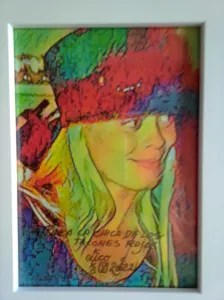
Readers who walked with Mikhail through the medina will remember the question he was left holding: a daughter lost between worlds, and what became of her. I will answer it here. But bloodlines travel further than the people who carry them, and they wait to be recognised.
在丹吉尔老城里与米哈伊尔同行过的读者,一定还记得他留下的那个问题:一个在世界之间失散的女儿,后来怎样了?我不会在这里回答。但血脉走得比承载它的人更远,然后静静等待被认出。
“Later, when Sandi was in Pretoria, in the refugee camps, she met a woman named Mpho. Brown skin, startling blue eyes. Seven daughters, all with those same impossible eyes.”
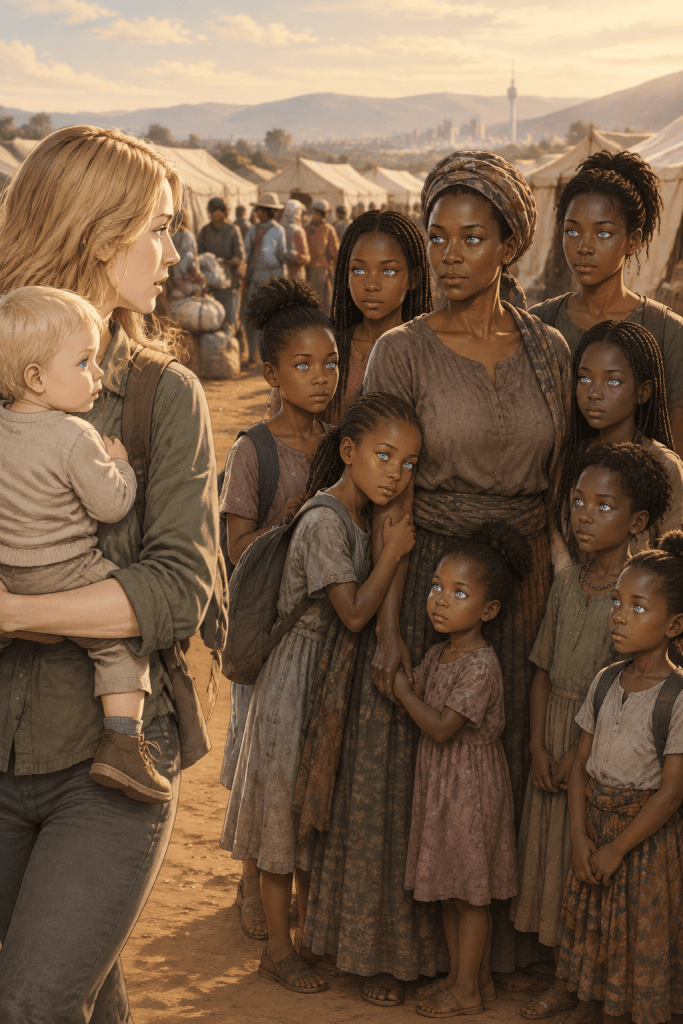
A woman in the camps
Sandi is carrying someone else’s child when she sees them. A camp in Pretoria, dust and queues and canvas, the long patience of people who have lost their addresses. And among them a mother with brown skin and eyes the colour of winter water, and seven daughters standing around her with the same eyes, as if one pair had been copied seven times and set into seven different faces.
It is the kind of thing you notice and can’t explain, so you carry it with you.
The generation poem
Many Chinese families keep a 家谱, a genealogy recording their lineage across generations. Some also preserve a generation poem: a sequence of characters used, one generation after another, in descendants’ names. The shared generation character is called 字辈. Traditionally, these characters were most often given to sons, though some families used them for daughters too. Within the same lineage, a character can tell you where someone stands in relation to you.
Two strangers comparing names might discover that they belong to the same family story. The genealogy supplies the connection; the names offer the first clue.
The poem outlives everyone who wrote it. A name becomes a small piece of memory someone can carry without knowing who will recognise it.
A name carried forward / 名字里的传承
有人把家族的记忆写进名字,一代传给下一代。
姆波的女儿们没有这样的字辈。她们有的是同一种蓝色的眼睛。
一个写在纸上,一个长在脸上。
相认的那一刻,陌生人便不再只是陌生人。
Some families write their memory into names and pass it from one generation to the next.
Mpho’s daughters have no such generation characters. What they have is the same blue in their eyes.
One is written on paper; the other lives in a face.
At the moment of recognition, a stranger is no longer merely a stranger.
What blood remembers
In much of southern Africa there is a similar habit. People meeting for the first time may recite their clan names, line by line, until they find the ancestor they share. Then the conversation changes. The stranger becomes a relative, with all the obligations that brings.
Mpho’s daughters carry no poem and recite no clan names. In this story, their eyes become another kind of inheritance: a resemblance someone might recognise before understanding what it means.
Not proof on their own. A clue. The beginning of a question that will soon be answered.
Long before this meeting—or long before it by the calendar’s reckoning—Elena and Mikhail had a daughter in Kaapstown. The universe had slung them there, then thrown them through time again after the birth. They never got to embrace their child.
But the daughter they could not hold grew up. She became Mpho’s great-grandmother. A life Elena and Mikhail were torn away from continued without them, generation after generation, until there was Mpho, and around her seven daughters with those same impossible eyes.
Now Sandi stands before them with another of Elena’s children in her arms: the baby Elena had with Tarmo only a few months earlier.
“Elena didn’t know it at first. She just felt the pull. Later, the pieces clicked.”
原来,自己的亲人,也可能是从未见过的陌生人。
It turns out that your own family can be strangers you have never met.
[Start the series here →]
© 2026 I.Ph. de Lange, published by CYcrds OÜ

