To call someone home from myth, first you must face what the story has done to them.
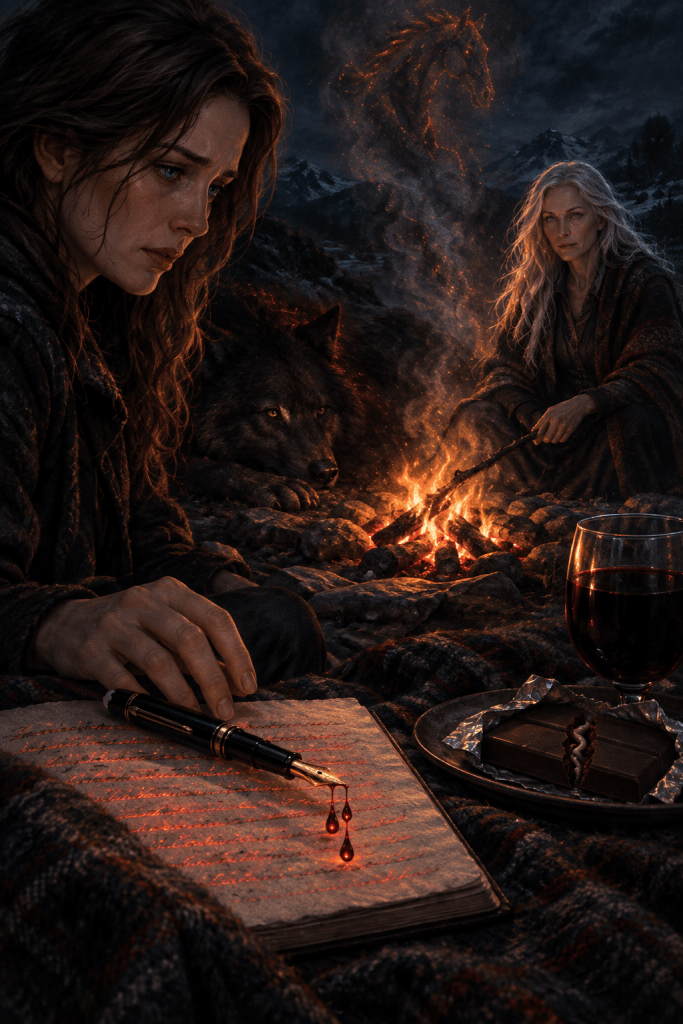
From Quantum Gravity — a field fragment about memory, myth, and the cost of calling truth through fable.
The Wolf Waining
Drina’s eyes flick past my shoulder.
“And Wolfgang?” she asks.
I turn.
Behind me, sprawled in the dying reach of the fire, the great black figure lies half-curled, his breath steady, his massive chest rising and falling without sound. Wolfgang has settled just beyond my reach, as though he has always been there, listening. His coat catches the emberlight in low, subtle waves: dark red beneath the black, a shadow remembering the warmth of a man.
The question lingers like smoke.
What of him.
“He’s watching,” I say at last. “He knows I’ve been rewriting her. Maybe he wonders when his turn comes.”
Drina holds my gaze. “It isn’t wonder, child. It is waiting.”
Wolfgang’s ear shifts once toward her voice.
“He remains bound while you remain divided,” Drina says. “Half your words belong to myth. Half belong to memory. He has nowhere whole to stand.”
I look at the wolf again.
“I thought freeing Louhi meant freeing him too.”
“You still speak of Louhi.” Drina’s voice softens, but its weight does not. “You mean Sandi. The name you gave her was never a gift. It became a cage—for her, for you, and for all that gathered around the story.”
The fire cracks.
Wolfgang stirs. One amber-gold eye slides open.
I meet it, and for a heartbeat I see the man beneath the wolf: curious, patient, unbearably gentle. Not a monster. Not a symbol. Not even a question waiting for my answer.
A person watching me decide whether I can bear to see him.
“He hears you,” Drina murmurs.
“I know.” My voice has gone thin. “That’s what frightens me. If I name him now, if I truly see him, everything I’ve written collapses.”
“Or becomes real.” Drina turns the burnt end of a branch between her fingers. “That is the risk of mercy. It redraws reality.”
The air shimmers faintly. The paper in my lap seems to breathe with the pulse of the red ink.
Wolfgang exhales.
The sound is almost human.
My fingers tremble over the Mont Blanc.
He does not move again. He only watches me with that one open eye, patient as a door left unlatched.
I turn back to the notebook.
The Cost of Return
The fire has dimmed to a red circle, steady and low. I sit before it with the notebook open on my knees, the Mont Blanc held between both hands.
The air thickens as I begin to write. My voice threads through the ink, each syllable trembling somewhere between invocation and apology.
“I call you not as the myth,” I say softly, “but as yourself. Come as Sandi—the one who laughs between pages, who drinks cheap wine and mocks my endless drafts. Come whole. Unbound from the witch I made of you.”
The pen bleeds red across the paper.
For one breath, everything holds.
The camp is silent. Wolfgang is still. Drina’s face is washed in emberlight, calm and grave. The boundary thins, and I feel it—not a hand, not a voice, but a familiar warmth grazing the edge of my sight, like someone standing just behind a curtain.
Then the smoke changes.
Something sour moves beneath its sweetness.
I stop writing.
Drina’s eyes shift toward the small plate beside the fire. A half-unwrapped bar of chocolate lies where we left it after our meal. Its surface trembles.
At first, I think it is only heat.
Then a crack opens down the centre.
The smell reaches me before I understand what I am seeing: wet earth, old cupboards, something sweet gone animal. My stomach tightens.
Pale bodies work slowly through the split chocolate, blind and glistening in the orange light.
A sound escapes me—not quite a gasp.
“What did I do?”
Drina does not answer at once.
Beside the plate, the wine has thickened in its glass. Its crimson has clouded to something duller, older. The scent of metal touches the back of my throat.
“The sweetness curdles when the veil thins,” Drina says at last. “Nothing crosses worlds without shedding something.”
I look down at the page.
My words still shine faintly in the red ink, as though they have begun to doubt their own meaning.
“I called her true name.”
“Yes.”
“Then why does it feel wrong?”
“Because you opened a door built for story,” Drina says, “and asked truth to come through it.”
The pen has grown heavy in my hand. Not with magic exactly.
With consequence.
Drina rests one hand on my shoulder.
“You bring truth through fable,” she murmurs. “Fable can shelter truth. Leave it there too long, and it rots.”
The air presses close around us. The chocolate moves. The wine darkens.
Beyond the firelight, Wolfgang gives a low, uncertain growl.
Not at the darkness.
At something moving toward us through it.
Quantum Gravity follows the unstable border between the stories we invent, the people we remember, and the truths that refuse to remain safely fictional.
The fire has opened a passage. Sandi may be close enough to answer—but something else has found the way in.
Start the series here →https://www.kobo.com/ca/en/ebook/the-european-records
© 2026 I.Ph. de Lange. All rights reserved. Published by CYcrds OÜ.
 The Memory Cartographer