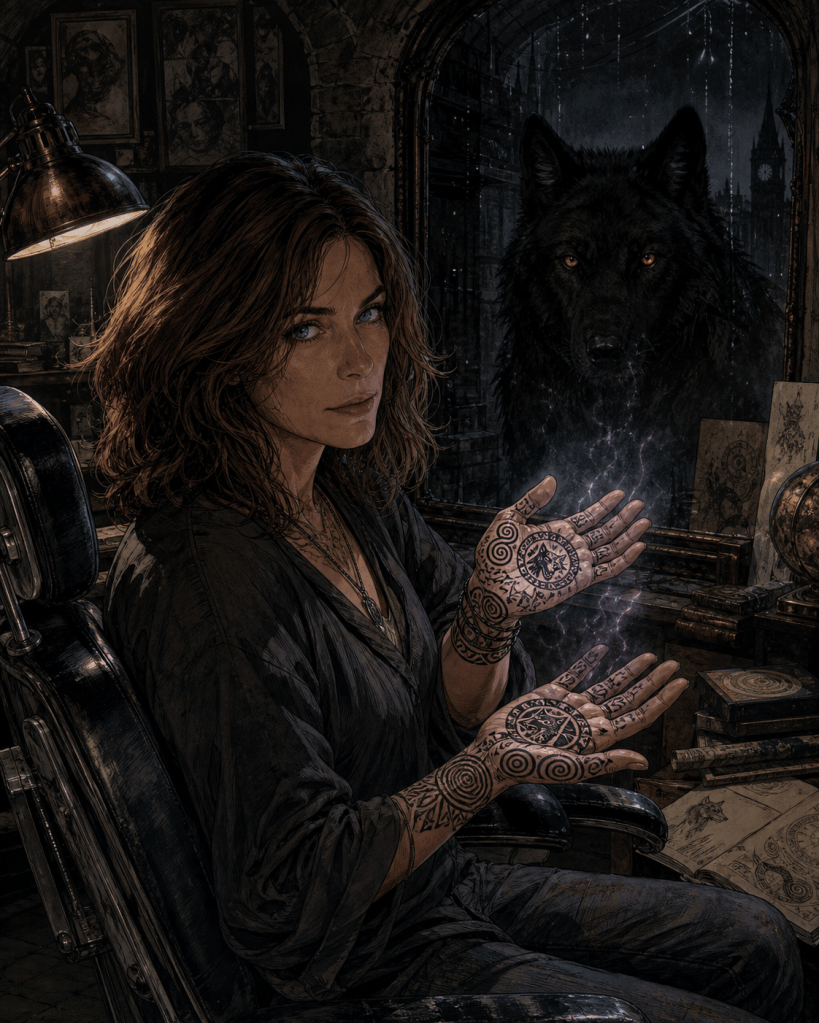
“A design inspired by the Dacian Draco: a wolf-headed, serpent-bodied standard that survives in Roman-era depictions.”
Green Book on the Third Shelf
The shop is not on any map Django admits to using.
Two turns off the main road, through a lane that smells of fried oil and wet cardboard, then down a flight of stairs that should legally belong to a boiler room. A bell tinkles over the basement door.
Inside, it is small, clean, and unapologetically old. No neon skulls. No glossy flash sheets. Framed photographs of men who look as though they lost wars and won duels. One glass case holds books instead of jewellery.
The man behind the counter looks up from his newspaper. Grey braid. Faded animals and stranger things running the length of both arms. Django calls him Maestre, with the particular respect reserved for dangerous people and very good mechanics.
“Hands,” I tell him. “Old symbols. Dacian, if you have them. I need connection. Protection. Translation, I suppose.”
One white eyebrow rises.
“You suppose.”
I am in a hurry, and aware that I sound mad even for London. But the idea has been pulling at me since the motorway: words will not reach someone caught between fur and speech. A note will not help. A phone will not help. I need another interface.
Whatever happened in Hyde Park after Wolfgang left Paloma, caught between fur and skin. I do not yet know who set the binding—or why it led him to me.
The Maestre points to the glass case.
“Books. Third shelf. Take the green one and the thin brown one. Mark what calls to you.”
The green book is Romanian and something older still. The brown one is almost all drawings: wolves, spirals, knotwork like frozen wind. I do not read the words. I let my fingers hover above the pages until something tightens beneath my ribs.
Interlocking spirals. A wolf’s head inside a broken circle.
“These,” I say. “Palms and backs of the hands.”
He studies me before he begins.
“You know what they were for?”
“Vaguely. Binding to ether. Speaking to what does not speak back. Walking between.”
“Good enough.”
The needle begins as pressure rather than pain. Ink enters skin in slow, deliberate lines. The symbols do not make me a wolf. They do not promise an answer. They mark a decision: I will no longer wait for the unseen to choose the terms of contact.
“These won’t make you talk to a wolf,” the Maestre says, tracing a spiral before the needle bites again. “But they will mark you as one who can knock on that door without being eaten immediately.”
“Good,” I tell him. “Immediate eating would be inconvenient.”
He nearly smiles.
When the work is finished, my hands look both entirely mine but feel not mine at all. Maps over maps. Palms turned into talismans. Under the sting of fresh ink, something hums: not a voice, not yet, but the beginning of a line.
“When you touch him,” the Maestre says, “think of nothing else. No words. No questions. Just the line between you.”
Then he gives me the sentence I will carry out into the wet London afternoon:
The hand remembers what the mouth forgets.
Start the series here https://www.kobo.com/ca/en/ebook/the-european-records
© 2026 I.Ph. de Lange. All rights reserved. Published by CYcrds OÜ.
On my right palm, a wolf’s head faced outward, its jaws open around a single curling line. The line became a serpent’s body, wound once around the heel of my hand, then broke before it could close the circle. Not a cage. A door left deliberately unlatched.
Historical note
The ancient Draco’s head is commonly described as wolf-like, with an open mouth; behind it was a long fabric tube or serpent-like body that caught the wind, creating a moving, animated standard. The image became an important Dacian emblem and was later adopted in Roman military use.
I.Ph.

