A Dark London Story of Power and Protection
Some nights are not nights out.
Some nights are reconnaissance dressed as dinner, surveillance dressed as champagne, and protection placed far enough apart that nobody notices it is protection at all.
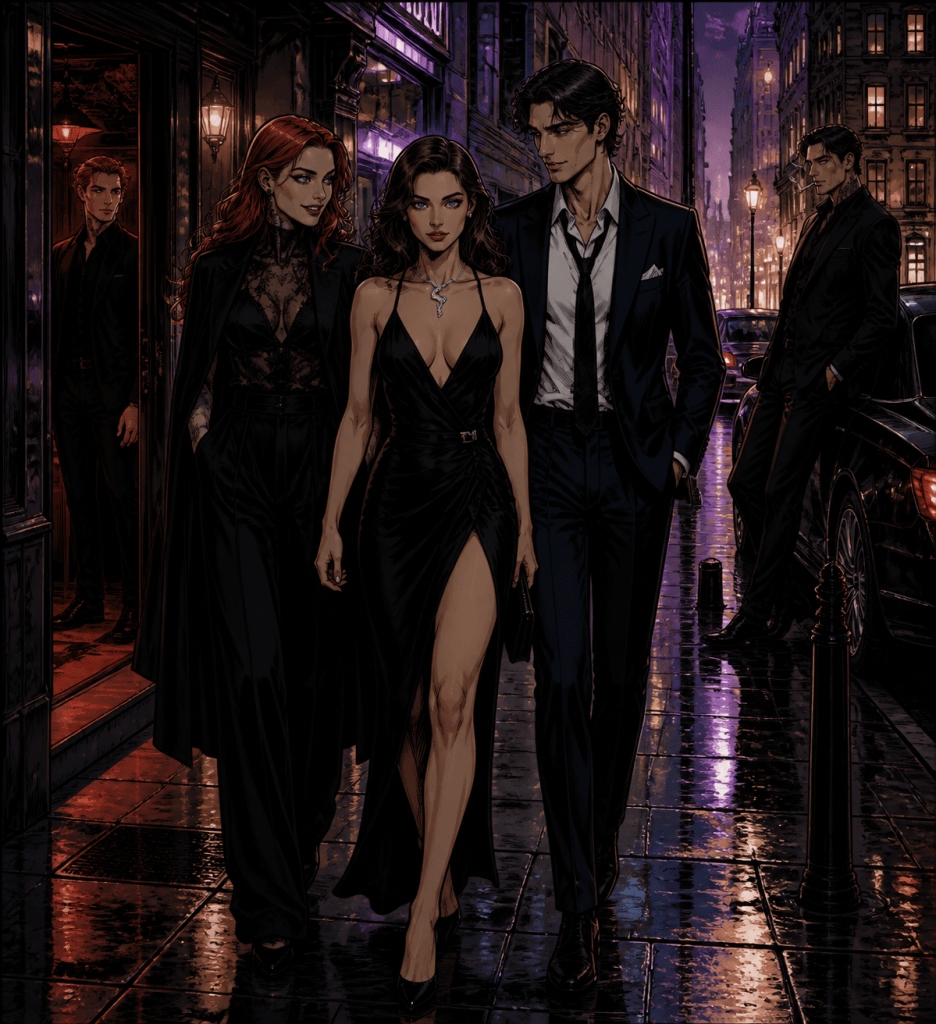
That is the atmosphere behind Paloma: a London scene of polished surfaces and shifting power. Ma’am arrives in black Givenchy, Jimmy Choos and a Bulgari snake—beautiful, deliberate, and impossible to mistake for unguarded. With her are Lord Taren and Eve: old glamour, sharp humour, and enough social theatre to make the evening appear harmless.
Meanwhile, the Boswells are already where they need to be.
Not together. Never obviously together.
A man by the car. A shadow in a doorway. A figure on a balcony. Another near the stairs. No threat announced, no confrontation sought. Just a room slowly becoming less safe for the person who thought it belonged to him.
“He might own two postcodes.
She owns the post office.”
The scene beneath the glamour
At the centre of Paloma is Boris: a small tyrant of local influence, the kind of man whose authority lives in the instinctive way people lower their eyes, bouncers let ropes move, and a crowded room makes space without being told.
He believes he is the apex predator.
That is his mistake.
The evening begins visibly, with dinner and drinks in London—enough photographs, enough laughter, enough social proof to create a convincing story. Three friends. Old money. New mischief. No obvious security. No Boswell presence.
Then, at Paloma, Boris watches.
He checks the corners. The balcony. The bar. The entrances. He convinces himself that Ma’am has come without the people who normally make him cautious.
And when he finally steps closer, the room answers.
Not with violence.
With presence.
Why this chapter matters
Paloma is about power that does not need to shout. It is about the difference between intimidation and control, between being seen and being understood, and between walking into a room alone and leaving it with a pack at your heels.
It is also about the people who make that kind of survival possible:
- Eve, whose apparent appetite and mischief can become perfect cover.
- Lord Taren, who turns aristocratic manners into a weapon.
- Asdar and Wolfgang, positioned not as spectacle but as certainty.
- The wider Boswell network, quiet until it needs to be visible.
The night belongs to appearances. Everyone is playing a part.
Boris thinks he is the one directing the scene.
He is not; he is merely licking the stamps.
Read the excerpt
“But you’re very loud in this postcode,” I add, mild as anything. “Hard not to notice when someone without land starts acting like a landlord.”
A laugh catches in one of his men’s throats and dies there. Boris hears it anyway.
Then he sees them.
Far corner: Asdar, no longer a rumour in a doorway but solid weight, arms folded, gaze like a blade.
Near the bar: Duke and Bartley.
By the stairs: Harry, alone, watching.
On the balcony: Darrel, casual against the rail.
Wherever his eyes go, a Boswell is standing. Not charging. Just there. A net he did not see closing until it already had him.
Author’s Note
The places, mood, and social intelligence behind this scene are rooted in the real experience of reading London rooms: knowing that clothing can be armour, that attention can be redirected, and that power is often revealed by who is allowed to look away.
The fiction heightens the shape of it—the manor, the Boswells, the Fold, the fire horse—but the emotional architecture is real: how you prepare, who stands where, and what it means when someone you trust makes sure you are never as alone as you appear.
Paloma is not simply a club scene. It is a map of who is watching whom.
I.Ph.
Want more from this world? Follow the ongoing Zavet / Azad universe for character scenes, London operations, mythic fractures, and the people who keep choosing each other when the world becomes dangerous.
Start the series here →
https://www.kobo.com/us/en/ebook/the-european-chronicles
© 2026 I.Ph. de Lange. All rights reserved. Published by CYcrds OÜ.

