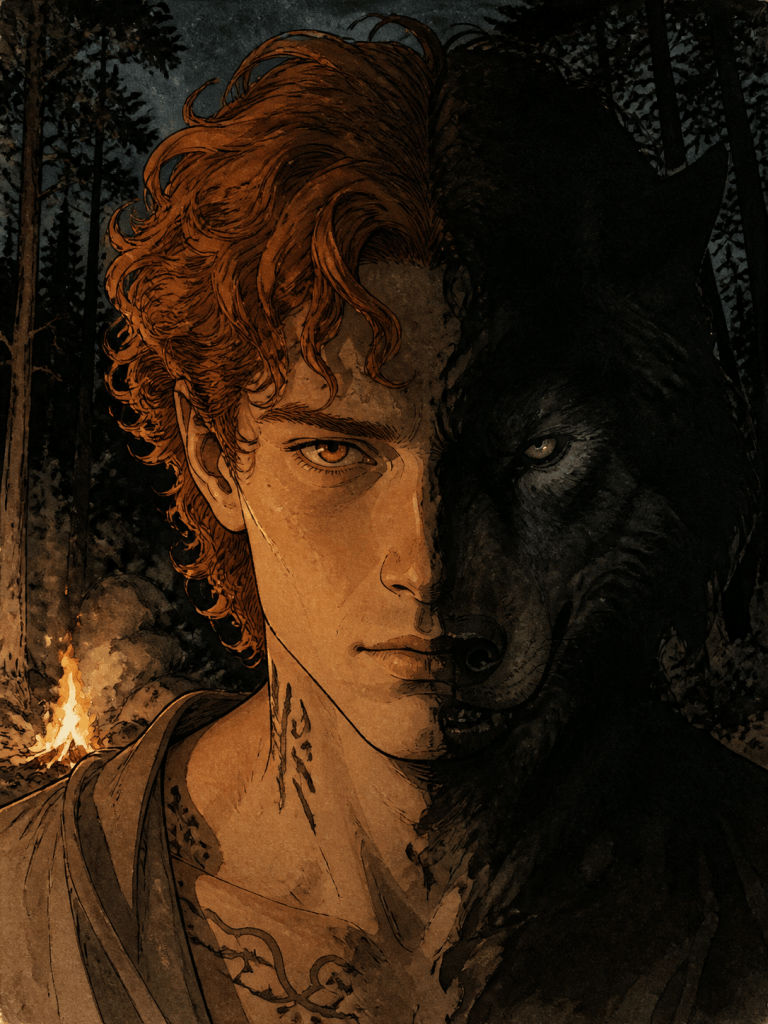
If you’ve arrived here from Pinterest or Facebook because a wolf-shadowed priest caught your eye: welcome. You’ve landed in the mythology spine of The Memory Cartographer.
There is a character in this series who has been running this continent longer than most of its languages have existed. He is a Dacian wolf-priest. He remembers the path you are standing on.
The Wolf Remembers is a reader’s companion to Book V.3 of The Memory Cartographer: five annotated chapters in Asdar’s voice, unpacking the cultural and cosmological material woven through the Kivuko Chronicles. Not a summary. Not a glossary. The view from inside the mythology, by the one character who was present at its origin.
What this companion is
This is field notes, not lecture notes.
Each chapter in The Wolf Remembers takes its title from a living African or reconstructed ancient language. Each word is a way of talking about what memory does to a body, and what paths do to the people who walk them.
If you are reading the Kivuko Chronicles and find yourself pausing on a word, or a ritual, or a choice a character makes because it feels like it belongs to a much older conversation — this is where Asdar talks about that.
Sira — the path as biography
“The path always meant for your feet”
Sira is a Kiswahili word for biography, for path. On a Kariakoo rooftop at 3am, a boy is carrying a kidnapping he can’t put down. A wolf-priest shows him how to speak a thing aloud so it stops living only in the body.
Nɔgɔ — what remains after pain
“The hardship that quietly changes your shape.”
Nɔgɔ is a Bambara word for the hardship that stays after the pain is gone. Three nights of watching. One plate of mandazi. The way Elena’s face through a closing car door can transmit more than any formal goodbye.
Bɔgɔ — clay that keeps its shape
“The clay remembers the breath. It still does.”
Bɔgɔ means earth, clay: the sacred material that holds a shape after the pressure lifts. Why Karim’s green eyes are the same in both forms. Why she says yes before he’s finished asking.
Kɔrɔ — the ancient, watching
“The ancient that survives every translation.”
Kɔrɔ is the ancient: the authority that accumulates in something that has survived long enough to become part of the ground itself. Two spectacularly underdressed men emerge from a Tanzanian forest at dawn. An old woman recognises what she is looking at.
Daina — language the body remembers first
“The daina ahead of me, arriving before I did.”
Daina is reconstructed Dacian, a language that lives in fragments. The chant that arrives before the body does and stays after the body has gone. Agathe still. Baran moving. Their first recorded opinion about anything.
A note on language
Every chapter title in the Kivuko Chronicles is a word from a living African or reconstructed ancient language. The Wolf Remembers is an act of translation — not from one language to another, but from inside the mythology to the reader standing at its edge. Asdar does not explain. He annotates from memory. The difference matters.
At the back, The Untranslated gathers the cultural and linguistic terms a reader might need: Vodun, griot, miombo, taarab, Mawu, La Tène, and others — precise, brief, in Asdar’s register rather than neutral academic voice.
Who this is for
This companion is for readers who like their mythology to behave like lived philosophy rather than decorative atmosphere — shapeshifters with dignity and complicated feelings, West and East African cosmology taken seriously on its own terms, Dacian reconstruction and the unsettling fact that a language can be remembered by the body before the mind recovers it. For narratives that work on you before you have the words for what they are doing.
And for anyone who has ever read Sira and felt the path doing something to them before they understood what it was.
Read The Wolf Remembers free
The Wolf Remembers: A Reader’s Companion is Book 0.5 of The Memory Cartographer — available to read free on Kobo, no purchase and no signup required.
→ Read free on Kobo
Save the pin that brought you here. Share this post with a reader who likes their shapeshifters feral, philosophical, and stubbornly embodied.
© 2026 I.Ph. de Lange. Published by CYcrds OÜ.

