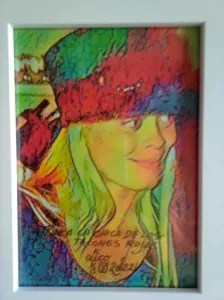
Field notes from editing Book V, Part III The Kivuko Chronicles, of The Memory Cartographer.
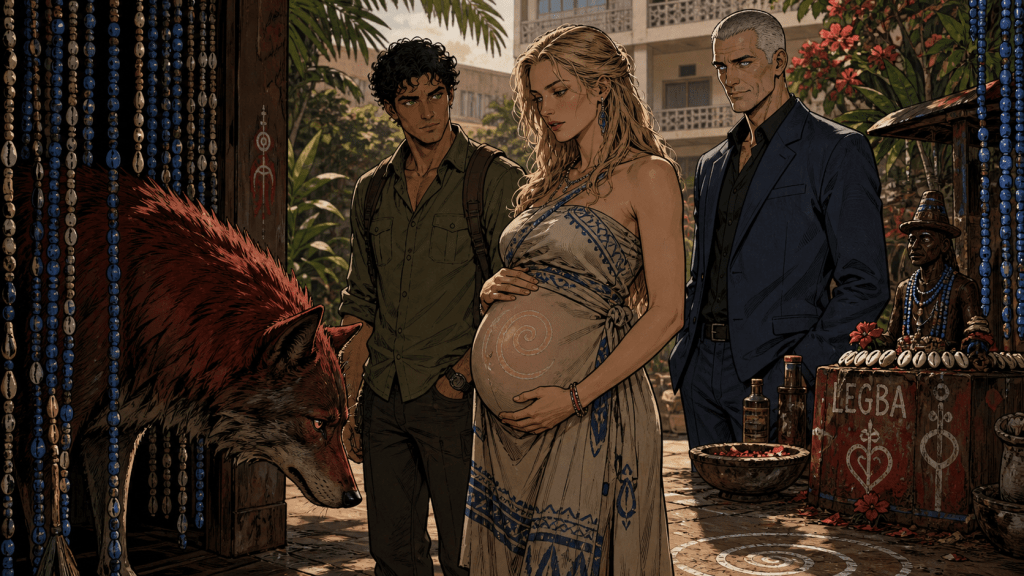
This week I’m deep in the opening of Book V, Part III of The Memory Cartographer: Elena six months pregnant in Cotonou, trying very hard to pretend this is still just “fieldwork.” Breakfast at the Sofitel, security logistics, anthropologist armour firmly in place—and then the day walks her straight into a Vodun courtyard and refuses to stay metaphorical.
On paper, the scene is simple: an antechamber of vines and beads, a priestess, chalk, cowries, the usual tools of ritual. Elena has seen ceremonies on other continents; she has catalogued her share of gods. She arrives with the usual reflexes: note, translate, contextualise, distance. In the draft, she even tries to file a shiver under “humidity change” and the silence of an entire courtyard under “collective affect.” It’s comforting, that kind of classification. It keeps the world safely on the page.
And then the priestess says, very calmly
“What you call magic—here, we call law.”
That line has been sitting in the manuscript for months, but it only really landed for me now, in the edit. It’s a reversal of everything Elena thinks she’s doing. For her, magic is a category—something to be believed in, disbelieved, analysed. For the priestess, it’s infrastructure. Gravity. Traffic rules. A system of cause and consequence that doesn’t care whether the anthropologist can explain it politely at conferences. The chalk circle around her pregnant body isn’t spectacle; it’s jurisdiction.
The twins—Agathe and Baran—turn this into more than a philosophical exercise. The priestess reads them as crossroads, “one summer, one storm,” spirits who move “as if they have seen lifetimes.” Elena tries very hard to file this under “things people say to pregnant women,” but her body refuses to cooperate. One kicks, one goes very still. The scene keeps cutting between what she tells herself and what her muscles, bones, and blood are actually doing. Editing these pages, I realised how much the twins have to be active participants, not just future plot devices: they’re instruments, registering pressure changes in the unseen weather.
And then there is the wolf. Asdar steps through the bead curtain on four legs first, not to steal the scene from Vodun but to bow to it. The priestess greets him as “ancient one,” offers blessing and cowrie, folds him into the same law that is currently rearranging Elena’s sense of reality.
Only later, in the alley, does he wear a human shape again, speaking in that old Dacian cadence about leylines, greed, and the kind of magic that lives in bones and blood. Editing this, I spent a lot of time balancing power: letting an older, European-adjacent myth walk into a West African ritual space without turning him into the main event. He isn’t. The law here is Vodun’s. He knows it. So does she.
By the time they reach the Temple of Pythons and the Porte du Non Retour, the anthropology has stopped being a shield. Elena watches possession and prayer and the quiet daily ways Vodun lives in greetings, in children’s games, in weathered stone. And for once, she does not take notes. The line that anchored the chapter for me this week was the simplest one:
“I am a Dutch anthropologist, six months pregnant, standing in a chalk circle in Benin, and I have run out of footnotes for this.”
That’s the moment I was really editing toward: not the apparition, not the prophecy, but the decision to stop pretending that everything can be contained in a notebook. Some experiences you don’t write down while they happen; you let them pass through you and accept that, for once, you are the field - and yes, at this point I’m not sure whether that’s Elena talking or me. I.Ph.
© 2026 I.Ph. de Lange All rights reserved. Published by CYcrds OÜ.

