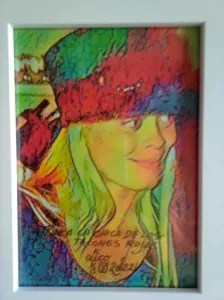
Swiebertje ’81
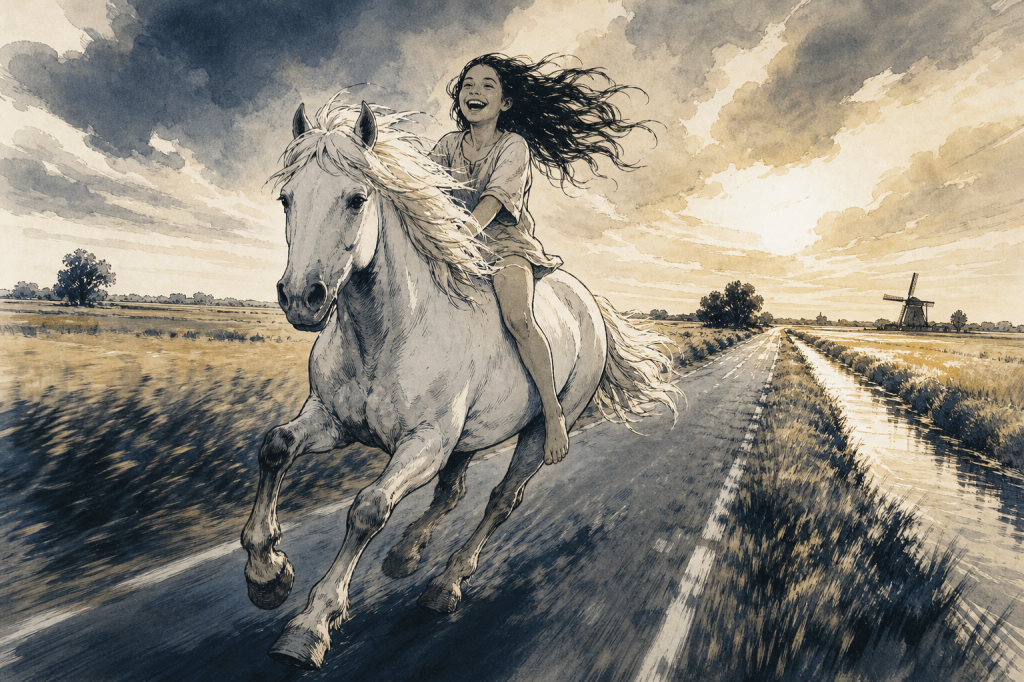
The first time I saw him I was ten, maybe eleven. Wild. Dark eyes. Long white mane. Tall in a way that made you reconsider your options.
They said he wasn’t made for riding.
I showed up anyway, with a saddle, a bridle, and no particular respect for what other people thought was possible. We spent months at war. Every morning I considered stopping. Every next morning I didn’t.
I saddled him and walked back into the paddock to be humiliated all over again. The older girls snickered.
I let them.
What broke it was the goats. He was easy with them in a way he wasn’t with other mammals.
I started running the length of the meadow. The goats took it as a challenge. Then he took it as a contest. Somewhere in that stupid, joyful negotiation we arrived at something else entirely—something like consent, something like a truce.
Not long after, I was riding him bareback—no saddle, no bridle—chasing the neighbours’ yearlings across the pasture. Through forest, my mouth permanently stained with brambles.
I still hear it: the echo of his hooves on asphalt lanes, the dull clatter of dirt on the forest floor. Proof that speed can sound like safety when you’re young enough.
The summer I was thirteen we were in full gallop through a ditch after a neighbour’s cats when I hit rusted barbed wire I hadn’t seen. It caught me across the throat and threw me. I got back on, because the farmer needed to know about the cats.
I rode up his lane. He stepped off his tractor, took one look at me, and said, “Who has tried to kill you?”
I didn’t understand until I saw myself in his mirror. The cut ran clean across my throat.
I still have the scar.
By then I had started to understand that the danger was never the gallop. It was the things people stretched across your path and didn’t bother to mark.
The new school year, Ronnie kissed me—Ronnie, best friend of Jochem, who was technically my boyfriend. The feeling itself was simple, obvious, as unremarkable as water running downhill. The trouble started only when someone remembered we were meant to stay inside a single fenced line.
I didn’t yet have language for that—how love moves one way and rules another. How the body leans where it leans, and the wire only appears after you’ve already crossed it.
These days I wear the wire wound around my wrist and watch the horses from the fence line.
Mostly I let them run. Some nights I still take one by the mane and ride.
I.Ph.
© 2026 I.Ph. de Lange. All rights reserved. Published by CYcrds OÜ.

