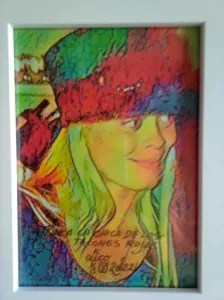
Another peek
“Mr… Karimi, is it?” the deputy said, mispronouncing his name in a way that sounded practised.
Karim smiled politely. “Close enough.”
“We hear you’ve been very… helpful,” the cousin added. His suit fit a little too well not to have come from Budapest. “Showing people how to use our new toy.”
“Our president’s new toy,” the advisor said. His smile didn’t reach his eyes. “Very eager, that woman. Computer democracy. Rotating this and that.” He shrugged. “Perhaps it works in Brussels.”
Karim shrugged back, light. “Perhaps it works in Nyíregyháza. So far the numbers say your town is ahead of the national average.”
The deputy’s eyes flickered. He didn’t like being reminded that someone, somewhere, was keeping score.
“Numbers,” he said. “Yes. We saw your query.”
Karim filed that away. They’d looked at the log. Someone downstairs had the rights to see who was asking what.
“You’re not from here,” the cousin went on. “You don’t vote here. And yet you are… how do you say… very invested in our citizens’ time.”
Karim let the silence sit for a beat, then nodded at the terminal.
“You installed it,” he said mildly. “The manual says everyone can use it.”
“The manual,” the advisor echoed, as if tasting something sour. “Written in the capital, by people who don’t have to live with what happens when every complaint arrives on our desk with a timestamp and a global audience.”
There it was: the real fear. Not the machine itself, but the idea that their hallway had become a corridor into somewhere they didn’t control.
“We only came to say this,” the deputy concluded, leaning in just enough to invade personal space without technically touching him. “Our town appreciates visitors. Tourists. Consultants. But stirring people up? That’s not a guest’s job.”
His tone was almost friendly. Almost.
“Especially now,” the cousin added. “New president, new rules. No one knows yet where loyalties will be measured. It would be a shame if a misunderstanding put you on the wrong side of someone’s file.”
Karim felt it then, under the coffee smell and old paint: the weight of the old security culture still coiled in the walls. The mayor upstairs, the deputy here, the unnamed friend at the police desk— all of them deciding, in real time, whether he was noise or threat.
He smiled, just enough teeth to pass for harmless.
“Of course,” he said. “I was planning to move on anyway. Hortobágy next. I hear the horses don’t file reports.”
The advisor’s eyes narrowed, trying to decide if that was a joke. The deputy clapped him once, too hard, on the shoulder.
“Enjoy the plain,” he said. “It’s empty out there.”
Karim walked away at an unhurried pace, every hair on his arms awake.
Outside, the square looked the same: tourists with cameras, a nun buying bread, a boy on a bicycle weaving between parked cars. But the new banner hanging from the town‑hall balcony—EU flag, new president’s slogan about “transparent Hungary”—seemed to flutter with a slightly more desperate energy.
His phone buzzed: a message from Ma’am, short as ever.
Nyíregyháza DONE. EGER NEXT.
CHECK HORSES. CHECK MEN WATCHING.
He huffed a laugh, the tension breaking just enough to move his feet.
“On it,” he texted back.
If the mayor’s people decided to look for him later that afternoon, they would find only a train ticket bought with cash and a hallway log showing a foreign name that had stopped appearing.
By the time the sun started leaning west, Karim was on a bus heading across the flat, sun‑bleached land toward Hortobágy, where the Przewalski herd grazed and where, for a few hours at least, he could be the least suspicious stallion on the plain.
The ranger’s jeep disappeared toward the observation tower, leaving a line of dust that frayed quickly in the wind. The other car—grey, civilian, with windows just a shade too dark—took the track slower, like someone arriving late to a meeting they didn’t want on the calendar.
Karim stood by the information board, watching both. His phone buzzed again in his pocket. Same Eger area code. He let it ring itself out.
“All right,” he said under his breath. “Hide‑and‑seek it is.”
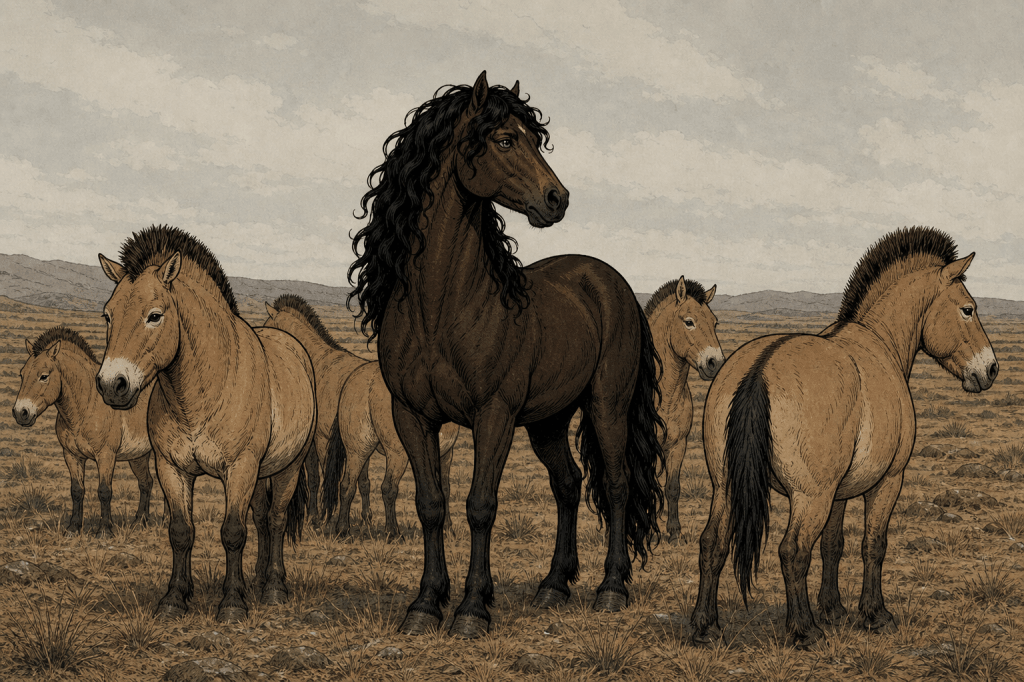
Beyond the low fence, the plain opened in every direction—flat, pale, deceptively empty. A cluster of brown‑beige shapes grazed maybe a hundred meters off: the Przewalski herd, compact and square, with thick necks and dark dorsal stripes that made them look like someone had sketched horses from memory and run out of paper halfway down the legs.
He checked once more that no one was close enough to film a tourist doing something stupid.
Then he stepped behind the board and let the skin go.
It began, as always, with the breath. In, and the ribs expanded too far for a human frame. Out, and the spine poured itself forward, vertebrae re‑counting, pelvis tilting. Hands flattened into hooves, fingers dissolving into keratin and weight. The world lurched and then steadied three feet lower to the ground, but wider—scent rushing in where language had been. Dust, old dung, cold iron from the fence. Grass. The sour tang of motor oil from the grey car. And, ringing above it all, the sharp, electric insistence of other horses.
He shook out his new body, black mane slapping against a neck that kept going further than his human one ever had.
Arabian, he thought wryly, feeling the arch of his own neck, the finer joints, the high‑set tail. In this herd he might as well have turned into a runway model at a rugby match.
The Przewalski stallion noticed him immediately.
The stocky bay lifted his head, ears snapping forward. For a long second he simply stared, chewing slowing to a halt, as if the program running in his brain had hit something it couldn’t parse.
Then he started walking.
The mares drifted aside without being asked, forming a loose, wary semicircle. Foals tucked themselves closer to flanks. Karim stayed where he was just inside the fence line, head low, trying very hard to project I am just visiting, sir, thank you, sir in whatever body language horses respected.
The stallion closed the distance at a measured pace—no rush, no panic, just inevitability. When he stopped three strides away, Karim could see the thickness of his winter coat, the scar along one shoulder, the dark line from mane to tail like a brushstroke.
The first greeting was simple: a heavy, scornful sniff straight at Karim’s shoulder.
The second was teeth.
They snapped inches from his neck, loud as a shot. Karim flinched, backpedalled instinctively, hooves scraping the frozen ground. The stallion snorted, clearly unimpressed, and snapped again, closer this time—not quite making contact, but leaving the message hanging in the air like a sign:
You are wrong. You are late. You are not in charge.
Karim flattened his ears, more out of reflex than intent, then forced himself to relax, to drop his head, to show throat. He moved sideways, not toward the mares, but along the edge, parallel to the stallion’s line—offering himself as extra eyes on the perimeter rather than competition in the center.
It took a few seconds for the message to land. Eventually, the stallion huffed, shook his thick neck once, and turned away with the air of someone who had demoted an upstart rather than accepted an equal.
One of the younger mares flicked an ear at Karim as he passed, gaze sliding over him with frank curiosity. Too fine. Too shiny. Wrong smell. But not immediately eaten. That passed for welcome here.
He exhaled slowly, the breath steaming from his nostrils.
The grey car had stopped by the ranger’s hut now. Two men got out—coats too stiff for fieldwork, shoes wrong for mud. Karim could smell their aftershave even from this distance, synthetic citrus riding the wind.
One of the younger mares flicked an ear at him as he passed, gaze sliding over him with frank curiosity. Too fine. Too shiny. Wrong smell. But not immediately eaten. That passed for welcome here.
Excuse me, madam, he thought dryly, edging a step further into the herd, mind if I hide behind your magnificent… derriere?
I.Ph.
© 2026 I.Ph. de Lange | All rights reserved. Published by CYcrds OÜ.
 The Memory Cartographer