The Persian at the Table
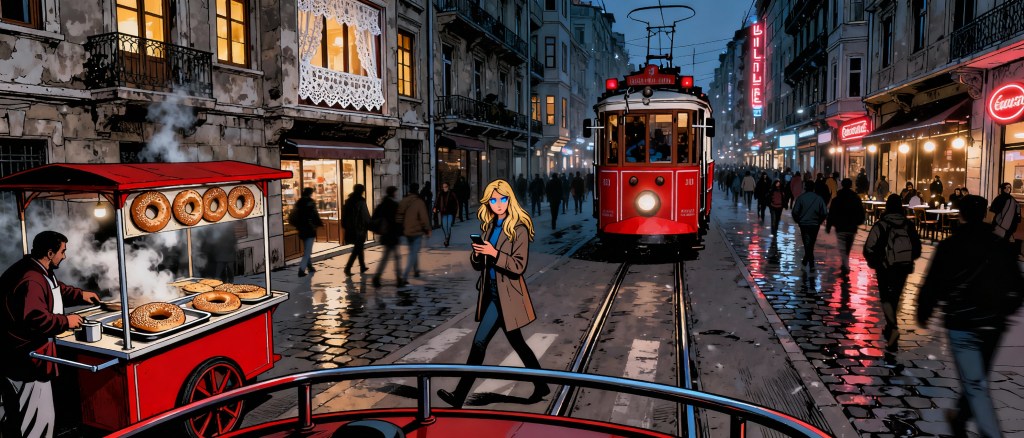
I cross Istiklal, tram bell shrilling and simit vendor’s shouts echoing off marble façades and old Beaux-Arts apartments. The phone buzzes hot in my hand—you trust the wrong one—but my eyes stay locked on the lace-curtained window.
Asdar falls into shadow-flank, no words; all fine-tuned presence, golden eyes watching for the first ripple of danger. Karim hovers half a step behind, head shifting to catch every glint and every movement, years on these streets teaching him the person you see isn’t ever the only one there.
The café is narrow; the chime of the door is dainty, almost ironic against the mood.
There she is. Mitra Akhtar. Stillness and night-black hair, that same queenly poise from the sauna in Peckham, now set against Shiraz tiles and the slow curl of Turkish coffee. Her eyes flick up—recognition a spark, no smile, no greeting. Just waiting, as if my next move is the only test.
I slide into the opposite chair. “I didn’t expect to see you here.”
She tilts her head, a shadow of a smile tracing her mouth.
“Roger Boswell did.”
Neutral mask, full-colour memory—the bench, the blink, the deal struck in steam.
“How long?” I ask.
“Long enough to hear a name that matters. Ekrem.”
I work the silence, letting the city’s pulse fill it.
Outside, Asdar posts at the corner window, a sentinel among tourists and tea drinkers. Karim orders an espresso, casual as a man who can turn deadly before the coffee cools.
Mitra’s gaze sharpens. “Ekrem won’t get you where you think. Some doors in Tehran only open if you knock the old way.”
“You know the knock?” I ask.
She holds the moment. “I know who does. But what are you offering, Elena?”
I study her, calculating. Is she here for Boswell’s limitless tab, or because she’s decided Sandi’s code is bigger than her instructions?
Outside, Asdar locks eyes with someone behind me—his hand flexing, signal sharp as a warning. Mitra’s gaze flicks past me, returns harder.
“We can’t talk here,” she says, low and clear.
The café air thickens the moment Mitra says, “We can’t talk here.”
For a breath, all I hear is the hiss of the espresso machine. Then Asdar signals—two fingers low at his thigh. The movement is instinctive: time to clear out.
A single nod from me.
Karim drops a few coins, not waiting for change. We exit together, the café chime ringing out far too cheerfully for how sharply my pulse hammers.
Mitra walks at my side now—silk headscarf loose, heels tapping out a measured rhythm on Istiklal’s worn stone. She moves like a woman used to midnight London: alert, unafraid.
“You never went back?” I keep my voice low.
Her gaze flicks to mine. There’s history there—a river under the city.
“My siblings did. My parents, too. But I stayed in London. Thirty years, and the line’s not cut. Calls, encrypted messages, even handwritten notes smuggled in pistachio boxes—we still talk.”
She pauses. “Blood runs its own route. That’s why I can open doors in Iran. But doing it? It paints a mark on my back.”
That’s her first admission, not a risk for me, but for her.
We join Istiklal’s current: shoppers, street vendors shouting in Turkish and Arabic, roasted chestnut smoke threading the winter air.
Behind me, I can sense the shadow Asdar marked inside the café.
He murmurs low as he draws even:
“One tail, maybe two. Not locals. Moving too close.”
Karim glides ahead, scanning window reflections, slipping into step with Mitra: loose, instinctive, box formation.
“Destination?” Karim asks.
Mitra doesn’t break stride:
“Somewhere the walls don’t listen. There’s an antiques warehouse over the Golden Horn—my cousin’s. Don’t worry, cousin’s in London. Keys are with me.”
She glances over her shoulder. The tail is there: male, burnt-leather jacket. A second a block behind, parallel.
We turn off onto a narrow side street—an Armenian jeweler, a boarded-up teahouse. Istiklal’s clamor fades, replaced by delivery trucks and overhead gulls.
Mitra leans in, voice almost a whisper:
“You were wrong to trust Ekrem. If your Sandi is in Iran, they won’t deal through him. But if Sandi’s holding what I think, someone else is already moving.”
“Who?”
She answers, soft but certain:
“Behroozian. Old guard, codes from before the Revolution. He owes my father his life, so maybe we get five minutes before he decides if we walk out or not.”
Five minutes. Enough time to change the story, or choke on it.
Behind us, footsteps get closer. The game sharpens, and Istanbul’s avenues become our first test.
I.Ph.
 The Memory Cartographer