Leeuwarden, July 2016
That summer, I was invited to stay at Tsjitske’s old monumental farmhouse, now home to Roos and her family. The accommodations were memorable: I slept in the back where cows once sheltered, beautifully transformed under Roos’s careful renovation. The shower, however, remained outside my comfort zone (in a horse stable), literally outside.
Stepping into the cool air, I’d find myself surrounded by trees and a stream wide enough for Tsjitske to anchor her boat, letting other “skippers” glide by. The place held a gentle, rural magic—Frisian practicality softened by the poetry of water and willow.
By then, my notebooks bulged with timelines and half-formed thoughts about Frisia. I had mapped the history, but the villages themselves—those names echoing with legend and whispered stories—remained abstractions. That was about to change.
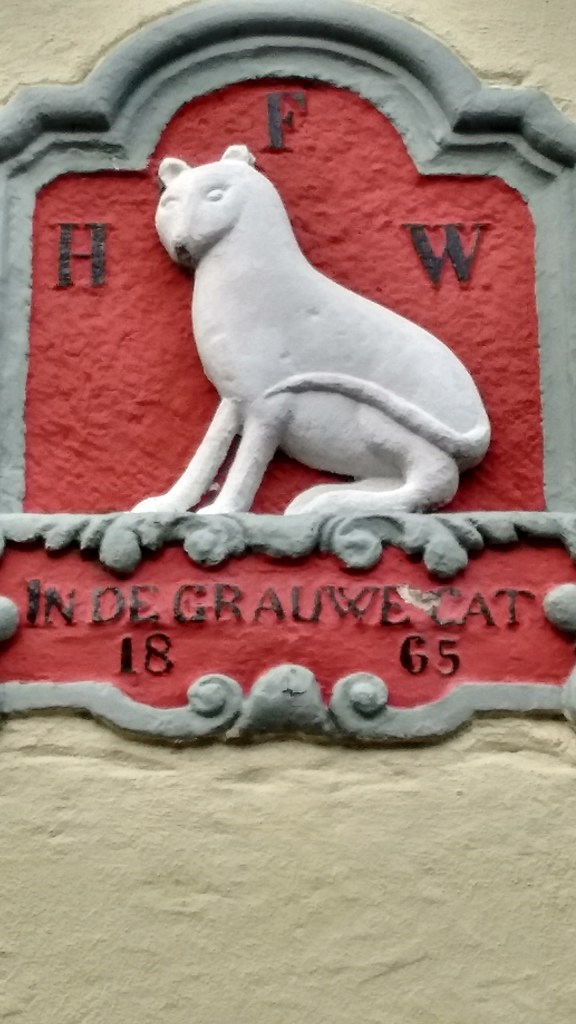
Roos and her husband Rienk became my guides. They took me to Harlingen, where the summer wind, cold and insistent, swept in from the harbour bustling with boats, trolleys, and skûtsjes. I was drawn to a gablestone with a grey cat on red scarlet, the bricks around weathered by time, watching the lane, almost as if standing guard over history. Below, the inscription: “In De Grauwe Cat – 1865.” Perhaps renovated, perhaps simply enduring, but unmistakably anchored in the past. The cat and the stone seemed to share a silent understanding of time’s passage.
Our journey continued through the Frisian landscape, a patchwork of green fields and winding waterways, the wind forever teasing the reeds and rippling the canals. In Leeuwarden, the old city vibrated with life—people walking, talking, filling terraces on the shore or on old barges turned into floating cafés. Little lights blinked on as the sun dipped below the horizon, softening the evening but not the mood. The city remained buoyant, relaxed, and utterly itself. For a moment, I felt suspended between the stories of the past and the easy contentment of the present.
Evenings at the farmhouse were reserved for conversation and drinks. The Frisians, I discovered, have a particular fondness for their spirits, and our glasses were rarely empty. Roos’s sister honoured us with a visit, bringing genuine curiosity about the CYcrds™ project and its focus on Friesland. Her husband, a professor teaching Fries at the university, offered to translate everything into Frisian—no payment required. “I do it for the love of our language,” he said, raising his glass. “And because you care enough to ask.” I was deeply touched by the love these people held for their heritage and the pride infusing even the smallest gestures of hospitality. In Friesland, belonging was not just ancestry, but participation—showing up, listening, joining the circle.
The next morning, I borrowed a bike and set out for the nearest supermarket, two kilometres away. The ride took me along shimmering bodies of water, where children leapt in and swam, their laughter echoing across the fields. It was a scene that felt timeless and utterly present—a living thread of shared history, as vivid as any legend.
That evening, Roos announced, “Tonight, we’re going to Ulbe’s.”
There he was, waiting for us—Ulbe, smiling broadly, standing on his expansive porch that seemed to shrink him by comparison. He waved us over with the easy confidence of someone who belonged to both water and land in equal measure. Ulbe’s idea of a night out was pure Friesland: “Hop in the longboat (dog included), I’ll whisk you over the lake.” We climbed aboard, the boat gliding effortlessly across the water, the evening air cool and alive with the scent of reeds and summer.
Our destination was Langweer, a town that seemed to materialise out of the dusk. We “parked” the vessel wherever it fit, Frisian nonchalance dictating that mooring rights were a matter of mutual understanding rather than strict ownership.
Langweer was mesmerising. The trees arched overhead, their branches forming green tunnels above the cobblestones. The town exuded a gentle, communal energy—everywhere we went, people greeted Ulbe. He was a public figure here, a “skipper” of blue blood turned local hero, his reputation gliding ahead of him like the prow of his boat.
As we wandered the streets, Ulbe shared stories—some true, some embroidered by time and beer. “In Friesland,” he said with a wink, “the water remembers everything. That’s why we never take ourselves too seriously.”
That night, we slept on Ulbe’s big barge, moored in his shipping yard-turned-harbour. The gentle rocking of the hull, the distant sounds of water lapping against metal and wood, and the lingering laughter from the town across the lake made for a sleep that felt both adventurous and deeply rooted in the Frisian way of life.
Lying there, I realised these days and nights, part history, part present, were weaving me into the living story of Friesland, not as a native, but as a welcomed guest, a witness, and storyteller. Yet this time, it wasn’t about finding my own story, but about having the honour of telling theirs.
For the curious among you readers, I never fell in love with Ulbe, though I suspect many have. If I ever had, it would have been because I was in love with what he represented: the spirit of Friesland itself. The country, with its wind-laced waters, stoic people who wear their heritage like a second skin. It all quietly claimed a place in my heart.
CYcrds™’s story and inspiration will continue to grow, shaped by the spirit of this place and its people. But that, as they say, is a story for another time.
May Harmony find you,
Irena Phaedra
P.S. The real secret of Friesland? It’s not just the wind, the water, or even the stoic people, though each is legendary in its own right. It’s the way all three conspire, quietly and persistently, to blur the line between reality and folklore. In Friesland, you don’t simply visit: you drift into a place where every gust, ripple, and reserved greeting is steeped in stories older than memory. Before you know it, you’re not just passing through, you’re walking the same roads as mythical kings, hearing echoes of lost islands, and feeling, for a fleeting moment, as if you’ve stumbled into a living legend, whether you meant to or not


Loved your story! Really. Not only because well written and the fact I’m from Harlingen—and know In de Grauwe Cat very well—, but also how you describe the second skin, and because I write about the heritage and like to blur history with legend. If you like, but do not feel obliged: http://www.frisiacoasttrail.blog
LikeLike