
Henk en Cees — Benidorm, winter ’89
By the time Henk and Cees arrived at the Sunset, I already had a name in town.
La chica de los sombreros — the girl with the hats. It had started in Ibiza, with a purple one, and grown its own legend the way nicknames do when nobody thinks to correct them.
Winter Benidorm was a different city from the summer version.
The big discotheques were shuttered, the package tourists gone. What remained were the dancing bars in the Zona Guiri and the old town, and those of us who moved between Alicante and Madrid and here, following whoever had enough to pay properly for an act.
I worked the major venues — proper stages, proper lighting — and when the season thinned they still sent for me. The cloth came with the booking: dress, hat, the full thing. I’d had ballet until I was fifteen and I knew what a body could do in the right frame, and the owners knew the difference between a dancer and a decoration.
The Sunset was smaller, a bar with a floor that emptied on slow nights. They paid me to fill it. Not glamorous work but clean — Felipe knew the owner, the owner knew me, and in that circuit certain things were understood. I wasn’t available for other arrangements. Nobody asked twice.
The evening Henk sent word through Felipe that he wanted me at the terrace, I almost didn’t go. That he’d asked specifically — past the usual girls already arranged around his table — was the only interesting thing about it.
They were Dutch. That was the first surprise. The second was the champagne — serious bottles, not the house persuasion. The company girls gave me the flat look they reserved for women who complicated the arithmetic. One by one they drifted off as the conversation found its own footing and stopped needing them.
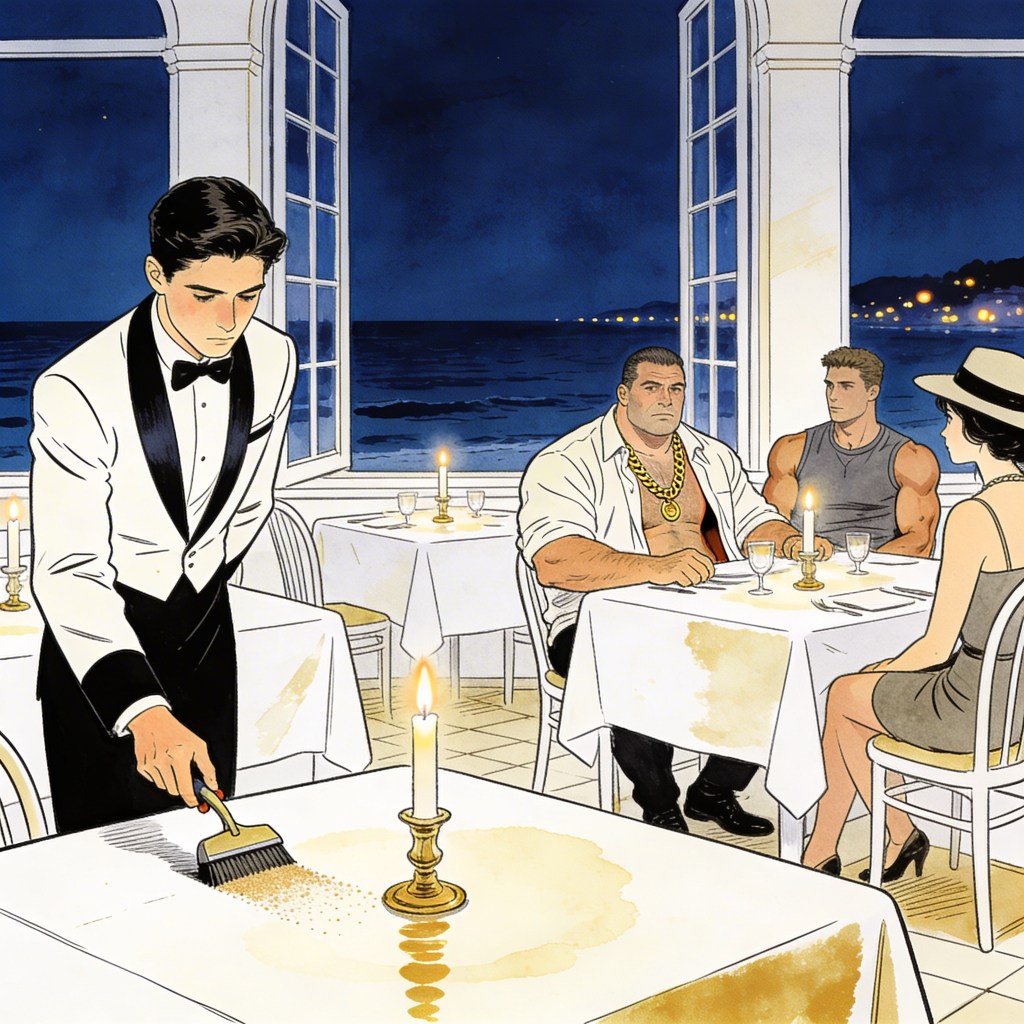
Henk was from the Wallen. You knew it from the first look — the Cartier panther chain thick on his chest, shirt open over a belly that had eaten well for decades, legs spread wide, and that Amsterdam-Dutch that carries the canal and the commerce in equal measure. Cees was almost elegant. Sportief. The kind of man who irons his own shirts on principle.
My own Dutch came out differently that night — the compression, the vowels that only surface when I’m actually at ease. Henk clocked it immediately. Where are you from, meisie. Not a question.
The nature of their friendship emerged over several bottles.
Henk ran a number of establishments efficiently and without apparent sentiment.
The anecdotes were numerous; the one I remember best involved a new girl who’d appeared in his office after her first few days to tender her resignation. Her fanny hurt too much, she told him. Henk and his madam exchanged a careful look. What exactly, the madam asked, did you think the work involved. The subsequent clarification — that the professional logic was largely digital, that only certain clients warranted the full arrangement, that there was an entire technique to be learned — left the girl staring. She had not understood. She quit anyway.
Cees’s situation was more complex and considerably sadder. He raced rally. Dakar.
The kind of man who reads terrain at speed and sleeps easily in desert cold. He had fallen, completely and without defences, for one of Henk’s girls — a Swede. What he hadn’t known, and what became apparent only after they moved in together, was that she was a nymphomaniac in the clinical sense. At first this had seemed like extraordinary luck.
Then the key in the front door had begun to sound differently to him. He moved through this part of the story with tears running and Henk laughing until he wheezed, and somewhere in the middle of it I understood that the tears were also laughter and the laughter was also grief, and that the Swede had eventually gone back to work for Henk, which solved the immediate problem and created a different one entirely. They had ended up taking holidays together so Cees wouldn’t have to go home.
Before all that — before I knew any of it — they took me to dinner in Altea. L’Ousteau, which was then the fanciest restaurant on the coast and knew it. A maître d’ who moved like a diplomat, and a boy whose sole function was to patrol the tables with a small machine that hoovered breadcrumbs from the cloth.
I remember watching that boy and thinking that the world contained an extraordinary range of vocations. Henk ate with the appetite of a man who had never once questioned his right to a good table. Cees ate carefully, like someone performing normalcy. I ate well and said very little and watched them both.
They came back many times after that. Always to the Sunset, always asking for me through Felipe, always with a hat — the ritual established without discussion, the way rituals are. I was never entirely sure what I represented to them.
Not romance, not transaction. Something luckier and less definable. A talisman, maybe, from a city that wasn’t theirs, in a language that suddenly was.
I didn’t ask. Some things hold precisely because nobody names them.
I.Ph.
© 2026 I.Ph. de Lange All rights reserved. Published by CYcrds OÜ.
 The C.O.M.C. Files