
Pichi
VenyVeras
Benidorm, late winter
I am nineteen, almost twenty, and I am still trying to find the right handles for this world.
Benidorm in those years was not the place people picture now. La Zona Nueve on a Friday night was Spanish — entirely, deliberately Spanish — the sons and daughters of Madrid money and Basque old names, families three generations deep at most but holding their inner circle with the grip of people who know exactly how recently they built it.
Post-Franco, post-everything, a culture running on cocaine and machismo and the particular social violence of new money pretending to be old. I had been noticed quickly — la chica de los sombreros, the girl with the hats, the foreign one who didn’t accept the coke or the casual sex that the other foreign girls accepted, which made me interesting in the way that things are interesting when they don’t fit the available categories.
Watched. Included up to a point. Never quite boxed.
My aristocratic upbringing had given me posture and languages and a certain quality of attention, but not exactly the right handles for this. I was navigating by instinct, working the disco’s, carrying flyers into bars I had no business entering, learning the difference between the rooms that wanted something from me and the rooms that simply let me exist.
VenyVeras was heaving the night I walked in. I worked my way through the crowd the way I always did — politely, a little clumsily, holding out the flyers like small apologies. Nobody was unkind. Nobody took one either.
Then I felt eyes on me and looked up.
He was not the tallest. Not the most sculpted — that would be Herrada, who knew it and carried it like a second passport. Not the blondest — that was the Basque one, already working in a bank, already building the careful life. Not the most chemically altered — that was Victor, or the green-eyed one, navigating some private interior weather in the corner.
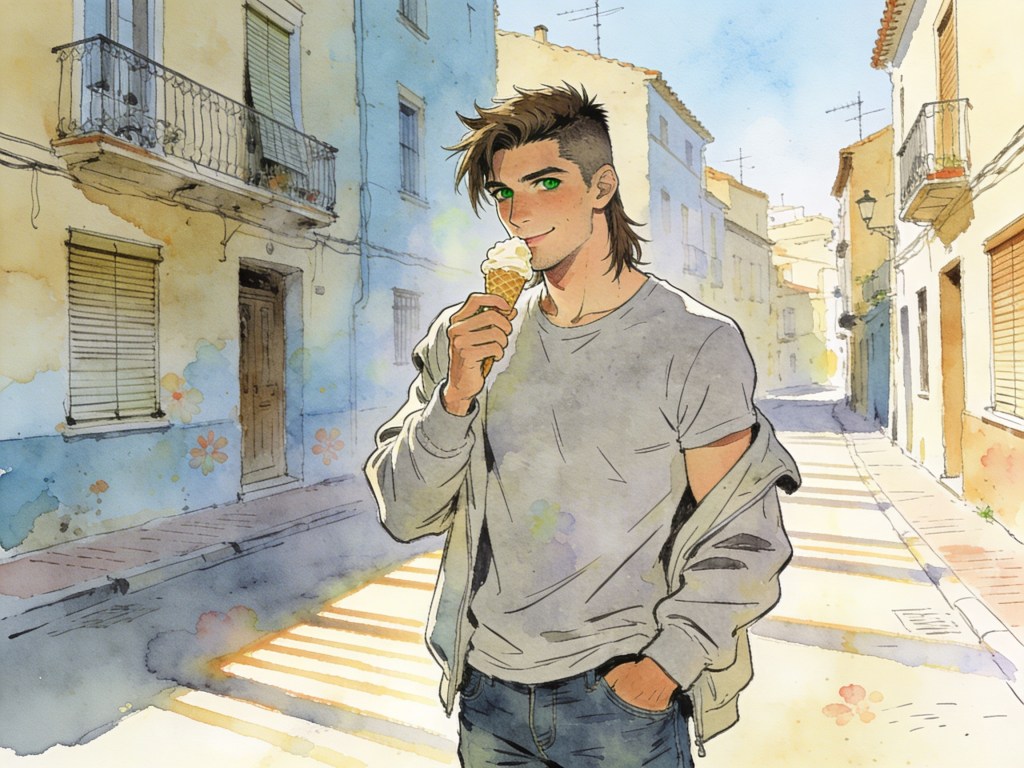
Pichi was simply the one the room oriented around without knowing it did. Brown hair to his jaw, wolf-cut before anyone called it that. Dark green eyes. A smirk that didn’t mock so much as recognise.
I held out a flyer.
He told me he didn’t need one. His bar, his crowd, his Friday.
He said his name was Pichi — what they call you when you play football well on a Sunday, when you’re the kind of person people want on their team without being able to explain why. He was my age and he had built this place with three friends and none of them were twenty-five yet and none of them seemed to find that remarkable.
There is a gap in my memory here, and I think I understand it now. There was so much happening in those years — the dancing, the offers, the navigation, the constant reading of rooms — that the quiet moments didn’t stick the way the dramatic ones did. What I remember of Pichi is not a sequence but a quality. His student flat in Alicante, small and easy. Making love without drama. Cinema. Ice cream on the street in the thin February sun, him entirely relaxed inside his own skin in a way I had not yet learned and would spend years trying to understand.
He would ask, genuinely puzzled, why I liked to spend my time with him there. As though it required explanation. As though the answer wasn’t simply: because nothing performs when you’re around.
He knew about the shoe brand in Elche, the New York offer I’d turned down. He didn’t press it. Some people understand instinctively that you have made your calculations and they are yours to make. In a world where everyone was measuring what you were worth to them, that quality was rarer than it had any right to be.
No box for me, with Pichi. Which in Benidorm in those years was its own kind of miracle.
The mornings I took the bus back from Alicante smelled of salt and diesel and the particular cold of a coast not yet decided about spring.
One of those mornings someone stepped off the pavement and put their arms around me before I had set my bag down. The embrace arrived before the words, which is how you know the words will be the kind that restructure things.
Pichi had gone out on the water that morning. Windsurf, the sea still winter-cold, the wind doing what it does on that coast in February. An epileptic attack. The water did the rest.
He was twenty-three, or twenty-four. I no longer remember which.
VenyVeras never functioned again. Not closed exactly — these things rarely close cleanly. Just emptied of whatever it had been, the way a room empties when the person who gave it its quality is gone. Victor and Herrada and the others were still there. The bar was still there. But the thing that had made people naturally kind when they walked through the door — that had drowned with him in the cold February sea.
I have met others like him since. Not many. You recognise them by the fact that they don’t recognise it in themselves.
I.Ph.
© 2026 I.Ph. de Lange All rights reserved. Published by CYcrds OÜ.
 The C.O.M.C. Files