
Part II
Chapter 1 Convergence
Mikael
Sahel dust still on my boots. Iron tang of gunmetal, old blood — layered beneath my skin by now, permanent. Isaa and his men, gone. Spent shells in the sand. Justice. Never clean, never simple. No victory. Just necessity.
Elena. The bright line. The only clarity in this landscape of blurred intentions. The team moves as extension of my will — flight plan files itself, Sandi scours communications. Kayar. Coastal, small. Strip rough enough for the turboprop. Serviceable.
Load up fast. Engines spool. The hum — a heartbeat drumming impatience through my spine. Every detail a ritual: her last signals, Lac Rose, then Kayar, then nothing. Fevered rumours only.
I close my eyes as we ascend. Map the coast from memory. Pale hair against a riotous Senegal morning. Her stubborn insistence — stories, always stories, even when danger is all that glowers back.
I don’t question whether I’ll find her. I always do. What I question is the cost. To her, to me, to the history we drag along for the ride.
Atlantic below. Banking low. Sandi points out the fishing boats — I adjust approach, every movement calculated. Kayar ahead. Thumbprint of colour and salt. I tighten my grip on the armrest. Jaw set.
Just a little further, Elena. One more heartbeat.
Heavy hush on descent. Engine noise gone, replaced by the dense quiet that lands in my chest before every touchdown. Sandi dispatches queries. Below — salt fields, villages, Lac Rose’s shimmer. Vast. And suddenly far too small to hide her long.
Blaise Diagne. Customs — fast French, stamped papers, money and names where needed. No patience for delay. This time, less for subtlety.
Tarmac. Muggy air, ocean and kerosene. Hired car idling. I grip the door handle. Jaw still set.
Stay safe, Elena. Closer than you think.
Tarmo
As we roll out from Blaise Diagne, my thoughts snarl with frustration and something I refuse to name, looping and unwilling to settle.
I had it planned. Every country on her research list — each stop chosen so she could gather her stories, quietly weaving connections meant to widen my network across West Africa. A controlled journey: safe, efficient, mutually advantageous. But nothing stays on course where Elena is concerned.
This woman is going to drive me to the edge of reason. Her will is more potent than logic, more reckless than fate. Pregnant — mine and Asdar’s — running through deserts and ports, carrying two lineages of power, protected apparently by little more than luck and that Moroccan shadow trailing her.
Karim. The so-called tourist guide. Her loyal companion, always either trailing after her or leading her into the next escapade. I should resent him more than I do. Part of me almost pities that relentless devotion — he is loyal to a fault, but even he cannot temper Elena when her mind is set.
What knots my gut the tightest is Asdar. Where is he? He moves between worlds, sees more than he lets on, and his hold on Elena is ancient — old as myth itself. He was always the wild card, the wolf in the shadows. If Elena is unguarded, it is only because Asdar allows it.
I scan the passing fields, the road unwinding toward the coast. Every move matters now. Elena is running ahead of her fate, and mine tangles in hers. My plans — useful, necessary — are only as good as the next wild turn she takes.
Hold on. I am almost there. And may Odin help anyone — man or legend — who gets in my way.
Elena
By midday the air in Kayar is a simmering thrum of voices and brine. I am squatting in the shade of a squat cinderblock house, half-listening, half-transcribing the chorus of women around me — bone-hard hands spinning stories while their daughters sort silver-scaled fish on reeds at our feet.
Then — a prickle, almost electric, beneath my dress. I shift, but the cotton pulls taut, clingy in the heat. A sudden ache — old, primal, inexplicable. I press my arms to my sides. A slickness. Gold, I know, and something close to shame rushes in behind it. Not here, not now, I beg my traitor body. Of all the places.
Karim stands sentry just beyond the chatter, eyes scanning the horizon with a patience that masks his worry. He sees the moment I falter. A question flashes between us — are you all right? — but he doesn’t voice it. He knows the signs. Quietly, efficiently, he murmurs an excuse in Wolof — something about a stomach illness, a restless traveller’s curse — and then his hand is beneath my elbow, gentle, guiding.
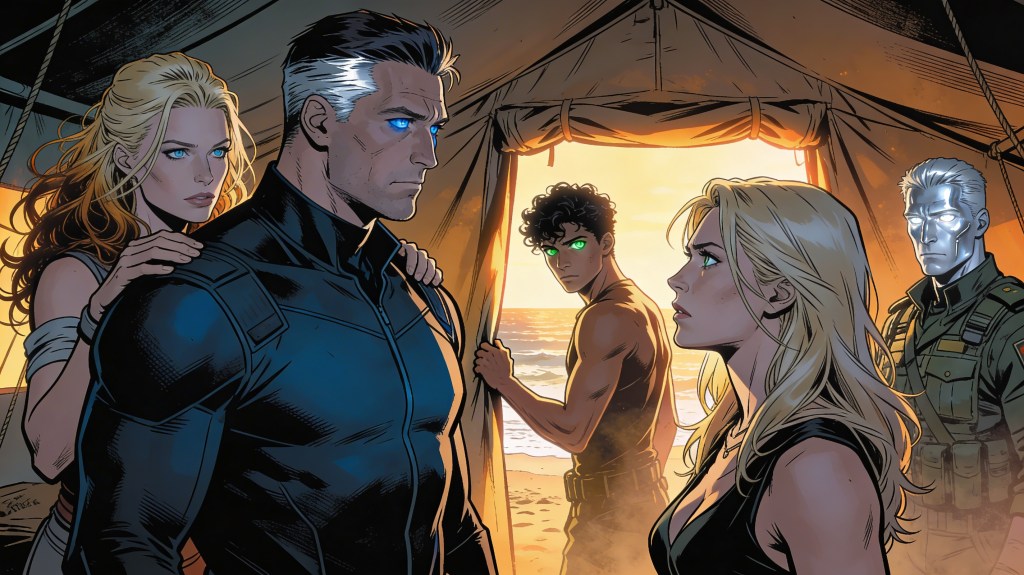
The tent’s coolness is a sanctuary after the scrutiny of the square. My dress, smeared and glimmering, is both curse and crown. Karim averts his eyes, more loyal than curious, always. I clean myself and apologise; he refuses it with a shrug, voice soft.
“One of them is near, Elena. It cannot be helped.”
Before I can answer, the tent flap whips open. Wind, footsteps, the unmistakable weight of Tarmo. His presence fills the narrow space to bursting. He studies me, silent, the air thrumming with everything unspoken.
My heart bounces between longing and defiance. I want to reach for him, to lean into that carved certainty, but instead I stare past him, jaw tight.
“You always find me,” I say, voice thin.
He takes a half-step closer, concern etched in the deep furrow between his eyes.
“You disappeared.”
Karim sets his jaw.
“We met pirates on our way to Dakar. You know her.”
I almost laugh — raw, uneven.
“You both make me sound so wild. Maybe I am. Maybe that’s the problem.”
Then the tent stirs again. Sandi — her hair grown wild since Armenia, her smile braced with joy and apprehension — sails in like a tidal wave of warmth. She barely hesitates before wrapping me in her arms, smelling of sweat and airport soap.
“Elena,” she breathes against my cheek. “You’re real. I kept thinking—”
I melt, impossibly grateful. “I’m here. Somehow.”
Mikael’s silhouette looms in the entrance, ever-watchful, eyes scanning both threat and miracle. “We should go soon,” he says quietly, “if that’s what you decide.”
I lean into Sandi, letting her steady me. Tarmo stands there — my fixed point, the promise of return. But I am not ready to be claimed. The world is still vast, and my story, even gold-tarnished, is not finished.
“I need more time. All of you — you came all this way — but I have to see this through. Just a little longer.”
There is pain in Tarmo’s nod, but also understanding. Sandi squeezes my hand. Karim meets my gaze, silent assent shimmering there.
Then Tarmo’s voice, low and ironclad. “I think not.” He says it as if I have posed a question, as if the crossroads belongs to him. “Go take a proper shower. Sandi will stay with you.”
“Tarmo—” but already he is turning, orchestrating the pieces.
He gestures, calm and commanding. “Karim. Come with me.”
An edge that brooks no argument — not now, not with the gold so raw and the situation teetering.
Sandi is through the canvas with a soft huff, her energy an anchor. She pulls me close with unspoken reassurance, Yerevan’s embrace returning at our story’s edge.
Karim’s shadow lingers for a heartbeat, torn between protector and subordinate. Then, with a stiff nod, he follows Tarmo out, leaving me to Sandi, to hot water, to slow shaking breaths.
It hits me like a wave — the loss of agency, my wildness suddenly corralled by these people I love and resent in equal measure. Tarmo has taken control.
For now, I let him.
I.Ph.
 The C.O.M.C. Files