
Chapter 36
Kayar
Karim ducks outside to find food, returning a while later with a plate of spicy thieboudienne — fish, rice, and vegetables, the flavours bright and grounding.
We sit cross-legged on the floor, devouring each bite. For the first time since the storm on the ship, I feel hunger fading and strength seeping back in. Karim, silent, wipes his mouth and pushes my notebook and a battered map toward me.
“We’ll need to find a way south — maybe another boat, maybe a bush taxi to Dakar,” he says quietly. “But for now, we should rest.”
Sunlight slants into the little room. Outside, Kayar pulses with life — a stubborn, salt-soaked kind that feels like hope. For a moment, there is no magic, no chase, only the comfort of food, clean skin, and the solid warmth of the man beside me as we retrace old routes and start planning, all over again.
That evening, when I hear his breath steady, I slip out of his arms and go on a mission.
https://reamstories.com/creator-hub/story/content/mluynoysf992b6/ebook
I wake slowly, still tangled in Karim’s warmth, last night’s truths hanging between us like morning mist — bittersweet, fragile, but honest.
When he asks, “So what’s next?”
I laugh softly against his chest, the question heavier than it sounds. For all my planning, nothing goes as I map out; yet each deviation, each detour, gifts me stories richer than expectation.
Breakfast waits beneath the acacia on Campement Calao’s terrace: thick bread, fruit cut open to reveal the sunrise within, dark coffee strong enough to jolt the dreams from our heads.
I watch fishing boats rock on the skin of Lac Rose, slipping out to sea or returning — every hull heavy with secrets. Karim, attuned to the subtle currents here, reminds me quietly, “People notice a stranger who watches too closely, especially in a place this small.”
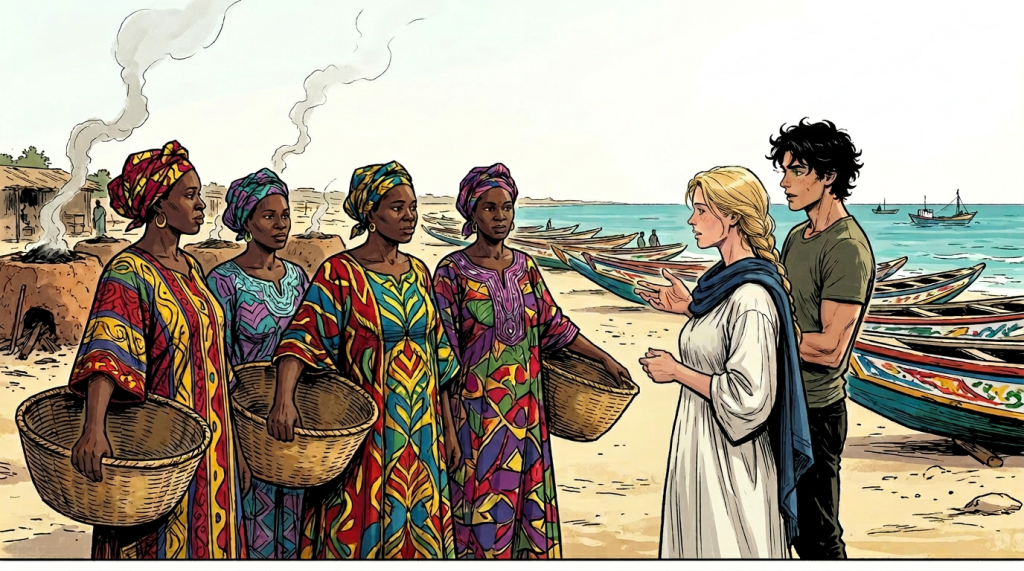
After breakfast, we walk through Kayar toward the sea. The town already thrums with morning: children race barefoot past paint-splashed boats, women weave through the market wrapped in every hue the earth offers, baskets balanced like proverbs.
I dress with intent, letting soft fabric fall in local shapes and colours, hoping to blend observation with respect. As we pass, one woman catches my eye — she nods, a small permission I hold with the care reserved for a delicate shell. It feels like a door might open if I listen before I speak.
At the shore, the women of Kayar stand waiting for the pirogues. Their baskets, usually bright with fish, sit nearly empty. Where once there was bustle and the scent of smoke, now there is only anticipation weighed down by disappointment.
Karim introduces me to a woman whose hands tell her story — hardened by years of brine and woodsmoke. Through his translation, she tells me about yaboi, the little fish that used to sustain families.
“We smoke it, dry it, sell what we can, feed our children,” she says, gesturing to an old smoking pit where embers gutter and smoke rises thin and slow. “Now the factory buys it all. There’s nothing left. What will we eat? What is left for us, for Senegal?”
From the beach, I see the factory on the horizon — modern, pale, humming like something misplaced. Yaboi, once the food of women and children, now vanishes almost entirely into fishmeal, sacked for export to Europe and Asia, destined for the bellies of animals continents away. Oceans of fish empty here, and yet the women of Kayar watch the waves with hunger, their vivid clothes fluttering against the bleak wind — a last refusal to be erased.
Earlier, a fisherman repairing his net speaks to me, resignation in his hands.
“All of us sell to the factory now. There’s no choice,” he says, fingers moving through holes he can never fully mend. “It’s like this net. Some gaps you cannot close.”
My notes as an anthropologist record the patterns:
Fishmeal export drains local food supplies.
Women are excluded, cut from the last link in the chain that once fed them.
Food insecurity rises where abundance sat only a generation ago.
But data feels thin beside the truth of those women — silent, dignified, abandoned by the very sea that once nourished them.
Karim stands beside me, voice low and grave.
“It is no longer the sea feeding the people. It is the sea feeding the world. And here, the poorest starve under plenty.”
I press the scene into memory. Stories don’t begin in statistics — they start here, in the raw ache of a woman’s gaze, in the permission to witness loss and the flicker of pride that refuses to fade. This is the heart of it: the intersection of dignity and erasure, and the resolve to carry those stories onward.
The Net Closes
By late morning, my phone bursts with missed calls and flashing messages. Chaos has its own rhythm now: whenever I drift beyond the reach of reliable Wi-Fi or cell towers, the world I leave behind springs to life — worry, clipped frustration, and the low hum of panic suddenly alive and kicking.
It starts with Hasna — gentle strength wrapped tight in urgency. Elena, please tell me you’re safe. Dakar is asking questions. Your contact in Ziguinchor hears rumours about Kayar. If you get this, write. I miss you. I need to know you’re all right.
Hot on her heels comes Mrs. H — every word a shot of espresso, formal disappointment in a bottle: This is unacceptable, Elena. I trust you with a significant project, and the Board breathes down my neck. If you don’t contact us within twenty-four hours, I won’t be able to shield you from consequences. Not this time. Remember your obligations.
Then Tarmo, clipped and precise, gravity bending even the pixels of the screen: Where are you? Last signal showed Lac Rose, now nothing. Your safety matters more than your stubborn streak. I’m sending someone to Dakar. Answer me. Please.
And from the rest — the great extended echo of team — a mosaic of exasperation spliced with real concern. Have you heard from E? She’s ghosted us again. GPS last pinged Kayar. Should I call the embassy?
Karim catches my eye while I scroll through the avalanche. “You have a whole world trailing your shadow,” he says, admiration and worry braided together.
My smile crooks. “They mean well, and some mean business. I just wish they trusted the journey as much as they trust their maps.”
I tap out brief replies — calm, unspecific, enough to dampen panic but never enough to tether me: I’m safe. Doing my work. Will check in soon. Then I close the phone and breathe deep. The world I leave behind will wait, or it won’t. But here, at the edge of the continent, stories clamour, and my heart, restless and raw, refuses to be pinned.
My messages buy some peace, but with every unsent update I know the circle I left behind is closing in.
Somewhere north, Tarmo is not waiting.
I can picture it: a curse in crisp Estonian, blueprints spread across the table, contacts dialled in rapid-fire precision. He never hesitates. By now he will have summoned Mikael — steady, cool-headed — and Sandi, all quick wit and sharper instincts. A few calls, and a private jet ready within hours.
I imagine their choreography: Tarmo locked on flight maps and landing permissions, Mikael double-checking every detail, Sandi half-amused by the drama, already betting on my next move. The mission clear — find Elena, keep her safe, bring her home, or at least within arm’s reach.
Meanwhile the air here thickens with new language and old stories. I trace fishermen’s nets, wander markets, scribble in my battered notebook — all the while feeling the invisible thread pull tighter as Tarmo and his team close the distance. I can almost hear the engine as their jet cuts across the continent, urgency and worry stitched with love and stubbornness, racing the sun to reach me.
For now, I let them chase.
I gather more voices, more glimpses, more of what I truly came for — even as the storm I left behind is already stitching itself back into my horizon.
I.Ph.
 The C.O.M.C. Files