
Chapter 32 Listeners
We rattle into Chinguetti mid-afternoon, dust trailing behind us like the tail of a slow comet. From a distance, the city seems built entirely of old secrets and the sort of stone that looks better in faded postcards. Minarets slice the sun, jagged and serene. The desert hush settles—ninety per cent heat, ten per cent reverence.
Sand clings to the alleys, swirling around my ankles as we wade through pale streets. Karim mutters about sunstroke and lost reservations; I indulge him with a dramatic sigh. The town smells of date bread, diesel, and the breeze that blows through a thousand years of stalled migration.
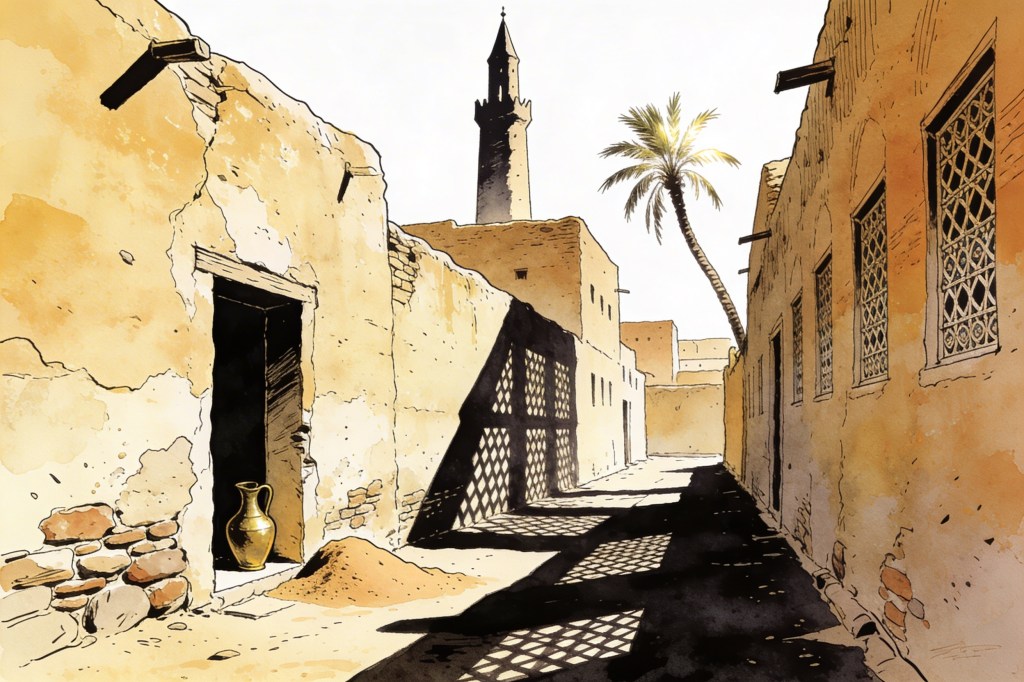
La Gueïlla, our guesthouse, finally emerges behind a crooked line of palms. All hand-chiselled sandstone and warped timber, patched together like somebody’s grandmother’s idea of a fortress. The courtyard is a mosaic of mismatched carpets, teapots, and lopsided chairs. I spot a trio of goats plotting an uprising by the fountain.
Inside, the light is thin, filtered through latticework and dust motes that float like philosophical questions. The walls are cool and thick, layered with faded Berber rugs and a collection of brass jugs that probably carry more stories than most people I know.
The proprietor greets us with that quietly suspicious warmth reserved for foreigners who don’t thrash in their sleep. Karim haggles for privacy; I haggle for extra pillows. The room is simple—stone, mat, handwoven throw, the kind of silence that carries the weight of old manuscripts.
I collapse onto the bed as the call to prayer drifts from the mosque, echoing across the dunes.
My tea cools untouched as the courtyard settles into the hush of afternoon. Chinguetti is both suspended and enduring—every stone a palimpsest, every shadow ringed with waiting stories. I’m here for them; the project is more than work, it’s a kind of devotion.
My phone erupts with reminders that the outside world refuses to loosen its hold.
Mrs H calls first. Her clipped London accent spares no mercy. “Elena, enough is enough! I want you back in London, now. You are—” I let her voice wash over me, all indignation and threat, the edges of a contract fluttering far away in a different life.
Before the silence can settle, a message from Hasna appears: Where are you? Please, Elena. I heard something. Just send a word. If you need me, I’m here. My throat tightens. With Hasna, worry is never currency—just care, given freely.
Then Tarmo.
His name sits on the screen, heavier than the rest. His words are precise, almost neutral. All is secure at the new location. The road ahead is clear. You may advise if you require extraction. I hope you’re eating well. —T.
Anyone else reads this as business—a logistical report stamped with care. Only I trace the anger with its undertone of affection in the clean lines, the way his silence presses up against the words, the way even the hope about my meals reaches all the way back through years and the aeons he claims connect us. He is a stoic man; his love has always worn armour.
I breathe out, slow. Whatever Mrs H’s fury, whatever Hasna’s worry or Tarmo’s silent gravity, the path I walk is mine. I send Hasna a quick I’m safe. Promise. With Tarmo, I wait a moment, then type only: Chinguetti called. Stories come first, as you know. I’m well protected.
The call to London will have to wait.
Before I can make any consequential decision—run or stay, fight or yield—I have to walk. I need to see what endures here, to sense the tempo beneath the quiet. Chinguetti is no ordinary waypoint. The air is thin with sun, thick with memory.
I slip from the guesthouse, notebook tucked under my arm, and drift into the labyrinth of sandy lanes. Each step over stone is a lesson: a city founded in the eleventh century, washed in centuries of camel caravans and golden trade, the crossroad of North Africa’s ambitions and faith. It’s impossible not to picture those old caravans, bundles piled high, threads of commerce tying places I can barely pronounce.
But it’s the libraries I want first—those sanctuaries of fragile manuscripts, those time-capsules lined with the trembling edge of loss. Mamoud’s collection began in 1699, hundreds of books on everything from the Qur’an to astronomy, each one more at risk with every gust of desert wind. The Habott library, older still, with manuscripts that could crumble in my hands like ancient wafers. Even their methods of preservation—sun, salt, vigilant hands—sound like rituals far older than print.
The desert presses closer every year; the sand here is a predator, and the green belts people have planted, the grand continental walls, most of the roots haven’t lived long enough to matter. I brush my palm across a blackened trunk in the market square and wonder what will survive—parchment or root, memory or story.
People pass me—children in faded scarves, elders whose faces have weathered more sand than I ever will, the odd cluster of tourists blinking through camera lenses at what’s left. I catch fragments of their talk, local gossip threaded with old Arabic prayer, and tuck every word away.
My work here isn’t touring. It’s listening. The city is a living manuscript, and perhaps it’s waiting for someone to help tell its story before the last page is lost.
I make a note to visit the Ahmed Mamoud library, to find Ahmed Ould Habott if he’s willing to talk. The solution might not be more walls or trees—maybe it’s in the work I came to do: bearing witness, stuffing as many voices as I can between the pages of my journal.
A gust of wind whips dust off the stones and stings my ankles. I smile wryly: even the desert can’t keep a determined woman indoors.
I weave through the sun-glazed alleys, every sense alive, the call to prayer chasing shadows along the sand-white walls. The village hums quietly—children playing near an old well, a boy offering dates with a conspiratorial wink, women crouched in doorways sorting mint and stories.
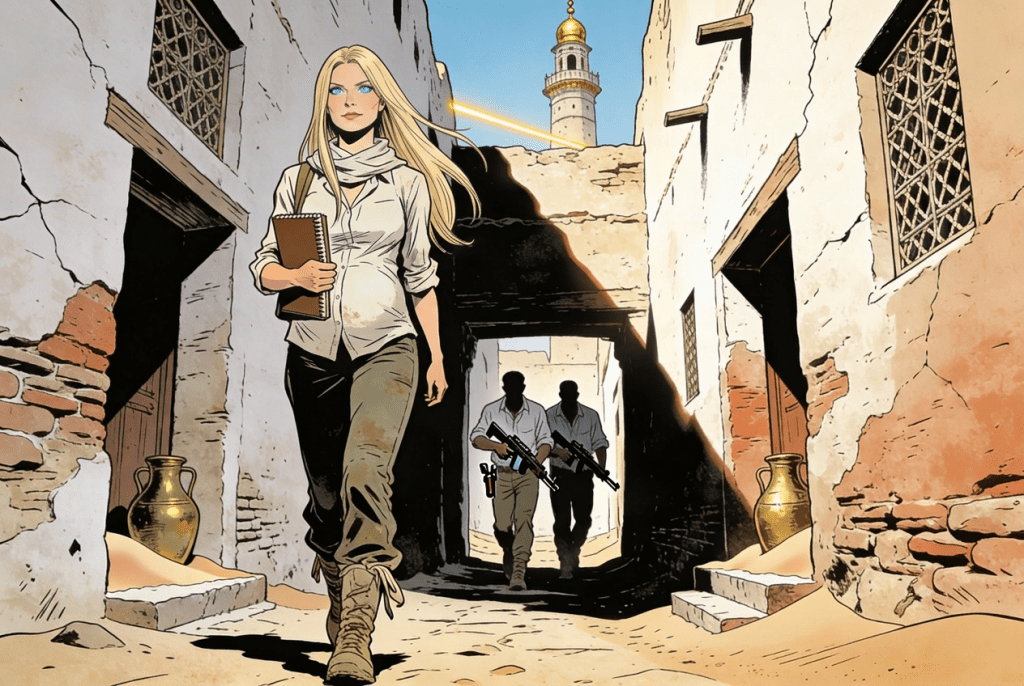
Karim and his armed satellites keep a tight orbit—never closer than ten paces, never farther. Their presence is a stone in my shoe, a constant itch between my shoulder blades. I can’t blame them entirely; Tarmo’s orders, I imagine, are as relentless as the wind. But the absurdity grates: an anthropologist with her own silent phalanx, as if I were some sacred relic instead of a woman hunting tales.
At the market, I pause, feigning interest in baskets of figs. The stall keeper, a wiry man in a faded melhfa, grins at me. “You are the English stranger? The one who writes?”
“Dutch,” I say. “I’m documenting stories. The libraries, the old days—the desert.”
He nods, gesturing toward the bookseller’s dusty nook. “You should speak to Ahmed Mamoud, or the old women near the mosque—they remember things better than anyone.”
Behind me, one of the guards looms. The bookseller gives him a wary side-eye before returning to me, voice lowered. “Careful with your shadows, Madame. This is a city of listeners.”
I thank him and set off down a lane swirling with sand—and frustration. Every time I pause, Karim materialises as if conjured by my irritation. “We move together, Elena,” he insists in his gravelly French.
“I can’t do my work trailed by armed men,” I snap. “I am not a gemstone or a conquering queen. I’m here to listen, not intimidate.”
He shrugs, unmoved. “Tarmo wouldn’t forgive me if I let you out of my sight. You know the risks.”
“If you must follow, do it less like a bodyguard and more like a shadow. Pretend I’m just another guest, please.”
A woman at the communal oven—flour-dusted, bright-eyed—offers bread with a smile and an arch of her brow at my entourage. “Too important to walk alone?”
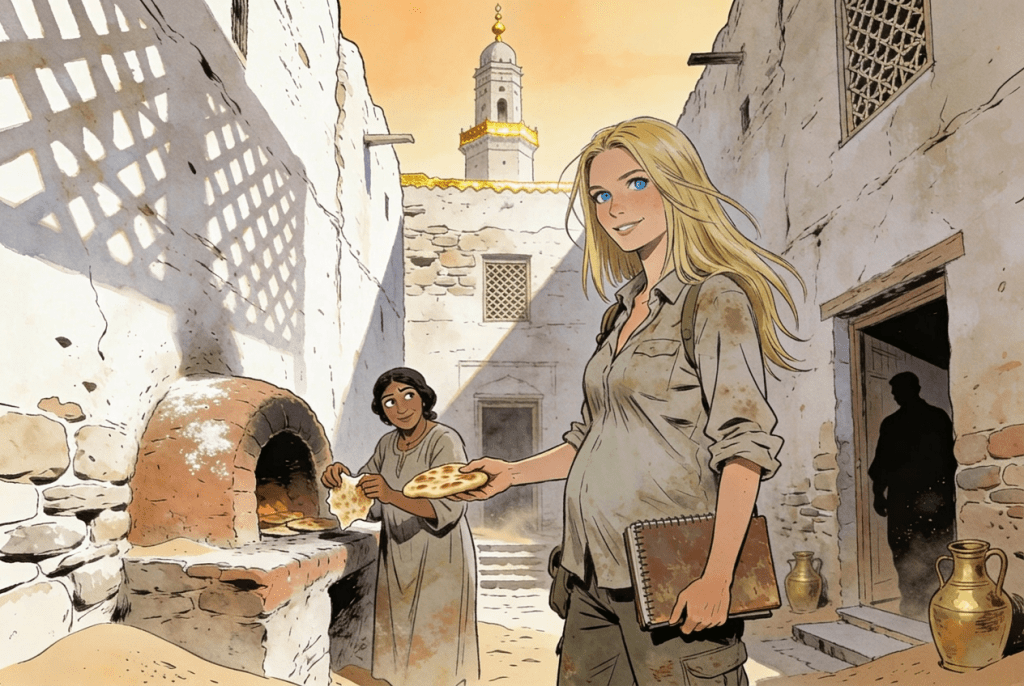
I grin, taking the still-warm flatbread. “Apparently. My only crime is curiosity.”
The woman laughs, and the group around her shares knowing glances at the sight of my patient, bristling tail.
As the day stretches on, I gather fragments—an old poem half-remembered in the library’s cool shade, gossip from a water vendor, laments about the desert creeping closer every year. I jot hurried notes, pretending I’m invisible, even as my companions ward the world away.
Chinguetti glows on the edge of things—a city built for lost causes and searching souls. If I’m lucky, dinner will be couscous and a story. If I’m unlucky, at least I have my own door.
I.Ph.
 The C.O.M.C. Files