
Chapter 31
The Black Script
Most of the stories I collect aren’t buried in clean sheets or whispered behind clinic walls. They drift like I do, carried by wind and memory along the old caravan roads. When the merchant’s wife mentions Chinguetti, her voice drops. “City of libraries. Find Amal. Ask for the black script.”
That’s enough.
Tichit coughs up another tepid morning — dust, prayer, leftover lamb. The guesthouse reeks of antiseptic and overcooked meat. The doctor fusses, the Marabout mutters, Tarmo hovers from afar dispensing meaningful warnings and implied prohibitions. The boredom is almost criminal.
I think about it anyway.
I’m sprawled on the dusty veranda nursing bruises and restlessness when Karim materialises — brooding in sunglasses, half-bodyguard, half-grumbling shadow, apparently convinced his sole function is preventing my next kidnapping.
“A little road trip,” I suggest, waving a battered guidebook. “Chinguetti. Ancient manuscripts, sand, existential malaise. Think of all the people who haven’t kidnapped me yet.”
Karim rubs his temples. “You’d sell your left arm for a legend.”
“Occupational hazard. Besides, Amal is expecting me, and my Arabic is mostly limited to ordering coffee and apologising for everything.” I pause. “Your paranoia is my secret weapon.”
He sighs toward the satellite phone, then back at me. “Everyone in Tichit thinks you’re trouble.”
“That’s ethnography.” I stand. “Fuel up the Land Cruiser.”
He grumbles. But nobody out-stubborns an anthropologist with a name and a direction.
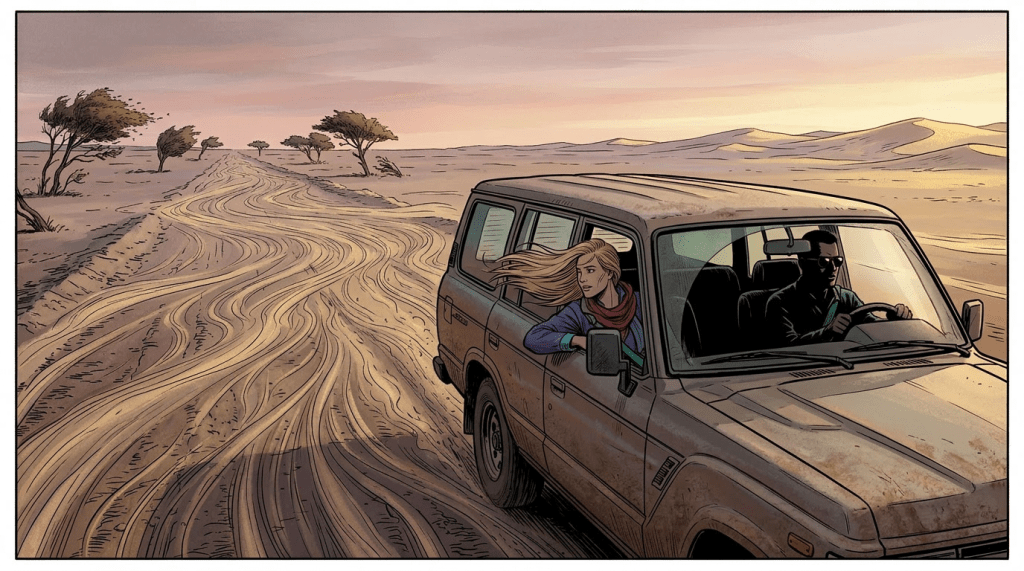
By first light we’re rolling north, bouncing over sand-slashed roads. No drama, no bravado — just the relief of motion. I’m not running from anything. I’m chasing voices, the way I always have, the way danger always seems to find me in return.
Karim scans the horizon. Counts suspicious Jeeps. Eyes wandering camels. I narrate the drive like a documentary host — ruined caravanserais, wind-bent acacias, nomad tents patched with satellite dishes, children chasing goats while their grandparents recite poetry to no one in particular.
We stop for tea at a roadside stand that doubles as a rumour mill. Old men trade proverbs about Chinguetti’s lost libraries and lost sons. Karim translates, deadpan. I swap my last piece of chocolate for a story about a manuscript hidden in a clay pot behind the mosque — the kind of story that’s either completely true or true enough, which in Mauritania amounts to the same thing.
The sun climbs. The landscape flattens, blurs, turns gold then grey. Sand eddies twist across the piste, painting moving maps across the road, and I lean out the window with my hair going wild and let the rhythm carry me.
Karim cracks a joke about camels having more sense than anthropologists. I tell him if anyone tries to kidnap me this time, he gets two pages in the memoir. He mutters something impolite.
The tension’s gone.
Chinguetti rises from the dunes like a mirage — a stray call to prayer curling through stone alleys, manuscripts waiting in shadowed rooms. Sand in my shoes. A name in my pocket. Karim behind me, suspicious and loyal in equal measure.
Uff, can it can any better?! Hell yes, it bloody well can!
History rarely feels this bright or brittle.
But I’m here for stories. Mauritania can find me in the library.
I.Ph.
 The C.O.M.C. Files