
The Chronomancer and the Twins of Time
The next morning, Karim rises hollow-eyed, every movement edged with the fatigue that follows a night spent wrestling with ghosts. Though he dresses with precise care, as if routine can anchor what feels suddenly adrift within, I sense the change at once—the subtle withdrawal, his gaze fixed somewhere I can’t reach.
“Rough night?” I venture, keeping my tone gentle.
He shrugs, not meeting my gaze. “Long drive ahead. That’s all. We shouldn’t waste daylight.”
I want to ask more, but something in his posture warns me off. Instead, I follow him out, the air briny and sharp.
But the road waits, indifferent to moods or memory. The streets of Nouadhibou, ghosts themselves in the half-light, already feel like they’re receding—windblown, stung by salt and neglect. The harbour is haunted by the bleached ribs of dead ships, scavenger boys and storytellers weaving between them with practised tales and furtive glances.
“There’ll be stories in Nouakchott,” I try, half-teasing. “Perhaps something to distract you.”
“We’ve enough stories of our own,” he says, dismissing a cluster of street storytellers with a curt shake of his head.
I raise an eyebrow but let it go. I follow, silent, trusting his reserve will pass. In the car, silence presses between us until the road has unspooled well beyond the city’s edge.
I break it softly.
“Karim, you don’t have to carry it all yourself.”
He grips the steering wheel harder, jaw flexing.
“Some loads are meant to be carried alone.”
We drive south, the city falling away as quickly as an old dream. The highway shimmers in the heat, the landscape reduced to sand and sky and vibration: endless monotony, the world stripped bare. In the car, our silence grows louder than the engine. Karim’s jaw works, hands tense on the wheel, but his mind roams elsewhere, worrying old wounds.
Nouakchott erupts around us in chaos—a city never truly at rest. Goats flow through traffic, vendors call in a hundred languages, children dart and disappear, and color spills from every market stall. Our old passion is unchanged, but something else between us is. If I notice Karim’s unsettled quiet, I let it be, content to orbit him, gathering what fragments of comfort I can in the electric air of the city. There will be time, I think, for whatever has shifted in him to settle into words.
Nouakchott’s chaos eventually forces conversation. Karim negotiates for the 4×4, haggling half-heartedly, pausing only to mutter to me:
“Make sure the spare holds air. And count the money twice. I don’t want surprises.”
I do as told, watching him from the corner of my eye.
After a day spent resting in our hot, idle, fan-swept room, we return to business. The fragile Peugeot is traded for a battered 4×4, all angular threat and diesel reek, its back seat packed with spare cans and tools for the journey east. Karim negotiates in a monotone, distracted, his attention snagged by half-seen worries. I keep my head down against the glare, organize our meagre cash, and take point in the negotiations—my practical resolve the only thing anchoring our plans. Hasna’s silence presses at the edge of my thoughts, her unanswered message a splinter in my calm.
That night, while repacking by the window of our faded hotel room, I finally try once more.
“You know I’m here, right? Even when you go silent.”
He looks up, for the first time that day, and the old warmth flickers behind tired eyes.
“I know. I do. I just…sometimes it’s easier to drive than to talk.”
“We’ll find our way. Even when the tracks vanish,” I say, squeezing his hand.
We set out—past the city limits, into the unyielding openness of the desert. Out here, the world dissolves into a geometry of emptiness: bone-white sky, ochre plains, brown thorn and broken stone. The road is no longer a road but a guess, a promise—and as the afternoon fades, I watch Karim lose our way, his inner compass spinning with the unresolved troubles he carries. The desert presses closer, wind gusting in sullen squalls.
The next day, as the desert swallows the road, Karim disappears into thought. Dust begins to rise, and a storm threatens on the horizon. When he misses a turning, I try to inject humour into the unease.
“If we end up in Timbuktu, you’re buying dinner.”
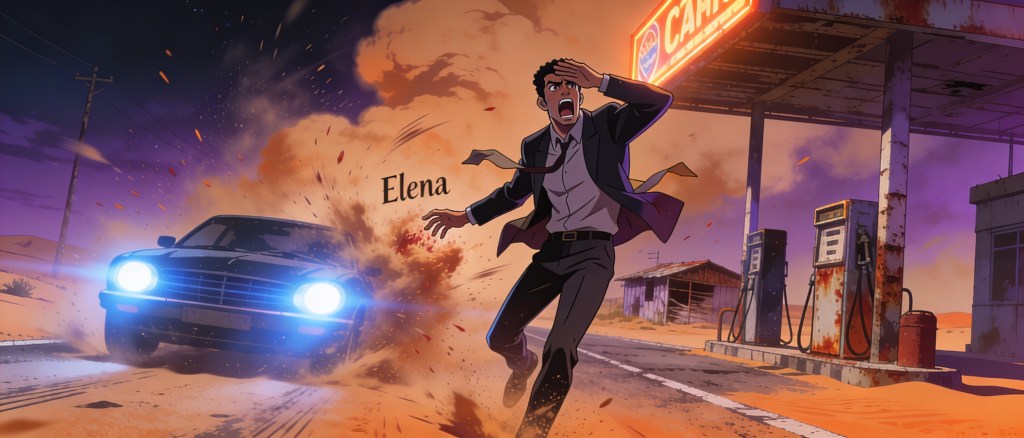
He gives a distracted smirk. But then, without warning, the storm hits. The sky collapses into shrieking ochre, wind driving clouds of sand so thick the world shrinks to the arc of headlights and the rattle of grit against steel. Blinded and desperate, we stumble on a battered gasoline station—a battered sign flickering weakly above rusted pumps, its shack warped and battered by old storms.
Karim pulls under the awning, kills the engine, and sits motionless, listening to the thunder of the wind. He stares at the swirling sand. After a moment, he turns—
“Elena, do you—”
But the seat is empty, the passenger door flapping wildly in the gale.
“Elena?”
His voice splits the wind, hope already thin.
No answer. Only howling desert.
He stumbles out, panic clawing at him.
“Elena! Where are you? Elena!”
KAREEM
I lose her in a wall of sand. One second she’s next to me, muttering about Timbuktu and bad roads, and the next there’s just the door banging itself stupid in the wind.
I shout her name once inside the car. Useless. The storm eats the sound before it even leaves my throat. So I get out. Maybe it’s a bad decision, but staying put while she’s out there isn’t an option. Not for me.
The sand hits like a slap. It finds every gap in my clothes, every old scar. I can barely see the pumps—just hunched shapes in the orange mess. I keep moving anyway, one hand over my eyes, the other out in front, like I can drag her back by will alone.
“Elena!” I don’t know how many times I say it. A hundred. A thousand. Each shout comes back thinner, like even my own name for her doesn’t believe me.
I trip over the curb by the station and go down hard. Good. Pain means I’m still useful. I push up, turn in a slow circle, looking for any break in the sand, any outline that isn’t rusted metal and bad decisions. Nothing. Just the storm, working over the building like it wants to erase it.
That’s when the old feeling comes back—the one from Nouadhibou. Eyes on us. A car in the mirror too long. The kind of attention people pretend they don’t see, because once you admit it, you have to act. I told myself it was nothing. Professional paranoia.
I lean against the wall, sand grinding between my teeth, and do the maths: open door, no footprints I can see, visibility gone, that itch between my shoulders. The conclusion isn’t complicated. Someone has been waiting, and I walked her straight into it.
People talk about their hearts “breaking.” Mine doesn’t. It just drops a few inches lower and settles there, heavier. This is on me.
The storm will pass. The tracks might not. No words, no sound, just the merciless wind and absence where I should be.
Elena
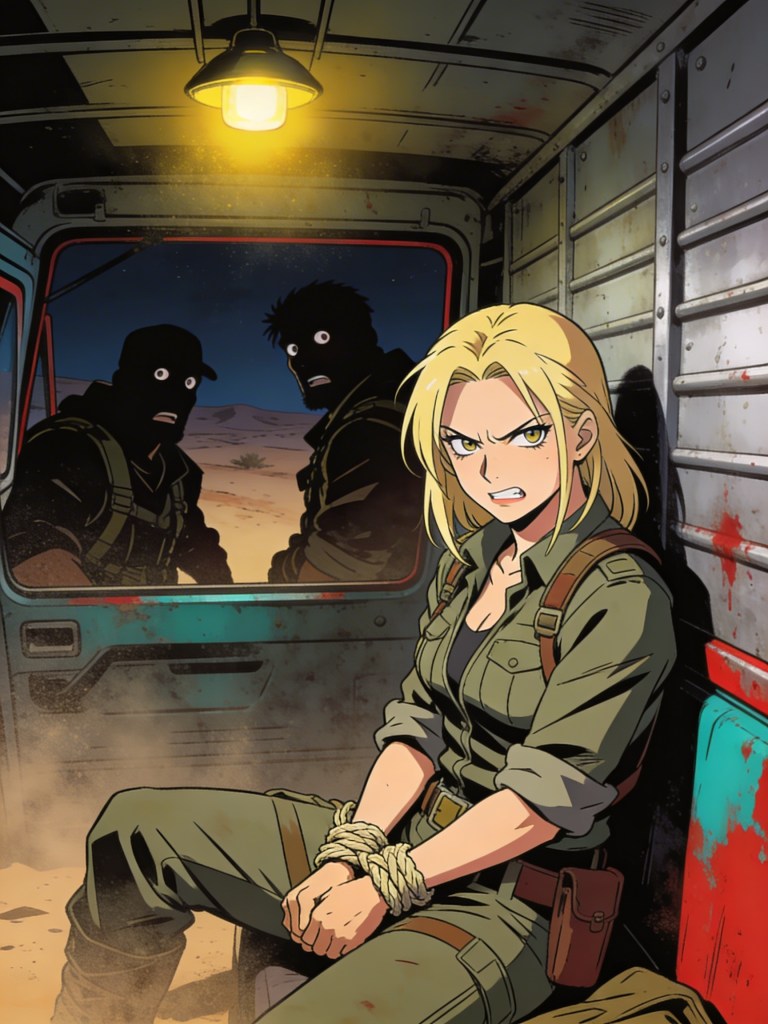
Far away—I don’t know how far—I regained my senses in a rattling, musty vehicle. My eyes stung; my wrists were bound in front with a rough cloth.
The truck’s engine rumbled through the darkness as my eyes fluttered open. Pain shot through my skull, and the metallic taste of blood coated my tongue. As consciousness fully returned, so did my fury.
“What in the fresh hell?!” My crisp London accent cut through the stale air like a blade. My captors exchanged startled glances—this wasn’t the reaction they’d expected.
“This does it! I definitely need another job, motherfuckers!” I spat, struggling against my restraints with surprising vigour.
They had anticipated tears, pleas for mercy, broken sobbing. Instead, they got a woman mentally updating her résumé while cursing them out.
“Third time in what—two years?” I muttered to myself, my voice dripping with professional exasperation. “Definitely time for another job. Or maybe I should insure myself like those famous people do—their legs, their arses, whatever. I am so done with this shit.”
Somewhere beyond this choking dark, Karim was braving the sandstorm—stumbling past battered pumps, bellowing my name until his voice went ragged. I could picture him fighting every step, the wind ripping at his clothes, grit sealing his eyelids shut. He must have been tripping over curbs, scanning that orange-violet dusk for any twitch, any sign I was alive. His panic—how deep did it bite? The wind answered him with its own howl, nothing more.
I.Ph.
 The C.O.M.C. Files