
The Chronomancer and the Twins of Time
Departure Morning: Atlas Village
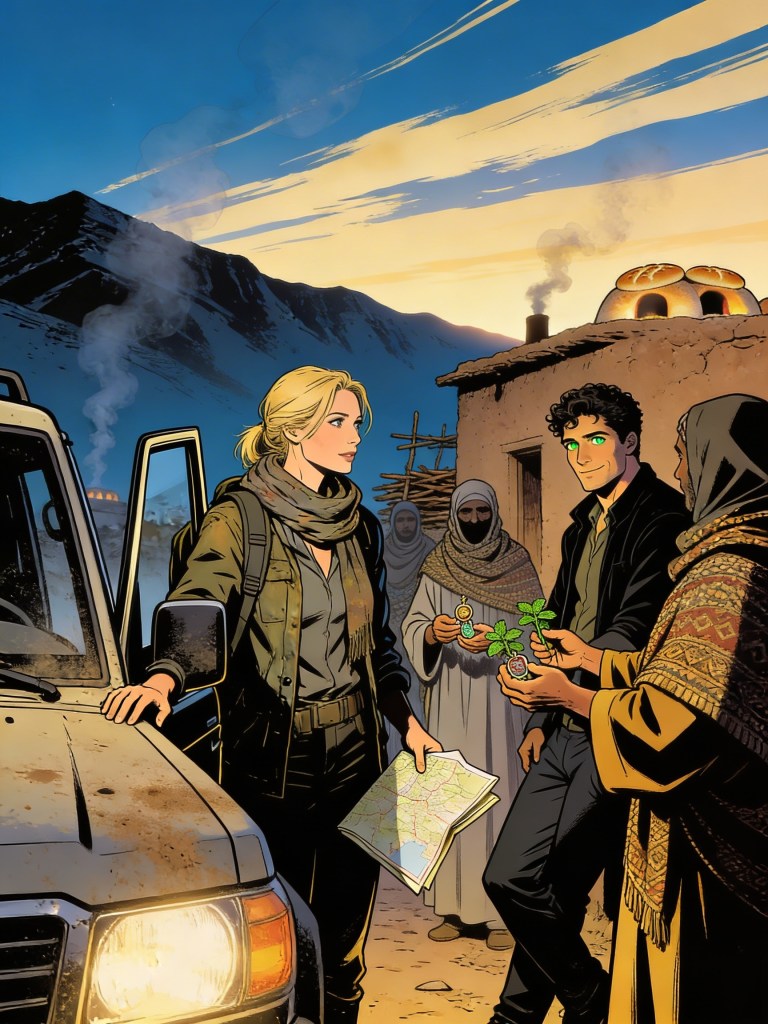
The sky is streaked with pale gold and indigo as the village begins to stir. We are greeted by the aroma of baking bread and woodsmoke wafting through the mountain air. The villagers, wrapped in woven shawls, beckon us into the communal room, where rugs are spread and bowls of honey, olives, and thick white cheese await. Mint tea steams in glass cups.
“Sit, eat with us before the road takes you,” offers Lalla Fatima, the elder, her voice both commanding and comforting.
Karim kneels beside me as the bread is broken and passed hand to hand. He smiles at me, holding up a piece slathered in wild honey.
“Fuel for the journey. If you can survive Hassan’s tea, the border guards will be easy.”
Laughter bubbles around the room. I grin, accepting the tea, wincing at its sweetness, but feeling the warmth in the chest more from the company than the drink.
As breakfast quiets, Karim unfurls a map etched with notes and bright marker lines. He spreads it on the rug before us.
“Alright, here’s the plan,” he says, tracing our intended path. “First, we drop down these valleys—look, the descent is sharp here, but we’ll pass walnut trees and old Berber towers all the way to Agadir.”
“How soon do we hit the ocean?” I ask, eyes bright with anticipation.
“Half a day. You’ll scent the sea before you see it. We’ll hug the Atlantic along the N1—not just a road, but a ribbon between worlds. Tiznit is old, full of silver and stories. Laâyoune waits for late lunch, Dakhla for sunset and maybe kitesurfers.”
One of the villagers, Youssef, interjects:
“In Tiznit, ask for Hajja Zohra at the café. Tell her you know us, and you will not pay for bread.”
I chuckle, jotting this in my notebook. Karim continues, finger moving south:
“Then the long drive—sand, wind, and the line of the coast. Border at Guerguerat—never the same twice, patience is your shield.”
“After we cross?” I ask.
“Nouadhibou for rest. Nouakchott for news and repairs, if we need. Then, inland—the road thins, but the stories thicken. Mahadra waits with open ears.”
Lalla Fatima leans in, her eyes kind but serious.
“Travel with open eyes and humble hearts. The road teaches more than any map.”
Karim rolls up the map and looks at me.
“What do you think? Any changes? This is your journey.”
I consider, then nod slowly.
“Let’s keep it loose—time for detours, and time to linger where the stories are thickest. But yes, I’m in. Let’s go hear the ocean again.”
A hush of anticipation. The villagers gather to say farewell, pressing tiny amulets and bits of mint into our hands.
“When you eat bread far from here, remember us,” one whispers.
We leave the village, hearts full, the air crisp and clean behind us, the long road promising Atlantic blue and desert unknowns ahead.
I write my decision in an email to Hasna.
Subject: Field Expedition: Communication Protocol and Collaboration Framework
Dear Hasna,
I am writing to confirm that I will undertake this trip on my own terms, rather than by the dictates of the questioned countries.
Throughout my travels, I will inform you of each arrival, sending the raw material directly to Mrs H. She will be responsible for organisation, curation, and sharing as necessary, provided that the approach continues to be supported by UNESCO, the African Union, and the Amellal Heritage Trust.
Should institutional support be withdrawn or prove insufficient, I am prepared to independently fund and publish the findings. In this event, I will ensure that all collaborating communities receive their own CYcrds, recognising and celebrating their vital contributions. The university will also receive a complete record of the work.
You can expect regular updates from me at each milestone—unvarnished and unscripted, in the true spirit of the Mahadra.
I trust this aligns with the expectations we discussed.
Kind regards,
Dr Elena Delange
I.Ph.
 The C.O.M.C. Files