
The Chronomancer and the Twins of Time
“Child of cities—you may name them metaphors. We name them truths, wrapped in song. And remember: bridges don’t ask what walks across them. They only tremble.”
She gazes at me, eyes deep and unblinking. For a heartbeat, time feels suspended.
My heartbeat thunders in my chest, but I master my expression, masking all. The courtyard feels oddly cool despite the sun outside; even the birds seem to pause. Karim, at his post by the gate, glances over, sensing something has shifted, though he cannot name it.
Lalla Fatima gives only a small, knowing smile, the corners of her lips barely moving.
“You can begin your questions now, daughter,” she says quietly, as if the song has been a mere formality. “The mountain listens with us.”
Her gaze lingers a moment longer—a silent verdict and a blessing, both. My pen hovers, the recorder light blinking red, but I hesitate before saying, in a voice calm and professional, “Thank you, Lalla Fatima. Please—tell me about the first story you ever learned by heart.”
The old matriarch begins to speak of rain, famine, and grandmothers under almond trees, slipping seamlessly into oral history, as if ancient truths and everyday reality are separated by nothing at all.
And so, the interview begins—while the knowledge of what Lalla Fatima has sung, and the knowledge of what I carry, hang in the air between us: unspoken, undeniable, and as eerie as the hush that follows a dream foretold.
As dusk stretches violet and blue against the stony slopes, the villagers—inviting as any rural hosts—insist that Karim and I stay the night. Food is spread on low tables: stews laced with cumin, flat rounds of bread, sweet mint tea poured high. Gradually, others filter in: cousins and elders, teenagers and shepherd boys. The air is soft with laughter and music, until someone rushes to the firelight, breathless, and cries out in Tamazight, “ⴷⴰⴷⵅⴰⴷⵉⵏⴰ! (wolf!)—A wolf is roaming!”
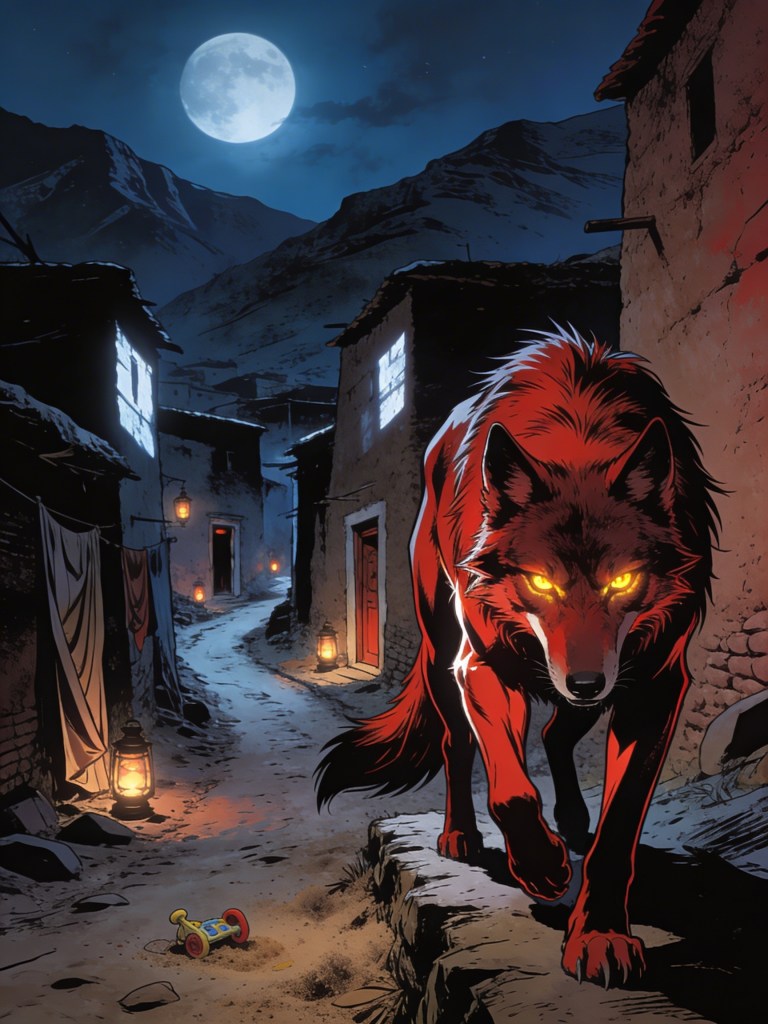
A low susurrus ripples through the circle. The younger men stand, eyes sharp, exchanging worried words about how there is no pack in these valleys—not in decades. For a moment, the mood teeters between the ancient fear of the wild and the thrilling pulse of collective defence.
In the midst of this, a woman bends and whispers in Lalla Fatima’s ear, her eyes sliding to me. The old matriarch nods, and with a rich, clear voice calls out, “Be at peace—she is Dr. Delange, the one who saved our site in Dakhla.”
A different hush follows—recognition, gratitude, a subtle recalibration. The tension dissolves as quickly as it rises. The music resumes, laughter rises again, and a drumbeat starts up among the youth.
Karim and I are escorted to our lodging: a traditional gîte d’étape of mudbrick, the walls thick against the mountain night, flickering lanterns casting gold shadows. Inside, the cold seeps from the floor, but the blankets are heaped high.
Karim averts his eyes as I freshen up, stripping away the dust of the road and donning the offered dashiki—bright with borrowed colour, ill-fitting but comfortable. I turn, glancing at him, eyebrows arched in mischief.
“It’s far too cold for stoic virtue,” I tease, “and I can’t think of anyone better suited to guard me from wolves—real or otherwise—than my Arabian stallion.” My smile is both a challenge and an invitation.
Karim’s reserved composure breaks with his first genuine grin of the day. He sheds his shirt and dives beneath the covers in a single, practised motion born of mountain nights, not seduction. Still, his bare chest, the flash of muscle—I look away at the last second, but I cannot pretend I am quick enough.
Warmth, closeness, the day’s wildness: it all curls around us as the night presses in and the music from the fire drifts softly through the mudbrick walls.
For the first time in a long while, I let myself laugh, surprised by how much I’ve needed it.
Outside, the drums continue—echoes of legend, old fears, and the living, breathing present.
As night deepens and the last voices from the campfire fade, Karim and I lie together in the thick warmth of the mudhouse. The mountain’s cold presses in close, and the heavy silence brings our breathing into gentle synchrony.
Karim’s voice is almost a whisper in the dark. “The villagers… They say it was a wolf tonight. Did you know Asdar is sometimes called ‘the wolf’ in old stories?” His tone holds a cautious curiosity, a question long half-asked.
I hesitate, then shake my head softly. “He may have many names. But if it were Asdar, I would know. I… there’s something that happens to me in his presence. Literally.” I let myself smile wryly in the dark. “When he or Tarmo are near, I ooze golden liquid from my nipples. It’s as impossible as it sounds. Tonight, nothing.”
Karim absorbs this quietly, the way he always does—with acceptance, not disbelief. His hand finds mine under the covers, gentle and warm.
After a moment, I shift closer, nestling against him, finding comfort in the simplicity of shared body heat and unspoken trust. Karim wraps me in his arms, breath slow and careful. “I promise to be a gentleman,” he says, a smile audible in his words.
I lift my head and press my lips to his jaw. “You have been more than that, Karim. Always.”
That is how we drift into sleep: two souls who, between them, have known passion, danger, loyalty—and a trust that outlasts circumstance.
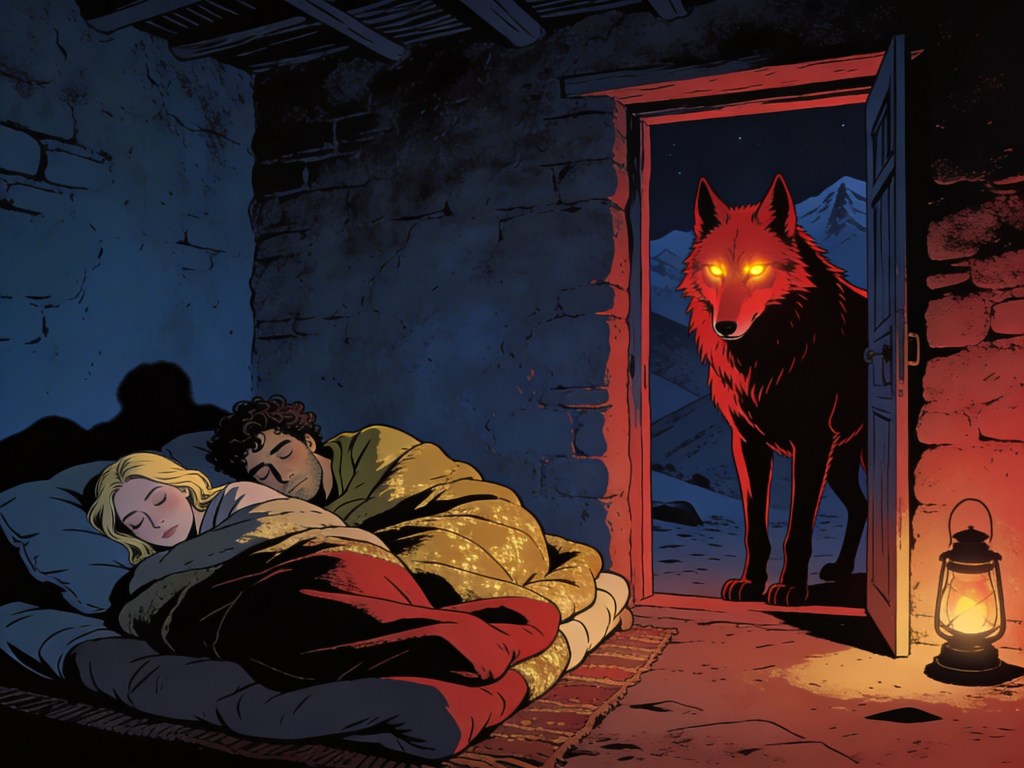
In the depths of the night, I stir. An instinct tugs me from dreams—the sense of another presence close by. I open my eyes to find, in the dim lantern-glow, a golden wolf sitting on the rug beside my bed. For a moment, fear spikes—then confusion.
But my body gives a sign, a tidal wave of golden milk. I simply watch, heart steadying, as the wolf’s eyes lift. They are a deep, impossible gold—the unmistakable colour of Asdar’s gaze.
I reach out, tentative. The wolf presses its nose to my palm—a velvet warmth, a silent benediction—then it nuzzles into the golden liquid coming out of my breasts. After, it gracefully tiptoes out the door, vanishing like a figure from a half-remembered legend.
I slide closer to Karim, nestling deeper in his embrace, and kiss his cheek. Even in sleep, he stirs and pulls me more firmly against him.
Before sleep claims me again, I smile in the darkness and think, with a profound gratitude:
How blessed am I—to love so many, and be loved in return.
I.Ph.
 The C.O.M.C. Files