
The Chronomancer and the Twins of Time
By the time the car pulls out of Marrakech, the late morning sun is already slanting gold across the ochre walls and crowded souks. Street vendors call after each other, the scent of coriander and diesel tangled in the air, and children dart between mules and scooters with the fearlessness of the city-born. I sit quietly in the back seat, the din sliding past the glass like another world withdrawing from me.
Karim holds the wheel with his usual calm. He has driven me through cities and deserts, coastlines and vineyards, and he remains unchanged: steady hands, patient breath, his emerald eyes fixed on the road. Never prying, never pressing—simply there. A sentinel since the beginning.
The climb begins gently, but soon the road rises into winding switchbacks. The air thins as the landscape stretches open: ochre hills rolling into deeper rust, then breaking into abrupt cliffs veined with green barley terraces. The last palms give way to almond groves, then the unmistakable austerity of mountain stone. Villages cling to slopes like clusters of clay, smoke rising in thin threads from rooftops. Women bend in fields, their bright scarves flickering like birds against the vastness.
I keep my gaze outward, but my thoughts press inward—turning again and again to the sealed email on my phone, to the phantom pressure in my belly, to the sense that I am both being carried forward in Karim’s care and climbing into unknown shadow with each curve of the road.
A truck rumbles past, laden with sheep, their cries cutting momentarily through the silence inside the car. I glance sideways, our eyes meet briefly—his steady, mine unreadable. No words pass between us. None is needed. His loyalty is something I can rely on without needing to ask.
I draw a long breath. The altitude sharpens the wind slipping through the window crack, cool against my cheek. It smells faintly of cedar. The Atlantic air of the city is behind us now; ahead lie the darker mysteries of the Atlas, where memory and myth still live in flesh and voice.
Somewhere among these mountains, Lalla Fatima, the matriarch storyteller, is waiting.
By late afternoon, we reach the village pressed into a fold of the High Atlas. Houses rise in bands of clay and stone like extensions of the mountainside. Children pause from chasing a worn football to stare as Karim eases the car onto the narrow dirt track. A few goats glance up from nosing olive pits scattered in the dust.
I press my palm once more against my stomach, quickly, as if it were nothing more than settling my scarf. Then I fold my hands back into my lap and whisper half to myself, half to the mountain air:
“Let’s see what she remembers.”
Houses rise in bands of clay and stone like extensions of the mountainside. Children pause from chasing a worn football to stare as Karim eases the car onto the narrow dirt track. A few goats glance up from nosing olive pits scattered in the dust.
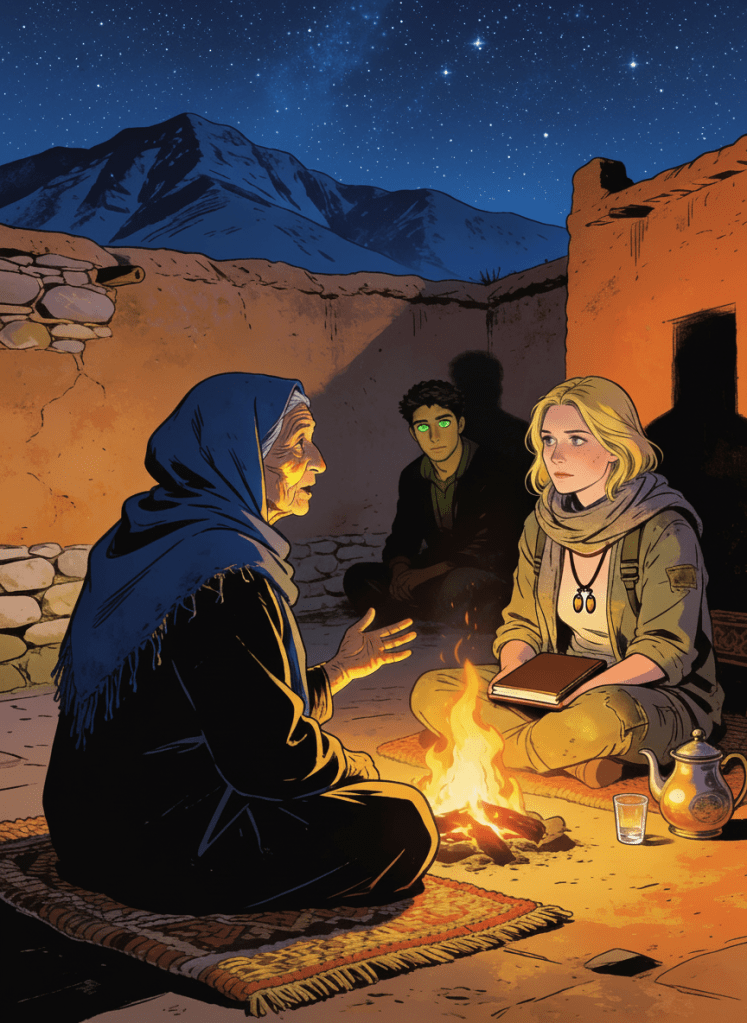
Lalla Fatima awaits us in the shaded courtyard of her house. Her scarf is a deep indigo, worn thin at the edges, her face weathered like the ridges around her. When I enter, she rises slowly—still straight-backed, her eyes alive with that impossible mixture of age and fire.
“Elena,” she says, her Amazigh accent turning the name into a softer, rounded sound. “So you have come. Good. The words are leaving us fast.”
Her voice carries the cadence of someone used to centuries of listening before speaking.
We sit on woven rugs, bread and sweet tea set before us. The customary courtesies fill the first moments, but soon Lalla Fatima leans on her cane and says:
“You have come to record voices. Then you must listen to mine before you are allowed into the circle.”
I incline my head, recorder set on the rug, notebook open. The anthropologist in me settles into a familiar posture: attentive, respectful, silent.
Lalla Fatima rocks gently as she sings, her gaze drifting unfocused, as though seeing somewhere far beyond the courtyard walls. The cadence of her izli builds, each line a fragment of stone, water, or breath carried down generations.
ⴰⵡⴰⴳⴳⴰⵍ ⴰⵢⵜ ⵜⴰⴳⴳⴰⵍ،
ⵡⴰⵙⵙ ⴽⴽⵉ ⵓⴳⵔⴰⴷ ⴷⵉ ⵉⴹⴼⵉⴷⴷⵓⵏ.
ⵡⴰⴳⴼⵓ ⴰⵢⵜ ⵓⵏⵉⴷⵓ،
ⵓⵙⵖⵓ ⵉⵙⵎⴰⵙⵙⵓⵏ ⵉⵎⵎⴳⵔⵉⴷⵏ.
ⵜⵉⴼⵔⵜ ⵜⴰⵢⵜ ⵜⴰⵎⵏⴰⵢⵜ،
ⵓⵔ ⵉⵏⵣⵉⴼ ⵉⵎⵎⴳⵔⵉⴷⵏ.
ⵜⵉⴳⵔⴰⵜ ⵜⴰⵢⵜ ⴳ ⵜⵙⵡⵉⵜ،
ⵓⵔ ⵜⵜⵍⴰⵍⵉ ⵜⴰⵎⴰⵍⵉⵜ ⵉ ⵜⴰⴳⴳⵯⴰⵜ.
ⴷⵉⵏⴰ ⴰⵢⵜ ⵜⴰⵎⴰⵎⴰⵜ ⴳ ⵡⴰⵙⵙ،
ⴰⵡⴷⵉⵏⵉⵏ ⴰⵡⴰⵙ…
…ⴰⵡⴷⵉⵏⵉⵏ ⴰⵡⴰⵙⵙⵓⵏ ≠ not one! — two!
ⵡⴰⵡⴳⵓ ⵓⴳⴰ ⵉⵎⵓⴽⴽⴰⵍ ⵓⴽⴽⴰⵍ،
ⵢⴰⵡⵉⵏ ⴰⴳⴻⵎ ⵓⴳⴰⵙ ⵉⵎⵎⴷⵉⴷⵏ.
ⵉⵙ ⴰⵏⴳⴳⴰⵍ ⵜⴰⵜⴰⵏⴳⵓⵔⵜ،
ⵙⵓⴽⴽⵉ ⵉⵜⵜⴰⴳⴳⵓⵔ ⴳ ⵜⵓⵣⴳⵉⵜ.
She falters, eyes rolling skyward as though correcting herself in trance:
“…ⴰⵡⴷⵉⵏⵉⵏ ⴰⵡⴰⵙⵙⵓⵏ ≠ not one! — two!”
Transliteration (Latin letters):
Awaggal ayt taggal,
wass kki ugradd di iḍfiddun.
Wagfu ayt unidu,
usghu ismassun immgriden.
Tifrt tayt tmenayt,
ur inzif immgriden.
Tigrat tayt g tswit,
ur ttlali tamalit i taggwat.
Dina ayt tamamat g wass,
awdinin awass…
…awdinin awassun ≠ not one — two!
Wawgu uga imukal ukkal,
yawenagem ugas immdiden.
Is anggal tatangurt,
sukki ittaggur g tuzgit.
English rendering (for clarity):
The Mountain stays silent,
but the day counts the lost steps.
The River waits unmoving,
hearing the names swallowed by absence.
The Mother guards her longing,
but the gone do not return.
The Bridge trembles in the wind,
It cannot hold, yet it does not fall.
Inside, there is a womb in the day,
At first, I said one…
…not one — two!
Two seeds are inside the cradle,
one blazing, one gilded.
The Bridge bears them both,
shaking above the abyss.
In that moment, her chant cracks the veil: she isn’t only reciting, but receiving. The pause, the correction—as though voices older than her speak through her, correcting her mouth, forcing truth out of the verse: twins. Fire and Gold.
I know then, in the pit of my being, that this isn’t just a metaphor.
The last notes fall into silence. Even Karim shifts his weight, the words press into him, though he tries to remain unaffected.
I sit motionless, pen above page, as if I am no longer the anthropologist recording verse. The imagery strikes too close—the shadows, the mothers waiting, the strange line about fire and gold in the womb.
Lalla Fatima’s gaze meets mine. The elder tilts her head once, as though listening to something beyond reach, before speaking.
“You are carrying life,” she says softly. Then, after a pause, almost to herself, “No—mistaken. Not one. Two.”
Her eyes sharpen. “Yes. Twins. One carries the fire. The other carries the gold.”
My throat goes dry. I still the instinct to touch my belly, my mask of unreadable calm locking fast over my face.
“You speak in metaphors,” I say carefully, notebook closed with ritual precision.
But Lalla Fatima only chuckles, her voice rasping like dry wood catching spark.
I.Ph.
 The C.O.M.C. Files