
The Chronomancer and the Twins of Time
I do not answer Hasna at once. My face betrays nothing—no forgiveness, no reproach, not even a flicker of guilt. Only stillness. If Hasna feels the weight of responsibility for ushering Amellal into my orbit, I know better: in the end, it is my own choice to remain in his game, to walk knowingly on the chessboard he sets. Responsibility always curves back inward.
I lift my cup and drink slowly, buying silence. Beneath my palm, against the table, I press lightly, protectively, without thought—over my belly. A barely-formed habit, almost unconscious. Three months along. No one here knows. Neither Hasna with her hawk’s eyes, nor Karim with his still, observant calm.
So when I finally set the cup down, I speak carefully, my voice even as stone.
“Let me think about it,” I say. “The scope of the work—the weight of it—cannot be taken lightly.”
Hasna opens her mouth, but I raise a hand. There is no space for further persuasion, not in this second.
Instead, my tone shifts, casual, as though moving a piece deftly across the board: “Who is the matriarch storyteller I am meeting today?”
Hasna blinks, caught off guard by the pivot, then gathers herself.
“You will meet Lalla Fatima,” she replies. “She is one of the last women of the High Atlas still carrying the izli sung-poetry in her bones. A well of memory. She is waiting for you this afternoon.”
I nod once, decisively, as if I have measured and stored the answer. “Good. Then I will consider everything you’ve said. And tomorrow—” my eyes flick between Hasna and Karim, calm and steady—“I will give you my answer.”
Breakfast unravels in its own quiet rhythm—small talk about bread and tea overlaying the heavier currents beneath. When at last we rise from the table, Hasna embraces me tightly, whispering something soft in Arabic that sounds half blessing, half plea.
“Take care,” she murmurs into my ear, pulling back with eyes full of concern. “Tomorrow, then.”
I smile faintly, steady. “Tomorrow.”
Hasna sweeps out with her characteristic energy, her scarf trailing, leaving only Karim in the shadowed room. He lingers, already calculating routes, schedules, obligations. Before he can speak, I touch his arm.
“Give me half an hour before we leave,” I say evenly.
He inclines his head without question and slips out as silently as he entered, leaving me at last in the calm hum of the house.
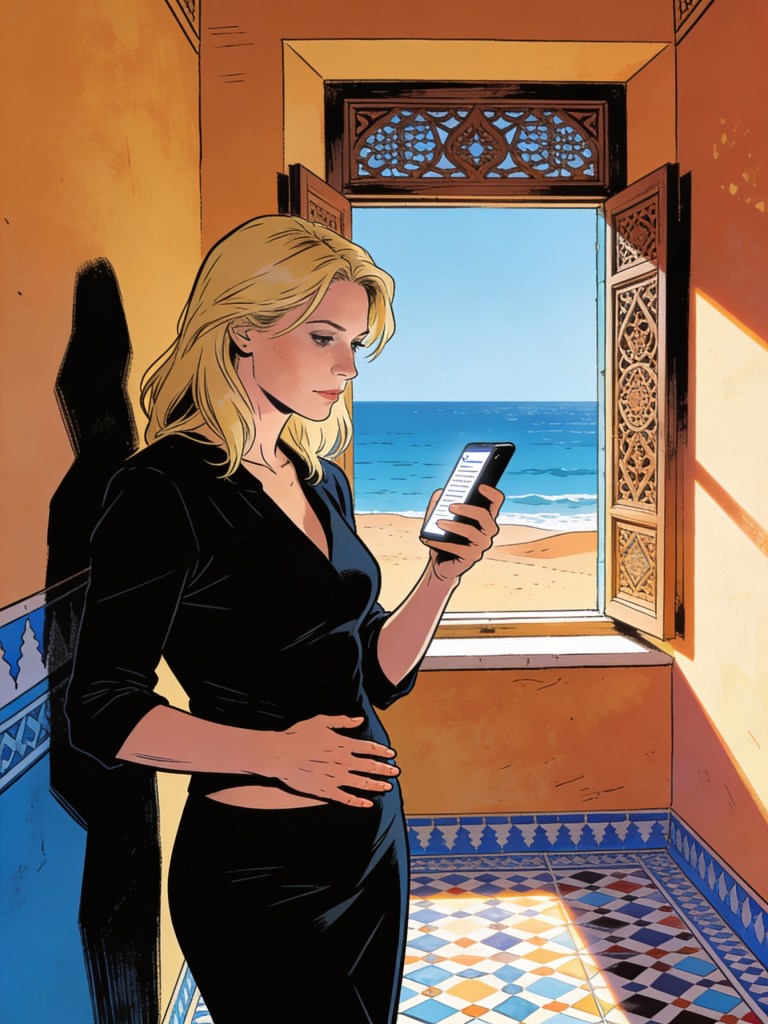
I cross to the window, phone in hand. The blue Atlantic light spills across the tiled floor as I dial. When Mrs. H’s voice filters through, crisp as always, I lean against the sill and say without preamble:
“Forward me the formal email request for the project. The one addressed to CYcrds.”
There is a faint rustle, the sound of papers and keyboard. “Elena, Hasna already—”
“I know what Hasna showed me,” I cut her off, voice firm. “What I want are the formal channels. The stamped, proper request was addressed to my office.”
A pause, then Mrs. H’s voice softens with an almost maternal concern. “Of course. You’ll have it in your inbox within the hour.”
“Thank you,” I say simply. My tone gives away nothing—not the storm of thoughts circling me, not the weight I feel pressing quietly inside.
I end the call, pressing the phone flat against the table for a moment. Then I draw a long breath, compose myself again, and turn toward the waiting day.
Subject: Formal Request for Collaboration – Joint Heritage Initiative (UNESCO – African Council – Amellal Heritage Trust)
From: Secretariat, African Council on Cultural Cooperation
To: CYcrds – Office of Dr Delange [Founder / Director]
Cc: UNESCO Intangible Heritage Division; Amellal Heritage Trust
Date: [Insert Date]
Dear Dr. Delange,
On behalf of the African Council, in collaboration with UNESCO and in partnership with the Amellal Heritage Trust, we are honoured to extend a formal invitation to CYcrds to participate in a multi-country initiative designed to preserve and transmit the oral storytelling traditions of North and Sub-Saharan Africa.
The project, provisionally titled “Echoes Across Continents: Oral Traditions as Living Memory,” seeks to:
- Identify and record traditions at imminent risk of fading, including women-led poetic forms, griot oral genealogies, and local myth-histories.
- Establish curated digital archives and regional knowledge-hubs accessible to communities, scholars, and policymakers.
- Provide training modules for local custodians to safeguard these traditions within their own sociocultural contexts.
Given your expertise in anthropological methodologies and the long-standing reputation of CYcrds as a leader in innovative heritage programming, your involvement is considered essential for the intellectual and logistical success of this initiative.
They note with particular interest my prior engagements with Mediterranean cultural projects and my recognised capacity to bridge community knowledge with institutional frameworks. It is on these strengths that the Council, UNESCO, and their local partners wish to build.
Scope and Partnerships:
Geographic coverage: Morocco, Algeria, Mali, Niger, and supplementary field-sites in Egypt and Senegal.
Institutional sponsors: UNESCO Intangible Heritage Division, African Council, in association with the Amellal Heritage Trust.
Timeframe: 24 months with staggered field deployments.
Your decision will be pivotal in confirming CYcrds’ role as the project’s principal operative hub, coordinating researchers and local liaisons. They therefore kindly request my formal reply within seven days of receipt.
We remain confident this initiative will not only safeguard invaluable cultural voices but also affirm CYcrds’ distinguished position on the international heritage stage.
With highest regards and anticipation of my positive response,
Sincerely,
Dr. Amadou Bensouda
Secretary-General
African Council on Cultural Cooperation
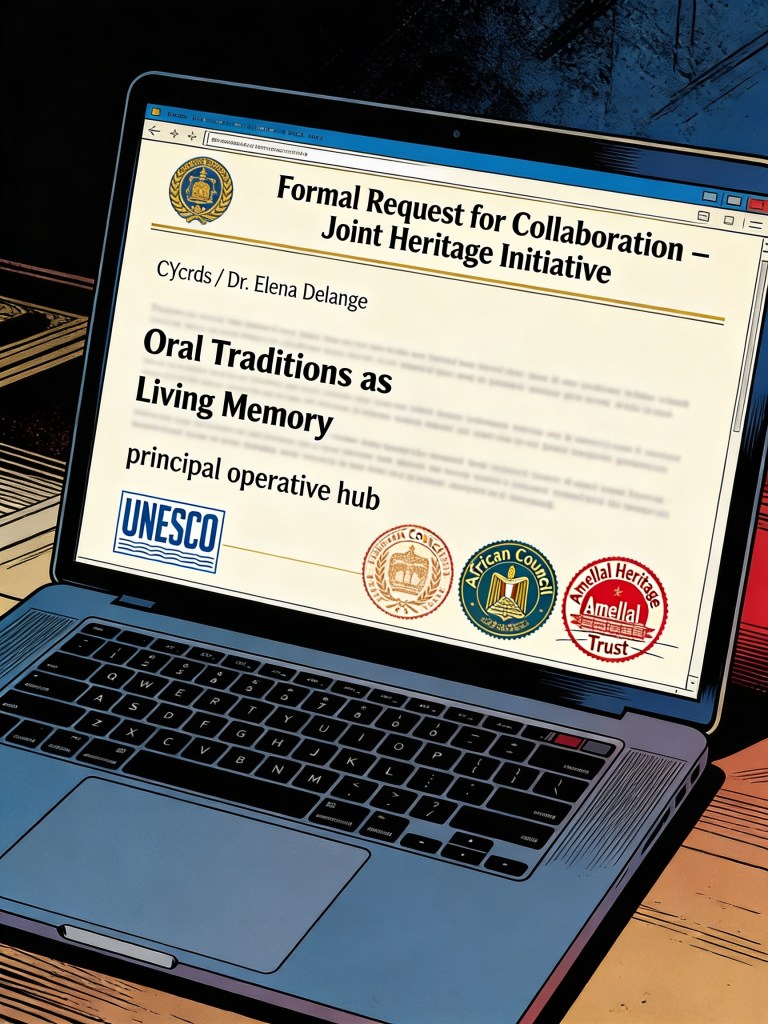
The email arrives with institutional polish, stamped and gilded by seals of legitimacy. I read line by line, lips parting barely, pulse steady though my breath thins. Every word hums with inevitability—courteous phrases meant to flatter, the jargon of “partnership” and “heritage preservation” meant to elevate CYcrds like a crown.
And behind it all, unmistakable, the print of Amellal’s hand.
I feel my heart sink, heavy and sudden, as though it has fallen to my feet.
He has told me once—in some half-lit shimmer between dream and waking—that he has searched through lifetimes, that he has walked the shadows to find me again. Words so devotion-laced they seemed like a confession, a vow. And yet here it is, the same pattern repeating: the man whose bloodline of power runs not only beside me but inside me now—coiling, forming, fathering itself within my womb—again using me as a node in his game.
A game of crowns and councils, heritage and power, all tending back toward him.
I close my eyes for a moment against the glow of the screen. Can I face this? Can I step into the thickets of the unexpected dangers that shadow any project touched by Amellal, without Sandi’s reliable grounding voice or pragmatic strength at my side?
For a brief instant, I imagine myself utterly alone: only my body, my mind, my quiet decisions stretched thin across the weight of two new lives—the one unborn within me, and the project clattering toward me, already half-claimed in my name.
The thought presses cold and luminous against my sternum.
Still, when I open my eyes again, my face is composed, my hands steady. I set the phone down calmly, as though the message has been no more than a logistical note, and inhale.
Tomorrow, I have told Hasna. Tomorrow I will give my answer.
I.Ph.
 The C.O.M.C. Files