
The Chronomancer and the Twins of Time
Night clung to the land, thick and expectant, as Asdar traced the contours of a sacred stone circle in Southern Africa.
His fingertips read the ancient grooves like braille, each depression and rise telling stories older than written language.
Alone but not alone—the air shimmered with the breath of ancestors and the distant drumming of an unseen shaman whose rhythm seemed to pulse from the very bedrock beneath his feet.
Smoke from a small fire twined upwards, carrying prayers and memories into the star-drunk sky. Beneath his hand, the old earth throbbed in silent rhythm, and the pilgrimage of his bones truly began.
The moon hung gravid and silver above the Drakensberg peaks, casting everything in pewter light.
Asdar had walked this continent for months now, following threads invisible to most eyes—ley lines that crisscrossed the land like veins in an ancient body.
Each sacred site had whispered to him, but none with the urgency of this place, where the stones seemed to lean inward as if protecting some precious secret.
He closed his eyes and let the trance wash over him—a slow tide drawn by the full-bellied moon.
Time loosened its grip, becoming fluid, malleable. The air crackled with potential energy, the kind that precedes lightning or birth.
The ley lines of the continent, invisible threads that connected Giza to Great Zimbabwe, pulsed with ancient memory.
Light played strange games on the rock faces around him, shadow carving his profile beside images of those long gone—Khoikhoi hunters, Bantu warriors, and others whose names were lost but whose spirits lingered in the carved stone.
The drumming grew louder, or perhaps his hearing had sharpened beyond the merely physical.
Each beat resonated in his chest, matching the rhythm of his heart, then overtaking it, pulling him deeper into the vision that was building behind his closed lids.
Vision overtook him like a wave crashing over a drowning man. He stood amidst stone and water, his priestly training recognising the sacred shift immediately—this was no ordinary trance.
The familiar rituals of his Dacian temple had prepared him for communion with the divine, but nothing like this.
Power thrummed through him, vast and ancient, expanding his consciousness beyond anything he had experienced in the mountain sanctuaries of his homeland.
Shadows bent toward him as if drawn by invisible threads. The ground beneath his feet warmed with an inner fire that had nothing to do with sunlight—the kind of heat that rises from the earth’s molten heart, from the forges where gods shape destiny.
Then the name whispered through his awareness like a prayer spoken in a language older than Dacian: Nergal.
Asdar’s breath caught. As a priest, he knew the ancient stories, the pantheons that stretched back to the darkness of Mesopotamia. But this—this was not knowledge but recognition.
The revelation struck him with such sudden clarity that he had to steady himself against the stone circle, his noble bearing momentarily shaken.
I have always served the gods faithfully, he thought, but I never imagined…
The truth settled over him not as a burden but as a calling—heavy, yes, but familiar in the way a sword feels right in a warrior’s practised hand—judge and ferryman, opener of gates, the divine force that handles endings so beginnings can flourish.
The god who understood that destruction and creation were merely different faces of the same eternal dance.
His loyalty, his unwavering love for Elena, his compulsion to seek sacred places—suddenly it all made sense. He was not merely seeking; he had always been preparing the way, guided by a divine nature he was only now remembering.
There beside him, a vision shimmered in the smoke-thick air—Elena as Inanna, luminous beyond description, crowned with the stars themselves, both lover and life-bringer.
Her hair flowed like dark water, and her eyes held the depth of eternity. She was desire incarnate, the force that drew all things to life, the queen who descended to the underworld and returned transformed.
Her gaze both welcomed and summoned him, promising union and demanding sacrifice in equal measure.
And Tarmo, tall and watchful at the vision’s edge, held the bearing of Anu—sky-father, guardian of possibility, the distant god who watched from the heights and gave his blessing to the unions below.
His presence was like the weight of the atmosphere itself, invisible but essential, the foundation upon which all other stories were built.
The three of them formed a constellation, their mythic selves overlaying their mortal forms like double-exposed photographs.
Past and present collapsed into a single moment pregnant with meaning.
The magic of the place thickened around them like honey.
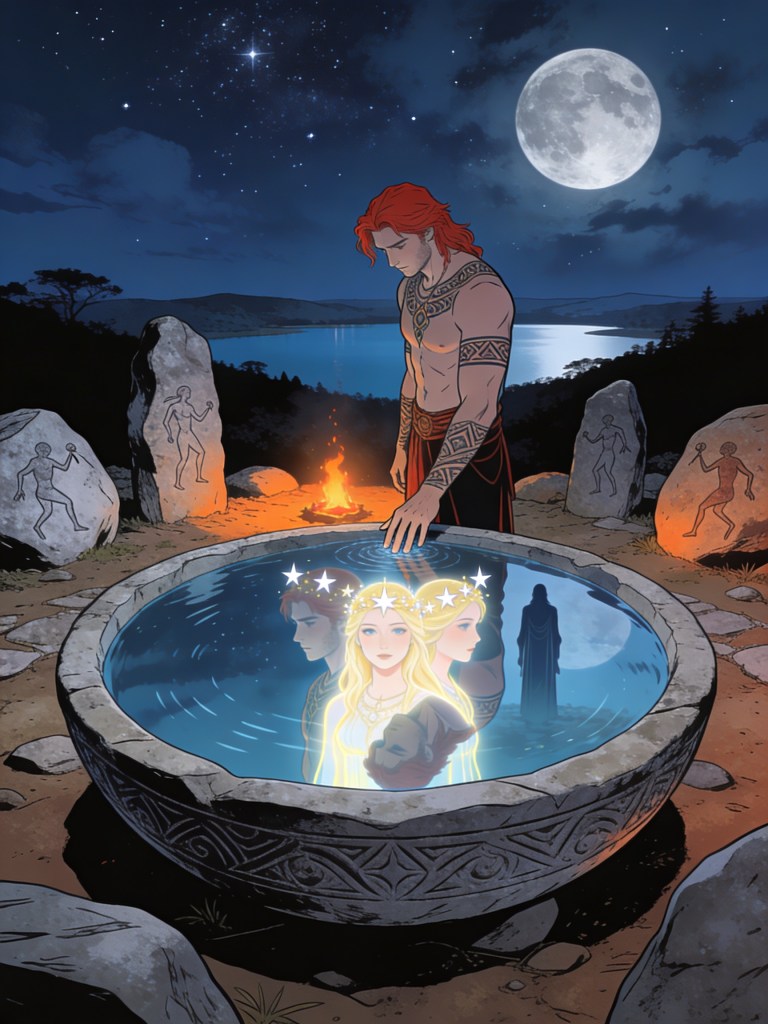
At the ancient lake’s edge—Lake Fundudzi, cradled in the green embrace of the Venda hills—he found what he had been unconsciously seeking throughout his African pilgrimage: a hemispherical bowl carved in stone, its surface worn smooth by countless seasons of rain and ritual.
A scaphe sundial, filled now with rainwater that had collected during the day’s brief storm. The ancient Greeks would have recognised it, this marriage of time and eternity, this cup that held both heaven and earth.
He knelt beside it with the reverence of a supplicant at an altar. The surface shimmered like quicksilver, catching the reflection of moon and sun—for even in the night, the sun’s presence could be felt in the warm stone beneath his knees.
And for an instant that lasted forever, all three of their faces appeared in the water’s mirror—his, Elena’s, and Tarmo’s—entwined as myth and starlight, past and future converging in the eternal now.
The water became a lens, focusing all of time into a single point of clarity.
He gazed into the water’s eye, and light bent around him like a living thing.
In its shifting depths he saw not only his journey—the months of walking, the dreams that had driven him from familiar shores to this remote corner of the world—but the spiral of history itself: migrations from north and east, the memory of Dacian hills where his bloodline had first stirred to consciousness, the shadows of Thracian forests where gods and mortals danced together under bronze-age skies.
All of it twisted inward like a whirlpool, drawing him toward this precise moment, this exact convergence.
He touched the water and felt its old intelligence meet his skin like a shock of recognition.
The lake itself was ancient, fed by springs that had bubbled up from the earth’s deep places for millennia.
The water that touched his fingers had fallen as rain on pharaohs and on the first humans to walk upright across these plains. It carried the memory of every creature that had ever drunk from its shores, every ritual that had been performed on its banks.
Through that touch, he sensed the blessing of African earth—not just the soil and stone, but the continent’s vast soul, patient and enduring, willing to shelter any who approached with genuine reverence.
This land had birthed humanity itself, had watched empires rise and fall like seasons, had absorbed the blood and tears and joy of countless generations.
Now it offered itself as a birthplace once again.
Here, where ley lines converged like the spokes of some cosmic wheel, where the bones of ancestors whispered in living stone, the world felt porous—a place where new souls could cross from dream to flesh with ease.
This was a birthplace chosen not by chance, but by convergence: between heaven and earth, between lovers, between the old world and the new possibility shimmering in the bowl’s mirrored dome.
The realisation struck him with the force of prophecy.
Elena’s unborn children—their children—would not merely be born here.
They would be initiated here, claimed by powers older than nations, blessed by gods whose names had been spoken in languages that existed before Babylon was even a dream.
Asdar breathed deep, tasting smoke and starlight and the green sweetness of night-blooming flowers.
The land, the mythic memory, the uncoiling axis of time—each played a part in this genesis that was both ending and beginning.
Beneath the southern stars, Africa held the sacred current, the wound and the healing, the alpha and omega of human experience.
The vision began to fade with the first pale suggestion of dawn on the eastern horizon. He rose with the first light, his body stiff from hours of kneeling, but his spirit expanded beyond all previous boundaries.
Elena materialised at his side as if stepping out of the mist itself, her face radiant with shared understanding.
Tarmo emerged from behind a standing stone, his expression grave with the weight of what they had all witnessed.
Three stories, three spirits, woven anew. The cradle of earth, water, and sky opened before them—in invitation, in promise, in sacred covenant.
“Here,” Asdar said, his voice hoarse with wonder and certainty. “At the crossing of ancient lines and cosmic memory. This is the perfect birthplace.”
Where it all began, and where it could all begin again.
I.Ph.
Author’s Note – The Axis of Return
Some of you have been wondering where Asdar went after Yerevan, and whether he simply slipped out of the story the way ghosts do out of rooms. He didn’t. He’s been walking off-page for a long time, following the same invisible threads that tug at Elena and Tarmo—just on a different part of the map.
This chapter is where those missing miles finally surface: not in a city or a battlefield, but in a stone circle above a sacred African lake, where old gods still listen. Asdar’s pilgrimage across the continent has not been tourism or escape; it’s been initiation, a slow remembering of who he is when the temple walls fall away.
Here, you’ll see him through a wider lens: as priest and wanderer, yes, but also as something older—Nergal waking up inside a very human body, standing at the place where ley lines, bloodlines, and love stories intersect. The vision at Lake Fundudzi doesn’t just explain his absence; it redraws the axis of the whole series, reaching back to origins and forward to children who haven’t yet been born.
You don’t need to know every mythic reference to follow what happens. All you really need is this: the earth is paying attention, the past is not finished, and when Asdar returns to Elena and Tarmo after this, he will not be coming back as quite the same man who walked out of Yerevan.
 The C.O.M.C. Files