
The Chronomancer and the Twins of Time
Sandi-Hargeisa
I sit across from Minister Faduma, anger gradually cooling into a renewed clarity. The betrayal stings, but beneath it is Elena’s voice, persistent even in absentia: What would Elena do? There are always more ways than one to skin a cat—especially on this continent, where deals live and die by relationships, not contracts.
I keep my conversation with the Minister short and respectful, quickly explaining the situation without mask or varnish. Faduma listens, her eyes sharp with curiosity and, I suspect, recognition. A quiet understanding settles between us: both women, sidelined in rooms full of men, adept at reading signals others miss.
As I rise to leave, the Minister offers me a slight, knowing nod—more nuanced than a formal blessing, but heavier than simple courtesy.
“You may find,” Faduma said, “that sometimes the door you came in is not the only way out. Those who understand this usually do not leave empty-handed.”
There is a hint, perhaps even an offer, buried in the words.
Outside, as Mikael and I cross the sun-bleached courtyard, I piece together the weight of local alliances, the invisible web of favours that strings together men and fortunes, promises and betrayals. Maybe the port isn’t lost yet—not if I can find the correct string to pull.
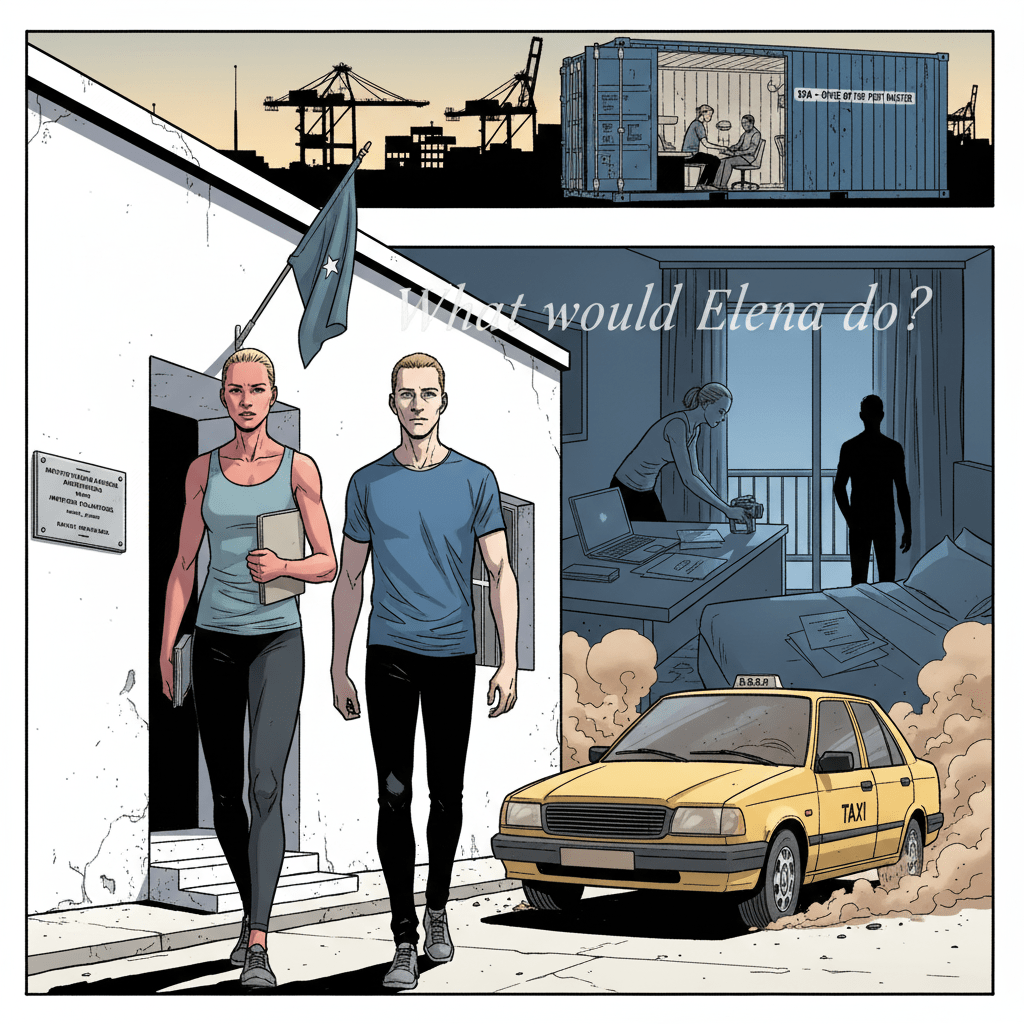
Mikael matches my pace, silent as ever, his presence steady but unreadable. I don’t ask if he follows out of duty, habit, or something else. I don’t need to. For now, his silence is just as helpful as a hundred words.
Back in the taxi, heading for the familiar anonymity of our hotel, I pull out my notebook and begin a list: names, connections, leverage points. What would Elena do? I write at the top, then underline it twice. This time, instinct and improvisation will be my map.
A plan forms, sharp and nervy as a blade’s edge: to outwit the Turks at their own game, I’ll need leverage, not just logic. The headlines about Turkey’s vast energy expansion, and the whispers of deeper, more controversial involvement—military contractors, drones, shadowy deals—offer more than one loose thread.
I piece it together: Turkish envoys aren’t just negotiating; they’re likely leaving a trail—digital, physical, or human—some whiff of impropriety, double-dealing, or bald coercion. If I can find a fragment, evidence incriminating enough, I can force Port Master Omar Dajib’s hand and salvage Tarmo’s original agreement. Out here, blackmail isn’t an abstraction—it’s currency.
That night, Berbera’s heat breaks into something breathable. Wind off the Gulf carries the clangour of cranes and distant ship horns. In the hotel’s shadowed hallway, my nerves buzz. Mikael moves beside me: no permission needed—his presence, assurance wrapped in danger.
He produces a slender tool. The lock whispers open, a secret shared only with the night.
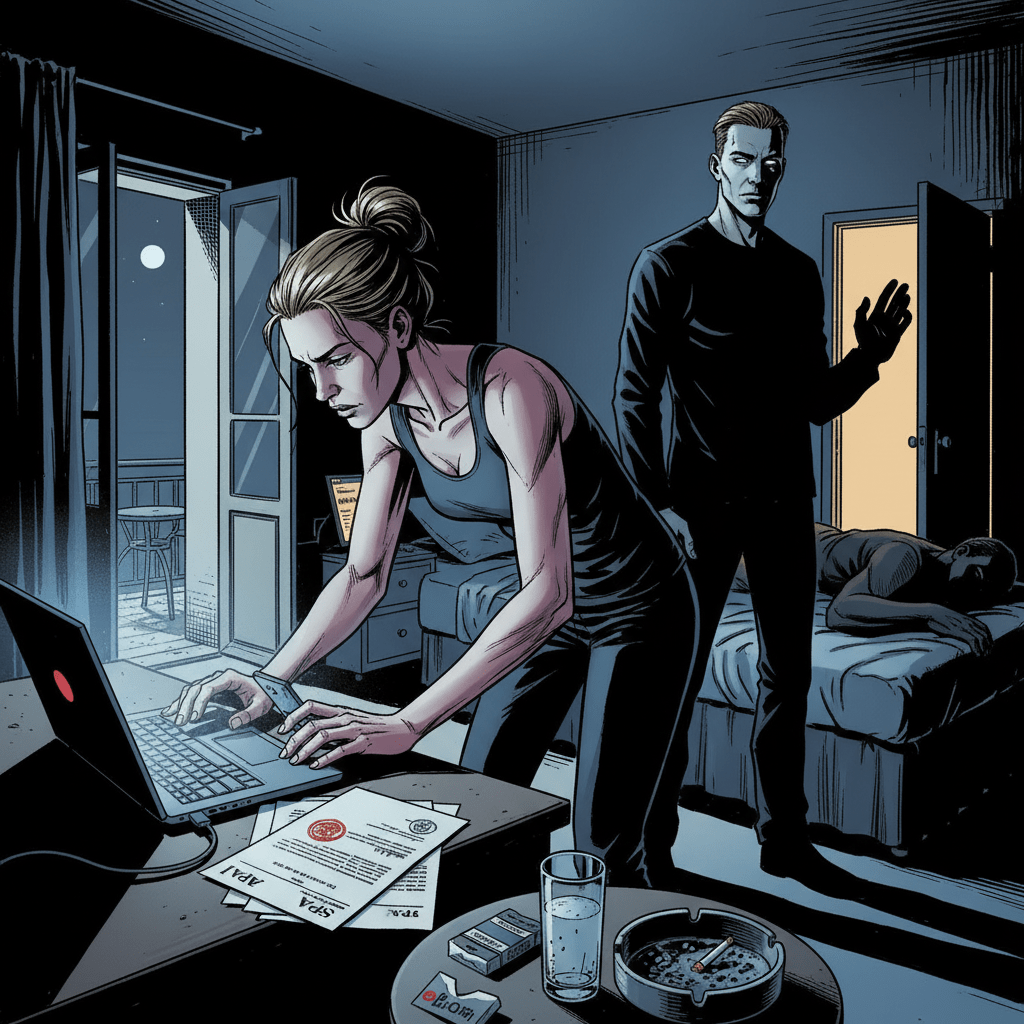
Moonlight drapes the Turkish envoys’ room in silver. On the table, a half-empty glass of raki sweats in the dark. The air—smoke and cologne. My steps are silent, trained. The desk is cluttered: files scattered, laptop pulsing with sleep-light. I lift the lid. Still logged in.
“Six minutes,” Mikael mutters, voice flat.
I move fast—photos of contracts with red stamps, Turkish letterhead, bold promises: expedited transfers, discreet payments, O. Dajib. My camera is silent, but my heart is all noise.
A rustle from the bed. I freeze, eyes on Mikael. He shifts, hand half-raised—a warning. The envoy rolls, mumbles about compensation and the president, then slides back into sleep.
“Four minutes,” Mikael says, calm as stone.
I eye the nightstand. The phone is unlocked, messages glowing. Audio memos, attachments, threads about “our friend at the port authority.” I plug in my USB, hands shaking as the progress bar creeps. On a chair: a thin envelope marked ‘SPA – Private.’ I pocket it without a sound.
The USB blinks complete. I restore everything—files, screens, even chair positions. Tarmo’s lesson: Leave no trace of your thinking.
A curtain lifts in the breeze; Mikael catches it before it betrays us. We slip out, feet muffled by old carpet, down the back stairs. The scents change: cigarette ash, hot concrete, pepper from the midnight cashew vendor.
Outside, in the alley’s blue dark, I finally exhale. My hands shake. Mikael hands me a battered bottle of water—his gesture of steadiness.
“Sometimes the world is made for the quiet,” he murmurs, eyes scanning the empty street.
I look at him, uncertain. “What does that mean?”
He almost smiles. “The loud ones make history. The quiet ones make it possible.”
I weigh the USB drive in my palm, heat flickering off the casing. “And which are we?”
“Tonight? We’re the ones who win.”
When dawn breaks—merciless and raw—we return to the chaos of the port. I lead, Mikael, drifting beside me like intent in human form.
Omar Dajib’s office stinks of stale coffee and nerves. I set the evidence on his desk—photos, printouts, the letter from the private envelope. His bravado wilts.
“Sign with us, as you promised Tarmo,” I say, voice gentle but steel-edged. “Or I take this public. Every newspaper in Somaliland, every minister. Your Turkish partners in Europe and the Gulf—the ones who care about stability.”
Omar’s jaw clenches. I see calculations flicker: Turkish money could buy silence, but not erase disgrace. The pen hovers, his hand trembling. The signature crawls onto the page: a small defeat, visible to both of us.
I fold the agreement and slide it into my bag. Mikael opens the door. For the first time, I catch the twist of satisfaction at his mouth—a minor, fleeting reward.
The port’s engines whine. Languages collide in the din. I stare at my hands. Steady now, but marked. Tonight, I’ve crossed over—interloper, blackmailer, survivor.
Mikael watches for threats, thinking ahead.
“You did well,” he says.
I don’t answer. Berbera’s sun blazes, indifferent to victory or method. The port waits, ancient and new, a place where everything—loyalty, trust, silence—can be won or lost.
I start walking toward our vehicle, agreement in hand. My promise to Tarmo kept. The cost? That, I’ll calculate later.
That night, I awake to the warmth of my own tears, the ache of dreams I can’t quite remember. I sit up, rubbing my face—and for the first time, I notice Mikael isn’t curled up on the floor.
Instead, his shadow looms at the side of my bed, silent, uncertain.
I.Ph.
 The C.O.M.C. Files