
The Chronomancer and the Twins of Time
Sandi-Hargeisa
I lock the door behind me and let out a breath I didn’t know I was holding. The city outside thrums with the machinery of new ambitions, but inside the room—neutral walls, starched bedsheets—I allow myself to let go. The adrenaline fades, leaving only the ache that always follows a run across borders and battle lines.
I peel off my travel disguise, letting the linen and scarf drop to a heap, bare feet cool on the tile. The bathroom is small, the showerhead ancient, but the water is hot—a rare gift. I stand beneath its stream, hands braced against the wall as the oil and dust of arrival run in rivulets down my skin.
My mind—traitorous but truthful—slides back to Yerevan. The aftertaste of trauma, Bartek’s loss still etched in my bones, the sterile lights of interrogation rooms. But it is Elena I cling to in memory: Elena’s gentle persistence, the way she refused to let me paralyse myself with grief. How she received me in her bed. More than comfort, I remember Elena’s mouth, warm and generous, coaxing me back into my own body, reminding me gently that survival is not the denial of pleasure. That healing can be showing my spirit the way back into my mind through orgasms.
My fingers trace lazy circles on my small, firm breasts. I squeeze my nipples and gasp, feel my cunt react immediately, thrumming with need. I stroke my belly, then slide my fingers into my wet, waiting, already slick cunt, my thighs tense, heat rolling through my core.
I let myself conjure Elena’s hands, silken—her mouth, the lull of her voice murmuring, giving me consent for everything I wanted and needed, and the divine pleasure as I came undone the first time, the second, the third. The way Elena gave herself over to my needs was a lover’s mercy. I bite my lip and let the images sharpen: how she nursed me back to life, made me feel alive, vital and not simply traumatised.
My breath grows ragged, fingers moving with practised certainty.
I imagine Elena underneath me, pressing me close, sucking up my delicious aroma, those impossible breasts grazing mine, her nipples I couldn’t let go of. I ache, spasm, climax and release so much fluid that it leaves me exhausted.
I still enjoy the milky slick, letting my fingers move slowly, feeling the throbbing ebb away.
After, I stand still, letting pulse and breath recalibrate, I soldier on. I dry off, wrap myself in the scratchy towel and stare at my reflection, lips curved in something like a challenge.
For you, Elena. For both of us—for surviving, for wanting. For every border we cross and still find enough of ourselves left to desire.
I pull on fresh clothes, sharper now, nerves ironed smooth by satisfaction. Somaliland awaits. I step into the night ready to make my own magic—even if, for tonight, it’s built on memory and my own hands.
Sandi — Meeting Hassan Awaale, Hargeisa
The Mansoor staff direct me east, past a roundabout with a sun-faded monument and three gaudy banks, to a small café the locals just call “Bishaaro’s.”
The sign sways above motley chairs. I keep my scarf neat, light linen trousers dusting my ankles, posture relaxed but spine straight—no room for softness here.
Hassan Awaale waits with a battered notebook, looking both wary and amused—a man who has brokered a hundred deals and outlasted a dozen governments. He stands when I arrive and extends his hand formally.
“Ms. Sandi. Somaliland welcomes you. We don’t often have women negotiating port policy—certainly not white women alone.”
I give him a dry smile. “That’s exactly why I’ll be remembered. I hear you are harder to impress than most ministers.”
He snorts, gestures for tea—served boiling and sweet. The café’s fans rattle, pushing the dust into patterns that catch the light. At a nearby table, two men in Western suits glance up, murmuring in accents sharp with Istanbul’s consonants.
Hassan lowers his voice. “You must understand—here, everything is kinship and history. Our Parliament is two houses. The elders run slow, but their roots are deep; the representatives, quick to strike but careful of custom. Do not show your ambition too quickly, or you will become the story—perhaps not in the way you wish.”
I nod, watching the swirl of city street beyond the window—hawkers, livestock, a woman balancing water jugs with regal ease. “My ambition is only to help my partners. Turkey’s men at the table don’t play fair. Neither do I, if necessary.”
He leans back, eyes narrowing. “You’ll need friends here. Not all have European faces, nor are they all clean-handed. I can be a bridge, if you’re careful. Faduma will meet you tomorrow. Don’t underestimate her—she is the closest thing to a kingmaker Somaliland has.”
From the corner booth, the Turkish businessmen speak just loudly enough to carry. “Contracts mean little without backbone,” one says, eyes fixed on me with a knowing smile. “It’s easy to get lost here.”
I meet his gaze head-on, my own smile calm, razor-thin. “Good thing I brought my own map,” I murmur, loud enough to be heard, earning a huff of amusement from Hassan.
Tea arrives. Hassan slips me a note under the cup—an address, a time for a private meeting, and a warning:
“Careful at night. The port isn’t the only thing being watched.”
I sip, let the sugar dissolve in the sand of my mouth, and catalogue my enemies, my allies, and the risks I’ve decided to run. I’m in the game now—no disguise thick enough to shield me, only wit, instinct, and the ghost of Elena’s courage steadying my hand.
After the café meeting with Hassan, I decide not to head straight back. Sightseeing, I call it, but really I need to map the city’s risk and rhythm—who’s watching, who keeps appearing in rearview mirrors, which vehicles linger too long at crossroads.
I wave down a taxi, settling in as the vehicle rattles along the avenues of Hargeisa. I give the driver no direct destination, only gestures and half-fluent Somali for “show me the city.” He beams, pleased to play guide, and we loop through markets dense with chillies and battered aluminium, past mosques dazzling in blue tile, through clusters of tailors, money changers, and children trailing goats.
My gaze sweeps the streets, reflections caught in glass, motorcycles that seem a little too idle, a Western face behind thick sunglasses buying qat with more attention on me than the merchant. I note everything: plates, colours, expressions.
After an hour, the taxi slows by Hiddo Dhawr—a club famed for its music, its celebration of all Somaliland’s cultures, and its grilled camel meat. I thank the driver, slip him a generous fare, and step out, moulding myself into the lunchtime mix of families, businesswomen, and musicians tuning up for afternoon sets.
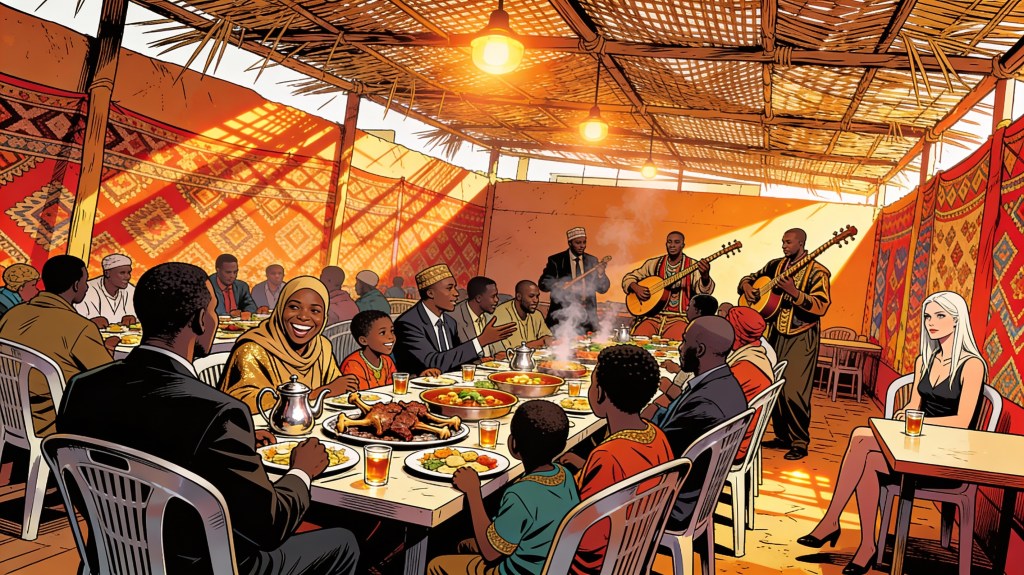
Under the shade of woven reed awnings, I order camel stew and thick, spiced tea. I soak in the sounds: a woman’s laugh, the tuning of a kaban, snippets of English from an expat table. For a moment, I feel almost anonymous—untraceable, simply a traveller, arms sticky with steam and sauce, mouth tingling with cardamom and pepper. Yet I keep my ears open for any sign my status has shifted.
Stomach sated, I linger over bitter black coffee, watching the ebb and flow of clientele. Across the room, I spot a man from the café—he leaves quickly when our eyes meet. Turkish? Local? It’s hard to know, but it confirms what I suspected. I’m being trailed.
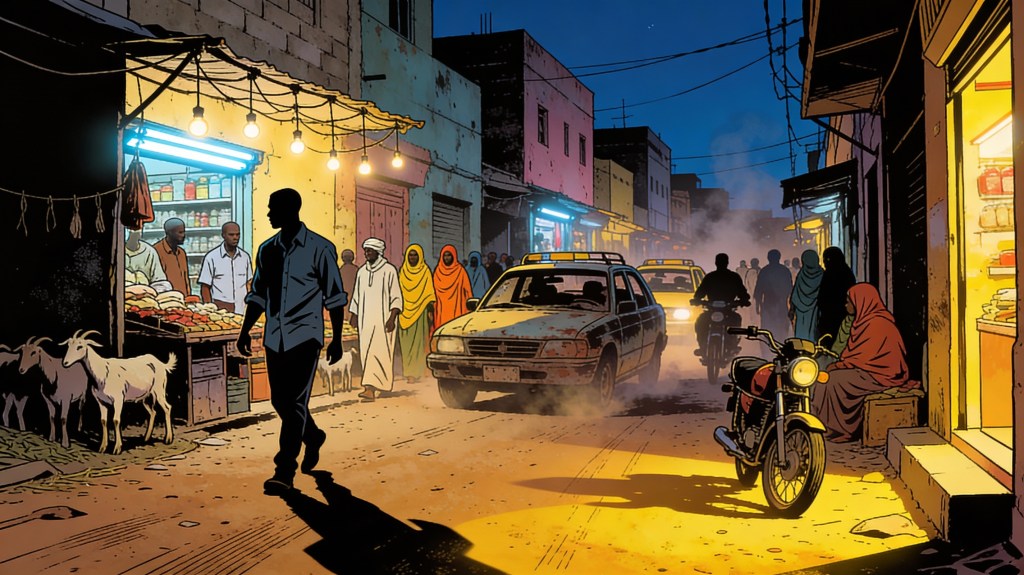
Later, gauging the angle of the sun, I decide against calling another taxi. I tuck cash into my sock, tighten my headscarf, and step out into the late afternoon—a foreign woman walking purposefully back toward the Mansoor, scanning shop windows for reflections, listening as much with my nerves as with my ears.
The walk is long but invigorating: the city alive with colour, exhaust, greetings, and heat. With each step, I recalibrate—a spy, a diplomat, a survivor, a woman longing for the careful hands of someone far away, moving through a story only half of my writing.
The first sign is the rhythm of footsteps narrowing behind me—syncopated, purposeful, just a shade too regular for afternoon bustle. I don’t look back, only let my gaze flicker in the surface of a shop’s glass: three figures, men, the sort of build and attitude meant to pass as casual and failing.
My muscles tense, mind recalling drills from Helsinki: don’t draw attention, don’t startle, but measure my options quickly. The street narrows; I have the Mansoor just blocks ahead, but too far for comfort. My breath slows, then shortens as the shadow of a tall building falls across the pavement.
I.Ph.
 The C.O.M.C. Files