
The Chronomancer and the Twins of Time
Marrakech’s night air clings to me as Karim leaves me at the doors of La Mamounia. His kiss lingers—warm, unresolved, weighted with memories of skin and laughter and the long, slow ache between touches. He sensed the shift in me, even if he can’t name it; perhaps I can’t, either. Not entirely.
I move through the hush of the lobby, Laly’s silk brushing my thighs, my body more wholly mine—and less—than ever before.
Desire doesn’t vanish with moral complexity; it just grows more ambiguous, richer, harder to name.
I can still feel the pull toward Karim—my former self might already be in his bed by now, dissolving questions in his mouth, but now I burn with new contradictions.
I’m pregnant. With two creatures. By two men, in one increasingly impractical body. Possibly magical, if I believe even half the things the old women whispered and the older gods hinted. I’m hardly innocent and certainly cultivated, but even my anthropology textbooks didn’t prepare me for this category: expectant mother under extraordinary circumstances, in the city of stories, wanting and withholding in the same heartbeat.
As I walk up the stairs, everything seems heightened: jasmine somewhere, a hush in the carpeted corridors, the knowledge that with every step, I’m leaving my old yet recently found sexual history a little further behind. This isn’t shame, but it’s not simple pride either. It’s a reckoning. I replay Karim’s words and the gentleness in his letting go, the observation in his gaze, the sadness mixed with trust.
Near my suite, I stop short. A pinprick sensation flares beneath my dress, and suddenly I feel it—the unmistakable warmth, an almost electric tingling, then the slow, impossible seep of golden liquid beading at my nipples. It’s not milk. Not exactly. Not ordinary.
I inhale sharply.
This only happens when Asdar is near or when Tarmo is present. Whenever one of them is close, my body becomes an oracle, a signal flare for magic and danger both. The sensation is equal parts intimacy and warning, as if the babies themselves are tuning forks vibrating for their fathers.
Bloody hell. Not even twelve hours in Marrakech, and already this. I scan the corridor, heart thudding, senses sharp. The suite door isn’t closed quite the way I left it.
So. One of them—Asdar or Tarmo. Someone has found me, or is about to. I press my palm discreetly to my chest, half exasperated, half wary, and feel a laugh bubble up, fierce and defiant.
“There goes my expensive dress!”
“Not even a day in this city, and here we go,” I murmur. “Can’t a woman incubate her mythology in peace?”
My hand tightens on the keycard. The story isn’t waiting for me to catch up.
Sandi — Arrival in Somaliland
Hargeisa.
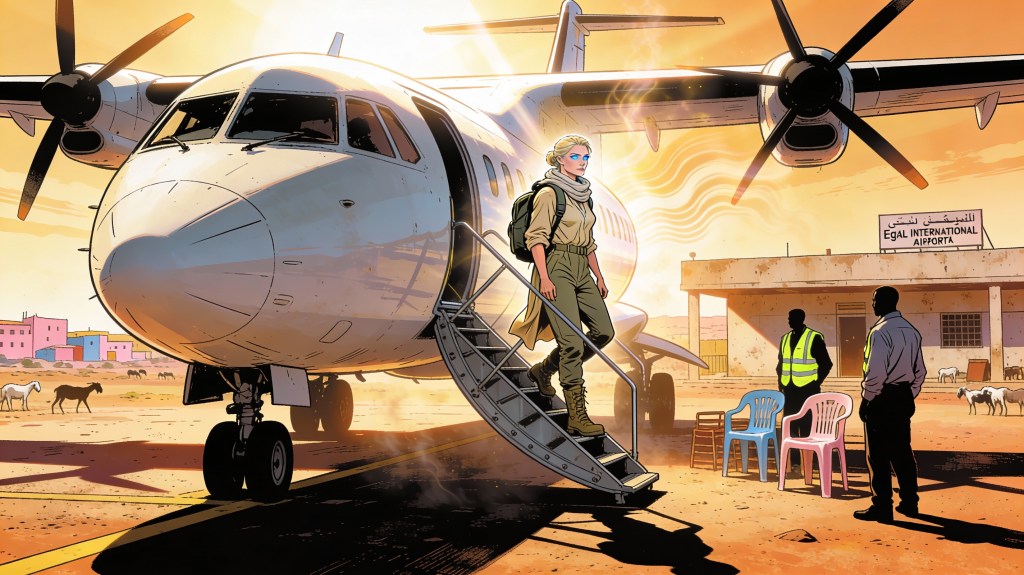
Even the name on the arrivals board looks improbable, a scrape of consonants between two parallel deserts. I step off the plane and am nearly knocked sideways by the impossible light—the sun so clean it feels like being flayed; the air a living thing, bone-dry and perfumed with sand and kerosene. I draw a breath dustier than any I’ve known.
The airport is its own logic. Egal Hargeisa: no glass-walled terminals here, just a squat, sun-bleached building, a handful of plastic chairs, and chaos organised by muscle memory and a thousand unspoken codes. Men in long shirts and bright vests hurry between baggage carts, shouting in a tongue that feels equal parts song and warning. I notice the slowness—the lack of hurry I’d expect at border control. People move at a tempo that’s both unfamiliar and ancient.
I straighten to my full height—an act that feels almost confrontational here. I’m alone, European-pale, a target in a sea of gaze and interest I can’t yet decipher. My heart thrums, sharp with a primal kind of awareness. Foolish to linger; I find the bathroom, change swiftly into a long, loose tunic and scarf—neutral enough, I hope, to blur my edges just a little. I check the mirror twice, press down wisps of hair, and school my features into calm.
Outside, a swarm of taxi drivers and “guides” closes wordlessly around me, voices pitching in a language I barely grasp. I stand my ground, scanning for the address written in my notebook before I left Nairobi. I flash the slip, meet a dozen eyes, let my posture say: competent, not beggar. I choose a cab, fingers brushing against my pocket—passport, phone, a sharpened bit of plastic I hope I won’t need.
In the backseat, I slide lower, lash the scarf snug beneath my chin and let my mind race:
Where did he send me now?
Not a tourist, no longer SUPO, only a carrier of maps and questions. My mouth is dry; I taste adrenaline with the grit. Out the window: the city is flat and alive, buildings painted in impossible pastels, goats threading the medians, a boy racing after a flock of bright kites.
This is nothing like the glossy panic of Nairobi, nothing like London. The rules here are different, more ancient. I am outnumbered, out-gunned, out-guessed. And yet—for a reason I cannot name—I am not afraid. Not yet.
The cab bumps over potholes, swerves to avoid a woman riding sidesaddle on the back of a motorbike, and I feel myself settling into the alertness that is nearly animal:
Let everything be new.
Let nothing be safe except my own instincts.
I watch the city swirl past, every sense on high alert, feeling the story—my part in it—waiting to uncoil.
The battered cab finally rattles to a stop at the Mansoor Hotel. Compared to the swirl of goats, dust, and raw-cornered commerce outside, the hotel looks like a minor miracle—whitewashed, outlined in palms, polite signs promising Wi‑Fi and air conditioning (though I trust neither until proven).
The driver, an old man with a gambler’s eyes, peers in the mirror and grins. “Goos, very goos hotel,” he says with emphasis, both thumbs up, as if he’s brought me to the very gate of heaven. I reward him with a broad smile and an extra shilling. It’s a small price for goodwill.
Mission now, I think, pulse steadying into the familiar cadence of work. Tarmo’s instructions were crisp, almost military: make contacts, gather leverage, keep Erdogan’s men guessing. The port of Somaliland is a prize—Red Sea access, a crossroads every regional power wants to grip. I’m here to tip the scales—not with overt power, but by out-talking, out-listening, out-charming.
Inside, the lobby is cool compared to the dusty commotion outside—clipped roses, grand curtains, the careful choreography of status and welcome. As I sign the register, I skim my mental agenda:
Hassan Awaale: ex-minister, still shifting pieces on boards nobody else gets to see.
Omar: port official in theory, but really half the city’s gateway to shadow trades.
Faduma: rare woman in council, respected by both chambers and definitely not because she enjoys compromise.
Names, positions. The city’s pulse mapped in three lines, each with its own hidden leverage.
Each of them has a different kind of risk. I plan the coming days in arcs and shadows, mind already mapping conversations before they happen. Staff show me to a room where the AC sputters—no matter. I unpack: a linen suit, a modest caftan, a notepad thick with Tarmo’s coded hints, and a burner phone to keep lines secure. I glance out my window: below, the city sparkles with the logic of trade and hope, markets and ministries bleeding into the horizon.
Tomorrow, I’ll begin: find Hassan in a corner café, break bread with Omar, trade proverbs with Faduma beneath a painted ceiling. For now, I sit on the edge of the hotel bed, letting the city’s new song pour over me—alert, a stranger made indispensable. If I play my hand right, I’ll shift more than one deal before my shadow fades from Somaliland.
I smile, just a little.
Not bad for Tarmo’s secret weapon in a silk scarf and travel-weary nerves.
I.Ph.
 The C.O.M.C. Files